Welding Process Change Requires Rewiring Every Time? How the "Plug-and-Play" of Ethernet to Serial Adapters Saves You 80% in Deployment Costs
You manage the welding shop. You know one thing better than anyone:
The process never stops changing.
Last week, the client asked to narrow the weld seam from 8mm to 6mm. You adjusted wire feed speed, changed torch angle, modified shielding gas ratio. That was just parameter tuning. Last month, the company decided to add a preheating step on Line No. 3—you had to squeeze a preheating unit into the middle of the line. The month before that, quality control said to add current monitoring—you had to pull an analog signal out of the robot controller.
Every process change isn't just a change order in front of you.
It's: rewire everything.
The welding robot controller is at the east end of the line, the new preheating equipment at the west end, the current sensor in the middle. Three points, originally connected by zero wires. You have to find an electrical engineer to draw diagrams, a construction crew to cut trenches and lay cables, a PLC engineer to change I/O addresses, a supplier to source new modules and cables—then shut down for two days while all the wires get connected, addresses configured, programs rewritten, and tests passed.
Two days.
Have you calculated that? An auto parts welding line—what's the loss of one day of downtime? Capacity loss, order delays, overtime wages, customer penalties—at least 100,000 RMB, conservatively. Two days: 300,000 RMB.
And what you changed was just the width of one weld seam.
Have you ever asked yourself one question:
What if there were a way where, no matter how the process changes, you never have to touch the wires?
Let's break down the real cost structure of a welding process change.
Most people's first reaction: changing process, the cost is in debugging. Tuning parameters, test welding coupons, destructive testing, running CPK—yes, these cost money. But if you calculate carefully, you'll find these add up to maybe only 20% of the total change cost.
Where does the other 80% go?
It goes to "connection."
Layer one: physical connection. Every new sensor, every new device, means a new wire. RS485 needs two conductors. Analog signals need shielded cable. Digital I/O needs dedicated cable. The cable trays in your shop are already full. Add more wires—you either switch to bigger trays, run cable ladders, or just fly wires. Flying wires is cheapest, but you know what flying wires look like after three months.
Layer two: protocol connection. Different devices speak different "languages." Welding robots use Modbus RTU, preheating equipment uses Profibus, current sensors output 4–20mA analog, the new vision inspection uses EtherNet/IP. You have to buy protocol gateway converters, write mapping tables, do data stitching in the PLC. Every new protocol means another integration project.
Layer three: network connection. More devices, not enough serial ports. You add serial expansion modules, or swap in a bigger PLC. Swapping PLC means re-doing hardware configuration, rewriting programs, rebuilding HMI screens. That keeps your electrical engineer busy for two weeks.
See, the process change itself might take two days. But to make that change "connectable," you spent two weeks, 300,000 RMB, and coordination across three departments.
The root problem isn't that the process changes. It's that the connection method is too "hard."
Wires are hard. Interfaces are hard. Protocols are hard. PLC I/O points are hard. Change any one point, the whole chain moves.
What you need isn't a faster construction crew. You need a "soft" connection method—no rewiring, no address changes, no PLC program edits. Unplug one port, plug in another. Done.
That's exactly what the Ethernet to serial adapter's "plug-and-play" solves.
Your impression of an Ethernet to serial adapter probably still stops at "converts serial to Ethernet."
That's a ten-year-old understanding.
Today's industrial-grade Ethernet to serial adapter is essentially a "universal translator + wireless relay station." It does far more than protocol conversion.
First, translation.
Equipment in a welding shop speaks every language under the sun. Robot controllers speak Modbus RTU. Temperature controllers speak RS232. Current transmitters speak 4–20mA. Vision cameras speak GigE Vision. Before, to make them talk to each other, you'd buy three or four different gateways—configure each one, write a mapping for each protocol.
Now?
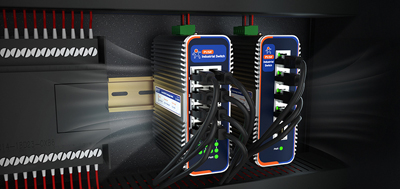
One Ethernet to serial adapter—say, the USR-N510—comes with multiple serial and network interfaces built in, supporting Modbus RTU/TCP, MQTT, HTTP, TCP Client/Server, and other mainstream protocols. You connect the robot's RS485 cable to Port A of the adapter, the preheater's RS232 to Port B, the current sensor's analog signal to Port C—three cables, three ports, plug in and done.
The adapter handles protocol conversion and data routing internally. Robot data goes out via Modbus TCP to the host computer. Preheater data gets pushed to the cloud via MQTT. Current sensor analog gets converted to digital and stored locally. Three devices, three protocols, one adapter.
You don't need one gateway per device. You need one Ethernet to serial adapter per production line.
Now, "wireless."
This is the real killer app of plug-and-play.
What's the biggest pain point of traditional wiring? The wires. Wires need trays, conduits, clamps, labels. Add one device, add one wire. More wires, more failure points. What's the most common electrical fault in a shop? Not a dead PLC—it's a loose wire, an oxidized connector, a cable crushed by a forklift.
The USR-N510 supports Wi-Fi and 4G/5G wireless connectivity. Your sensors, your welding robots, your new equipment—no need to run wires to the adapter. On the device side, a small wireless serial module sends data via Wi-Fi directly to the Ethernet to serial adapter.
Physical connection becomes wireless connection.
What does that mean? Next time you change the process, add a preheater, squeeze in a vision inspection—no trenching, no cabling, no shutdown. Drop the equipment on the line, pair the wireless module, data flows.
From "process change takes two weeks" to "process change takes two hours."
Let me run real numbers.
Assume your welding shop has one main line: 6 robots, 2 preheaters, 4 current sensors, 1 vision system. Now you need to add a step: a laser cleaning unit, placed mid-line, transmitting pre- and post-cleaning temperature data to the host computer.
Traditional approach:
Electrical engineer draws diagrams: 2 days
Procure cables and connectors (shielded twisted pair, aviation plugs, cable trays): 1 day, ~5,000 RMB
Construction crew trenches and lays cables: 1 day, labor ~8,000 RMB
PLC engineer adds I/O points, rewrites program, updates HMI: 3 days, labor ~15,000 RMB
Shutdown for commissioning: 1 day, capacity loss ~150,000 RMB
Total: ~178,000 RMB, 8 days
Ethernet to serial adapter plug-and-play:
Laser cleaner has built-in RS485, pair with a wireless serial module: 0.5 days, ~2,000 RMB
Add a Modbus RTU slave config on the USR-N510: 0.5 days, engineer labor ~2,000 RMB
Wireless pairing and data test: 0.5 days
Line keeps running, connect on the fly: 0 days
Total: ~4,000 RMB, 1.5 days
178,000 vs. 4,000. Saved 97%.
You might say that's an extreme case. Let's look at something more common: adjusting process parameters, no new equipment, just changing acquisition points.
Traditional: PLC I/O address change, re-download program, shutdown test. 2 days, ~30,000 RMB.
Ethernet to serial adapter: Change the serial mapping in config software, push new config. 10 minutes, zero downtime.
You're not saving money. You're saving downtime. And downtime is the most expensive thing in manufacturing.
I've talked to many factory equipment managers. One thing keeps coming up:
What they fear most isn't the process change—it's the "coordination" after the change.
Change process? Find the electrical engineer. He says, "Wait for my schedule, next Wednesday." Add equipment? Find the automation supplier. They say, "Quote takes two weeks, delivery takes a month." Change PLC program? Call the OEM. They say, "Our engineer can't come until next month."
You're stuck in the middle. Process is waiting. Client is waiting. Boss is waiting. And all you can do is—wait.
Wait for electrical. Wait for automation. Wait for PLC. Wait for suppliers.
The Ethernet to serial adapter's plug-and-play doesn't just solve the physical connection problem. It solves the "dependency" problem.
You no longer wait for the electrical engineer to wire. Wireless connection—you configure it yourself.
You no longer wait for the automation supplier to do protocol conversion. The adapter has built-in protocol stacks—you tune it yourself.
You no longer wait for the PLC vendor to rewrite programs. Data aggregation and conversion happen at the adapter layer—the PLC doesn't move an inch.
You go from a person who "waits for others to make changes" to a person who "makes changes yourself."
What's that autonomy worth in manufacturing?
Think about it. While your competitor is still waiting for a supplier quote, you've already run the new process. While others are coordinating three departments, you've already delivered.
This isn't about saving 80% of the cost. It's about being 80% faster than everyone else.
Talking products—there are plenty of Ethernet to serial adapters on the market. Some cost tens of yuan. Some cost thousands.
You don't need the most expensive. You need the least troublesome.
Industrial-grade adapters like the USR-N510 don't win on specs—they win by minimizing "trouble."
Metal housing, fanless, wide temperature range, -40°C to 75°C—shove it straight into the electrical cabinet, no extra cooling needed. That's layer one of "not troublesome"—no environment constraints.
Built-in RS232/RS485, Wi-Fi and 4G support, enough interfaces that you still have two ports left after connecting everything. That's layer two—no interface shortages.
Graphical config software, drag-and-drop protocol setup, no coding required. The electrical engineer can configure it. So can you. That's layer three—no begging.
Firmware supports remote OTA updates. No teardown, no shutdown. Click in the backend, done. That's layer four—no site visit needed.
Add all four layers together, and you get one word: fast.
Process change? Fast. Add equipment? Fast. Connect wires? Fast. Troubleshoot? Fast.
Fast is manufacturing's biggest cost advantage.
Let me say something from the heart.
Many factories don't want to optimize processes frequently—they can't afford to.
One process change: two days down, 300,000 RMB lost. Ten changes: 3 million gone. So most factories' strategy becomes: don't change if you don't have to, make do if you can. Process locked in for three years, aging equipment just gets by, low efficiency accepted.
That's not a management problem. It's a cost structure problem.
When you drop deployment cost from 300,000 to 4,000 RMB, when you drop downtime from two days to ten minutes, you suddenly realize—
Changing process? You can afford it.
Adding equipment? You can afford it.
Trying new solutions? You can afford it.
You're no longer locked in by "can't afford to change." You can iterate your production line like a software company iterates a product. Try a new welding method this week, add a new inspection next week, swap parameters next month. Continuous optimization, continuous improvement.
That's the real value of Ethernet to serial adapter plug-and-play—it doesn't just save you 80% of deployment cost. It gives you the freedom to change anytime.
And that freedom, in today's manufacturing, is worth more than anything.
You sit in your office, looking at the new laser cleaning unit on the line.
No extra wire. No extra junction box. No extra shutdown.
It just stands there quietly, and data is already dancing on your big screen. Temperature curves, cleaning duration, before-and-after comparison—crystal clear.
Your electrical engineer didn't come today. Your automation supplier didn't quote today. Your PLC vendor didn't send anyone today.
But your line is already running.
You pick up your coffee, glance at the clock. From decision to equipment online: four hours.
Four hours. Used to be four weeks.
You suddenly feel—manufacturing isn't that "heavy" after all.
What was always heavy was never the equipment. It was the connection.
Make the connection light, and everything becomes light.