In-Depth Analysis of Protection Rating Certification for Industrial Panel PC: How Do IP65 and IP67 Build Robust Dustproof and Waterproof Defenses?
In a smart agricultural greenhouse, an industrial panel PC deployed outdoors suffered a short circuit of its motherboard due to rainwater backflow, resulting in direct losses exceeding RMB 30,000. Meanwhile, in a food processing plant, a display screen experienced touch failure due to dust accumulation, leading to a two-hour production line shutdown. These cases reveal a core pain point: How can protection rating certifications ensure stable operation of industrial panel PC when deployed in complex environments? This article will provide an in-depth analysis of the dustproof and waterproof standards of IP65 and IP67, along with practical selection and testing solutions.
The application scenarios of industrial panel PC are far more complex than those of consumer electronics devices:
Outdoor Scenarios: Traffic command screens in smart cities must withstand heavy rain (with daily rainfall reaching up to 200mm) and sandstorms (with PM10 concentrations exceeding 500μg/m³).
Industrial Scenarios: Control screens in chemical plants must resist corrosive gases (such as H₂S concentrations ≥10ppm) and oil penetration.
Agricultural Scenarios: Monitoring screens in greenhouses must cope with high-humidity environments (with relative humidity ≥90%) and pesticide spray erosion.
A photovoltaic power station once selected displays with low protection ratings, leading to a 300% increase in equipment failure rates during the rainy season and an additional RMB 150,000 in annual maintenance costs.
The core value of IP protection rating certification lies in:
Quantifiable Standards: Transforming vague descriptions of "dustproof and waterproof" into measurable technical indicators (e.g., the "5" in IP65 represents "no damage from low-pressure water jet spray").
Risk Pre-control: Certified equipment can identify design flaws in advance (such as aging-resistant materials for sealing rings), avoiding batch failures.
Market Access: In high-demand industries like rail transit and energy and power, IP65/IP67 have become mandatory clauses in bidding documents.
A rail transit project had its bidding qualification revoked due to the supplier's inability to provide an IP67 certification report, resulting in direct losses exceeding RMB 2 million.
Enterprises often fall into three major misconceptions during selection:
Concept Confusion: Misinterpreting "IP65" as "completely waterproof," when it can only resist low-pressure water jet spray.
Detail Neglect: Failing to pay attention to "angle requirements" in certification tests (e.g., IP65 tests require water jet spray from six directions).
Overdesign: Pursuing IP67 by adopting bulky housings, sacrificing heat dissipation performance and touch sensitivity.
A smart factory once selected IP67 displays, but the overly thick housing caused excessive internal temperatures, leading to frequent touch chip crashes.
The protection capabilities of IP65 can be broken down as follows:
Dustproof (Level 6):
Testing Standard: Place the equipment in a dust chamber for 8 hours, with dust particles ≤75μm in diameter (equivalent to flour particles).
Implementation Method: Employ dual protection with silicone sealing rings and dust screens to ensure no dust enters the equipment interior.
Application Scenarios: Indoor industrial control, smart classrooms, commercial displays, and other environments with minimal dust.
Waterproof (Level 5):
Testing Standard: Use a nozzle (with an inner diameter of 6.3mm) to spray water from a distance of 1.3 meters for 1 minute per square meter.
Implementation Method: The housing structure adopts a "groove + protrusion" design to guide water flow out quickly; waterproof connectors are used at interfaces.
Application Scenarios: Outdoor advertising screens, agricultural monitoring terminals, logistics sorting equipment, and other scenarios that may come into contact with rainwater.
An IP65 display in a logistics warehouse operated continuously for 3 hours without failure during heavy rain, verifying the reliability of its waterproof performance.
The protection capabilities of IP67 are upgraded as follows:
Dustproof (Level 6): The same as IP65, but must pass more stringent dust penetration tests (such as being blown with a high-pressure air gun).
Waterproof (Level 7):
Testing Standard: Immerse the equipment in 1 meter of water for 30 minutes, with water temperature ≤35℃.
Implementation Method: Seal the housing using ultrasonic welding processes and coat critical components (such as the motherboard) with conformal coatings.
Application Scenarios: Aquaculture monitoring, underground pipeline corridor inspections, port crane controls, and other scenarios that may be immersed in water.
An IP67 display at an aquaculture farm continued to operate normally during heavy rain-induced flooding, avoiding data loss and equipment damage.
The core differences between IP65 and IP67 lie in their waterproof capabilities:
Indicator IP65 IP67
Waterproof Scenario Rainwater splashes, washing Brief immersion, standing water
Test Pressure 30kPa (equivalent to a 3-meter water column) 100kPa (equivalent to a 10-meter water column)
Typical Applications Outdoor advertising screens, agricultural monitoring terminals Aquaculture screens, underground pipeline corridor equipment
Cost Increase Approximately 15% Approximately 30%
A smart city project selected IP65 for road monitoring screens and IP67 for underground parking lot entrance screens based on actual needs, achieving a balance between cost and performance.
Before selection, clarify three major environmental parameters:
Dust Concentration: Use a dust detector to measure PM2.5/PM10 concentrations (e.g., PM10 often exceeds 1000μg/m³ in flour mills).
Waterproof Rating: Determine needs based on the type of water the equipment may come into contact with (rainwater, washing water, standing water).
Temperature Range: Consider extreme temperatures from -40℃ to 70℃ for outdoor equipment (e.g., winters in Northeast China and summers in Hainan).
A chemical enterprise discovered through environmental assessment that its control screens needed to meet both IP67 protection and -30℃ low-temperature requirements, ultimately choosing a customized solution.
Key structural details determine the protection rating:
Housing Materials:
Aluminum Alloy: Good heat dissipation but requires anodizing to prevent corrosion.
Engineering Plastics: Strong impact resistance but requires the addition of anti-UV agents to prevent aging.
Sealing Processes:
Silicone Sealing Rings: Require regular replacement (recommended every 2 years).
Ultrasonic Welding: Permanent sealing but requires housing destruction for repairs.
Interface Design:
Waterproof Connectors: Need locking nuts to prevent loosening.
Aviation Plugs: Support quick plugging and unplugging but are more costly.
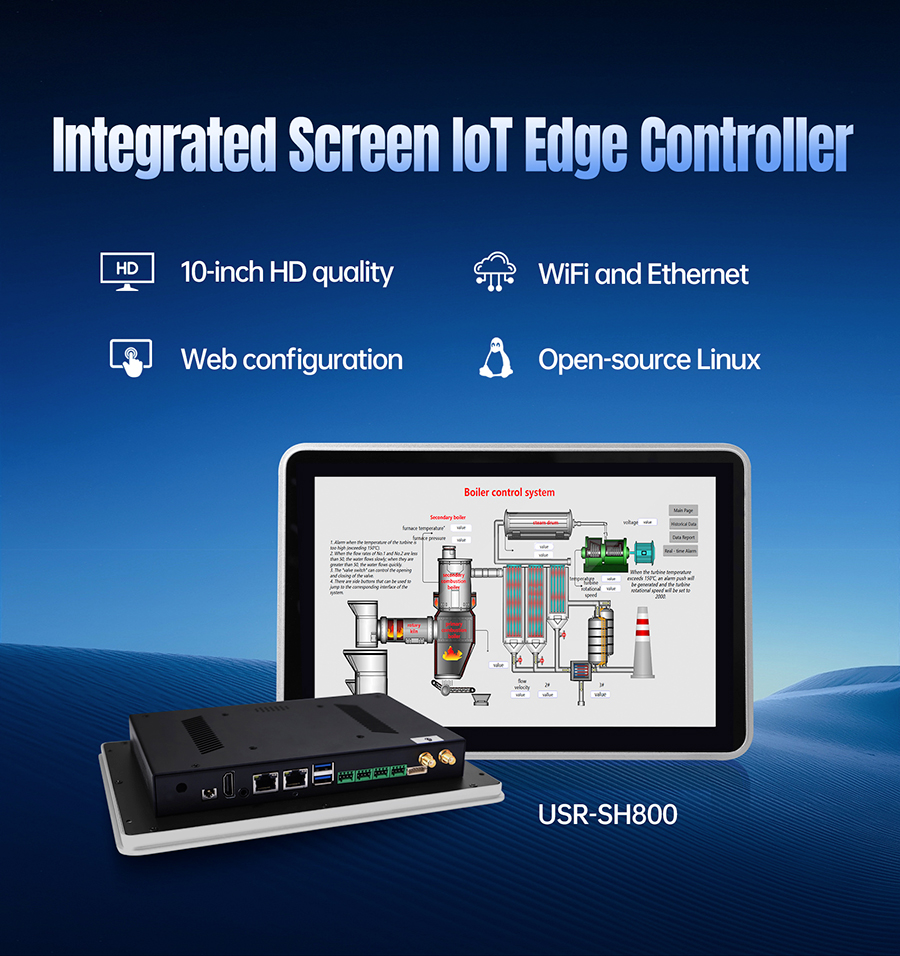
The USR-SH800 industrial panel PC adopts an aluminum alloy housing and ultrasonic welding processes, achieving a balance between dustproof and waterproof performance and heat dissipation.
When verifying protection ratings, pay attention to:
Certification Bodies: Prioritize laboratories accredited by CNAS (China National Accreditation Service for Conformity Assessment).
Test Reports: Must include detailed information such as test environment, equipment model, and test results.
On-Site Testing: Simulate actual usage scenarios (e.g., spraying display corners with a high-pressure water gun).
An enterprise once experienced equipment water ingress during heavy rain, despite a certification report stating "passed IP65 test," leading to a dispute.
High protection rating equipment still requires regular maintenance:
Cleaning Cycle: Wipe dust screens with a soft cloth every quarter to prevent clogging.
Sealing Inspection: Replace sealing rings annually and check for housing cracks.
Software Upgrades: Update firmware via OTA to fix potential vulnerabilities.
The USR-SH800's accompanying operation and maintenance platform can monitor equipment status in real-time and provide early warnings of sealing failure risks.
Among numerous products, the USR-SH800 industrial panel PC stands out for its balance of "protection performance + ease of use + cost-effectiveness":
Protection Rating: Supports dual certification of IP65/IP67, allowing flexible selection based on needs.
Display Performance: 10.1-inch IPS screen with 800cd/m² brightness, visible in sunlight.
Rich Interfaces: Equipped with RS485, Ethernet, WiFi, 4G, and other communication interfaces.
Intelligent Management: Built-in WukongOS system supports remote monitoring and firmware upgrades.
Easy Installation: Supports VESA mounts and embedded installation, adapting to various scenarios.
A smart park project achieved "zero-fault operation" of outdoor monitoring screens by deploying USR-SH800, reducing annual maintenance costs by 60%.
With the development of IoT technology, protection rating certifications are showing two major trends:
Intelligent Protection: Use sensors to monitor environmental parameters (such as humidity and dust concentration) in real-time and automatically adjust equipment operating modes.
Self-Healing Materials: Develop sealing materials that can automatically repair cracks, extending equipment lifespan.
If you are facing the following challenges:
Equipment frequently fails due to insufficient dustproof and waterproof capabilities, affecting production efficiency.
Unable to determine the applicable scenarios for IP65 and IP67, leading to cost waste.
Lack of experience in protection rating certification and concern about project acceptance risks.
Hope to obtain data on the protection performance of equipment in actual environments.
Contact us, and we will provide you with:
Free Environmental Assessment Services: Analyze your application scenarios and recommend IP65/IP67 selection solutions.
Customized Test Reports: Conduct protection rating tests on the USR-SH800 in a third-party laboratory and generate detailed reports.
Sample Experience: Offer a 7-day free trial to personally experience the dustproof and waterproof performance of the equipment.
Expert One-on-One Consultation: Design optimal protection solutions based on your business needs.
Industry White Paper: "Guide to Protection Rating Certification and Selection for Industrial Panel PC."
In the wave of IoT, protection rating certification is not just a "technical threshold" but also a "cornerstone of trust." The USR-SH800 industrial panel PC is not just a display screen but a "versatile guardian" for you to cope with complex environments.