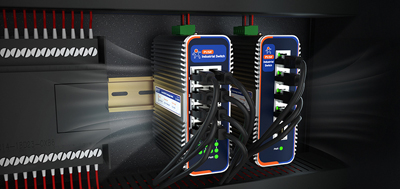
Industrial 4G LTE Modem Empowers Remote Equipment Operation and Maintenance: Breaking the Cost Dilemma of On-site Maintenance with the Cost-Reduction and Efficiency-Enhancement Practices of USR-G771
In the wave of Industry 4.0, equipment operation and maintenance (O&M) models are undergoing a profound transformation from "passive emergency repairs" to "proactive prevention." However, traditional on-site maintenance methods still account for over 60% of a company's O&M costs—engineers travel between various factories, equipment downtime is unpredictable, and spare parts inventory is severely overstocked... How can this dilemma be broken? Industrial 4G LTE modems (data transmission units) provide a quantifiable and sustainable cost-reduction path for companies by enabling remote equipment O&M. This article will analyze the core value of remote O&M by combining technical principles, industry pain points, and real-world cases, and will provide practical solutions with innovative products such as USR-G771.
1.2 Cost-Reduction Logic of Remote O&M: From "Manpower Tactics" to "Data-Driven"
Remote O&M enables real-time equipment status monitoring, fault预警, and remote diagnosis through industrial 4G LTE modems, transforming the O&M model from "post-event emergency repairs" to "pre-event prevention." Its core value is reflected in:
Reduced on-site attendance: Over 70% of routine faults can be resolved through remote debugging, reducing on-site maintenance frequency by more than 50%.
Shortened downtime: Fault warning lead time is shortened from "hour-level" to "minute-level," reducing downtime by 80%.
Optimized spare parts management: Precise spare parts procurement based on equipment health data improves inventory turnover by 40%.
2.1 Core Advantages of USR-G771
Full network coverage: Supports multi-mode communication including 4G/5G/Wi-Fi/Ethernet, automatically switching to the optimal network channel to ensure 99.99% data transmission stability.
Ultra-low power consumption design: Adopts industrial-grade low-power chips with a standby current of only 5mA, suitable for remote scenarios such as solar power supply.
Edge computing capabilities: Built-in Python script engine enables data cleaning, anomaly detection, and other preprocessing at the industrial 4G LTE modem end, reducing cloud computing load by 30%.
Security protection system: Supports TLS encrypted transmission, device identity authentication, and access control to meet industrial control security requirements.
2.2 Remote O&M Technical Architecture
A remote O&M system centered around USR-G771 typically includes the following layers:
Device layer: Collects equipment data (such as temperature, pressure, vibration) through protocols such as Modbus and OPC UA.
Transmission layer: USR-G771 encrypts and uploads the data to the cloud, supporting offline data transmission and caching.
Platform layer: The cloud platform performs data storage, analysis, and visualization, providing functions such as equipment management and alarm management.
Application layer: Enables remote debugging, firmware upgrades, and other operations through PC or mobile apps.
3.2 Scenario 2: Remote Debugging Reduces On-site Attendance
Case: An automation equipment manufacturer enables remote programming and debugging of equipment through USR-G771, covering 30 production bases nationwide.
Effect: On-site attendance frequency drops from 20 times per month to 5 times, travel expenses are reduced by 65%, and debugging efficiency is improved by 3 times.
Key point: USR-G771 supports VPN tunnels and port mapping to ensure the security of remote debugging.
3.3 Scenario 3: Spare Parts Inventory Optimization
Case: An injection molding machine manufacturer establishes a spare parts life prediction model based on equipment operation data collected by USR-G771.
Effect: Spare parts inventory is reduced from 8 million yuan to 5 million yuan, and the spare parts out-of-stock rate drops from 15% to 3%.
Key point: The protocol compatibility of USR-G771 supports unified access to data from multi-brand injection molding machines.
3.4 Scenario 4: Energy Management Optimization
Case: A steel company connects blast furnace temperature sensors through USR-G771 to achieve real-time energy consumption monitoring and optimization.
Effect: Energy consumption per ton of steel is reduced by 8%, saving over 10 million yuan in annual energy costs.
Key point: The wide operating temperature range of USR-G771 (-40°C to 85°C) adapts to the extreme environment of blast furnaces.
4.2 Step 2: Pilot Deployment and Data Collection
Small-scale pilot: Select 1-2 production lines or key equipment for pilot deployment to verify data collection accuracy.
Sensor installation: Add temperature, pressure, vibration, and other sensors according to O&M needs; USR-G771 supports parallel access to multiple sensors.
Data cleaning: Perform data denoising, missing value filling, and other preprocessing at the industrial 4G LTE modem end or in the cloud.
4.3 Step 3: Cloud Platform Construction
Platform selection: Choose public cloud platforms such as Alibaba Cloud or Tencent Cloud, or build a private cloud.
Function development: Develop modules such as equipment management, alarm management, and data analysis according to needs.
API integration: Open platform capabilities to existing enterprise systems (such as ERP and MES).
4.4 Step 4: Remote O&M Process Development
Hierarchical response mechanism: Define response processes for different levels of faults (such as remote debugging and on-site maintenance).
Knowledge base construction: Accumulate solutions to common faults to form a reusable O&M knowledge base.
Training system: Train the O&M team in skills such as remote debugging and data analysis.
4.5 Step 5: Scale-up Promotion and Optimization
Phased rollout: First promote to similar equipment, then expand to different product lines.
Cost-benefit analysis: Regularly evaluate the reduction in O&M costs and return on investment (ROI).
Continuous iteration: Add advanced functions such as AI prediction and AR remote assistance according to business development needs.
5.1 A Smart Park Project
Requirement: Achieve unified remote monitoring of air conditioners, elevators, fire protection, and other equipment in the park.
Solution: Deploy USR-G771 to connect various equipment and upload data to the park management platform via 4G networks.
Effect: The number of O&M personnel is reduced by 60%, and equipment fault response time is shortened from 2 hours to 15 minutes.
5.2 A Sewage Treatment Plant Project
Requirement: Solve the problems of poor network coverage and difficult equipment maintenance at remote sites.
Solution: Adopt the dual-mode communication of 4G+Wi-Fi of USR-G771, prioritizing Wi-Fi and automatically switching to 4G when the network is interrupted.
Effect: Data transmission stability is improved to 99.8%, and on-site inspection frequency is reduced from 3 times per week to once per month.