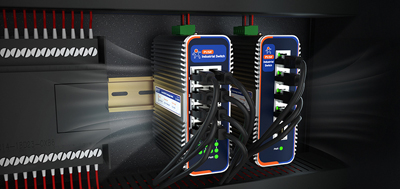
Industrial Switches: The "Nerve Hub" for Efficient Communication Between Traffic Lights and Cameras in Intelligent Transportation
In the wave of intelligent transportation, the collaborative work between traffic lights and cameras has become a core scenario for urban traffic management. However, in traditional solutions, cameras rely on visual recognition to determine the status of traffic lights, and factors such as direct strong light, rainy and foggy weather, and obstruction by large vehicles often lead to a sharp drop in recognition accuracy. Moreover, the independent operation mode of traffic lights and cameras, due to the issue of data silos, makes it difficult to achieve global optimization of traffic scheduling. How can we enable "zero-delay, high-reliability" communication between traffic lights and cameras? Industrial switche, with their industrial-grade design, high-bandwidth transmission, and intelligent network management capabilities, are becoming the key technological foundation for solving this problem.
In traditional traffic scenarios, vehicles identify the status of traffic lights through cameras, which is essentially "passive perception"—relying on visual algorithms to analyze the color and countdown of traffic lights. However, this mode has three major drawbacks:
Poor environmental adaptability: According to test data from an automobile company in 2024, under direct strong light and rainy and foggy weather, the recognition accuracy of cameras for traffic lights drops sharply from 95% to below 70%, and the false detection rate (such as misjudging yellow as red) rises to 15%. For example, in a city, three rear-end collisions occurred consecutively at an intersection on a rainy day due to camera misjudgments.
Insufficient information integrity: Cameras can only identify the color and countdown of traffic lights and cannot obtain key information such as the remaining time of a phase (e.g., "15 seconds left for the left-turn light"), special statuses (e.g., flashing yellow light, faulty red light), etc., resulting in a lack of decision-making basis for drivers.
Weak anti-interference ability: If the traffic light is blocked by trees or billboards or goes out due to a fault, the camera will completely fail. In a pilot city, a traffic light fault went undetected by the camera, causing an intersection to be congested for 2 hours and affecting the passage of tens of thousands of vehicles.
In traditional solutions, traffic lights and cameras operate independently, and data cannot be interconnected:
Delayed scheduling: The adjustment cycle of traffic lights is fixed, and they cannot be dynamically optimized according to real-time traffic flow. For example, during the morning rush hour in a city, the number of vehicles queuing in the left-turn lane at an intersection reached 50, while only 3 vehicles were in the straight-ahead lane. However, the traffic lights still allocated time according to the fixed timing, resulting in a threefold increase in the waiting time for left-turning vehicles.
Slow accident response: After a camera detects a traffic accident, it needs to notify the traffic lights to adjust through manual means, with an average response time of over 5 minutes. In a city, due to the failure of traffic lights to adjust in a timely manner, secondary congestion occurred at the accident intersection, and the congested mileage extended to 2 kilometers.
High operation and maintenance costs: Traffic lights and cameras belong to different systems and require independent inspections and maintenance. In a first-tier city, there are over 200 traffic paralysis incidents caused by equipment failures each year, resulting in direct economic losses exceeding 100 million yuan.
Industrial switche break through environmental limitations through three core technologies:
Wide-temperature operation capability: With a fanless cooling design and industrial-grade chips, they support extreme temperatures ranging from -40°C to 85°C. For example, the USR-ISG series switches have been operating stably for over 3 years in an environment of -35°C at a wind farm in Inner Mongolia, with a failure rate one-fifth that of commercial switches.
High protection level: With a fully metal casing and IP40 protection design, they can resist dust, moisture, and electromagnetic interference. A marine wind farm adopted Yutai Technology's UT-63424G series switches, achieving zero failures for 5 years in an environment where the salt spray concentration exceeded the standard by three times.
Redundant power supply design: Supporting dual power inputs and automatic switching, they ensure that the network is "never powered off." A steel enterprise, through the redundant power supply function of the USR-ISG, achieved a switchover within 0.2 seconds in the event of a main power failure, avoiding production accidents.
In intelligent transportation scenarios, cameras need to transmit 4K high-definition video streams, and traffic lights need to push millisecond-level control instructions, which place stringent requirements on network bandwidth:
Gigabit optical port support: Industrial switche are equipped with SFP optical ports, supporting long-distance fiber-optic transmission and covering scenarios such as tunnels and cross-city areas. For example, a subway line adopted the USR-ISG to build an on-board video surveillance system, achieving zero-interruption data transmission over 10 kilometers via fiber optics.
Integrated PoE power supply: Supporting the 802.3af/at standard, with a maximum power supply of 30W per port, they can directly power devices such as cameras and radars, reducing wiring costs. The Hanyuan Gaoke HY5700-7528G-DC switch provides stable power to 4K panoramic cameras through PoE+ power supply, avoiding surveillance interruptions due to power failures.
QoS traffic scheduling: Through 8-level priority queues, they allocate dedicated channels for key services such as video backhaul (CS6) and emergency event uploads (CS5). During a New Year's light show in a city, the switch increased the video stream guarantee rate to 99.9%, avoiding "blindness" in the command center due to network congestion.
Industrial switche achieve network intelligence through three mechanisms:
ERPS ring network technology: Building a dual-ring network architecture with 50ms-level fault switching. After a new first-tier city introduced the HY5700-7528G-DC switch, the transmission delay of traffic light control instructions dropped from 200ms to 15ms, and the congestion index during peak hours decreased by 18%.
Broadcast storm suppression: With a suppression ratio of up to 95%, it prevents excessive broadcast traffic from causing device offline. During holidays at a scenic spot, this function ensured the orderly passage of 200,000 vehicles under the command of signals, avoiding large-scale congestion.
Remote operation and maintenance platform: Supporting multiple management methods such as SNMP, Web, and CLI, it enables device status monitoring, firmware upgrades, and fault diagnosis. An energy enterprise, through the remote management platform of the USR-ISG, shortened the equipment inspection cycle from 1 week to 1 day and reduced operation and maintenance costs by 60%.
Project Background: A pilot city transformed traffic light information from "visual signals" to "data signals" through a "roadside unit (RSU) + on-board unit (OBU)" architecture, achieving millisecond-level push.
Solution:
Roadside unit deployment: The RSU is installed at the top of the traffic light pole, connected to the signal controller via an RS485 interface, and collects real-time traffic light status, countdown, and phase information. It then transmits the data to the vehicle screen via 5G/C-V2X technology.
Industrial switch support: The USR-ISG series switches provide stable network connections for the RSU, and their dual-ring network architecture ensures data transmission reliability. For example, when the main fiber optic is damaged, the ERPS ring network can switch to a 4G backup link within 20ms, avoiding data loss.
Vehicle screen interaction design: The screen displays the current traffic light color and countdown in the center, with a font size of at least 5cm; it prompts the next phase through icons (e.g., "The left-turn light will turn green in 3 seconds"); when the traffic light fails, it displays a red exclamation mark and triggers a voice reminder.
Implementation Effect:
The accuracy rate of traffic light information reaches 99.9%, an increase of 22 percentage points compared to the camera solution;
The false trigger rate of the ADAS system for running red lights decreases by 76%, and the green wave passage efficiency increases by 30%;
The permanent police presence is reduced by 20%, and the police force demand during holidays is reduced by 25%.
Project Background: The Xi'an Traffic Police Detachment, through its "traffic brain" system, real-time schedules over 2,100 groups of intelligent traffic lights and processes 21 million pieces of light status data daily to achieve precise traffic疏导.
Solution:
Network architecture: The USR-ISG series switches are used to build a core-aggregation-access three-layer network, with 10-gigabit switches deployed at the core layer, gigabit switches at the aggregation layer, and 100-megabit switches at the access layer, forming a dual-ring network redundant architecture.
Data collection: Data such as traffic flow, speed, and queue length are collected through cameras, radars, geomagnetic sensors, and other devices and transmitted to the command center via industrial switche.
Intelligent scheduling: Based on AI algorithms, signal timing plans are generated, and instructions are pushed to intersection signal controllers via industrial switche. For example, when congestion occurs on North Street, the system automatically cuts off the green light at upstream intersections to achieve "slow in, fast out."
Implementation Effect:
700 intersections have achieved adaptive signal timing, and green light utilization has increased by 30%;
205 road sections have achieved green wave passage, and the congestion index during peak hours has decreased by 15%;
15 green wave belt road sections save 76.09 tons of fuel per day and reduce carbon emissions by 20%.
Submission Content: Click the button to fill in the enterprise name, contact person, contact information, project type (urban traffic/highway/park traffic, etc.), scale (number of intersections, number of cameras), and existing network architecture diagram.
Output Results: Within 5 working days, provide an "Intelligent Transportation Network Assessment Report," including:
Network topology optimization suggestions;
Equipment selection list (including USR-ISG series switch configurations);
ROI calculation (investment return period ≤ 1.5 years);
Protocol compatibility analysis and conversion plan.
Pilot Benefits:
Provide 1 USR-ISG industrial switch (including a PoE power supply module) free of charge;
Assign a dedicated engineer for remote guidance;
Provide 7×24-hour technical support during the trial period.
Applicable Scenarios:
Upgrading and renovating existing traffic systems;
Verifying newly built intelligent transportation projects;
Data collection and algorithm training for research institutions.
In the future vision of intelligent transportation, industrial switche have upgraded from "data transmission tools" to "traffic nerve centers." The USR-ISG series switches, with their industrial-grade design, high-bandwidth transmission, and intelligent network management, are helping cities achieve a leap from "passive response" to "proactive prediction" and from "local optimization" to "global collaboration."