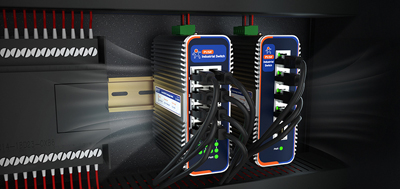
Is the IoT router overheating? In-depth solution for heat dissipation module modification and air duct optimization
In industrial scenarios such as intelligent manufacturing and smart energy, as the core hub for device networking, the stability of IoT router directly impacts production efficiency and data security. However, performance degradation, network disconnections, and even hardware damage caused by device overheating have become frequent pain points in the process of enterprise digital transformation. A photovoltaic enterprise once experienced data loss in its remote monitoring system due to router frequency reduction caused by high temperatures, resulting in direct economic losses exceeding one million yuan. A car manufacturing plant suffered a network interruption due to device overheating, leading to a two-hour production line shutdown and a single-day production capacity loss of 30 million yuan. These cases reveal a core issue: the heat dissipation design of IoT router has become a key factor determining their reliability.
Modern IoT router integrate high-power components such as 5G/4G modules, Wi-Fi RF chips, and multi-core processors, with a power density far exceeding that of ordinary consumer-grade devices. Taking an enterprise-grade router as an example, the temperature of the main control chip can exceed 70℃ under high loads, and the Wi-Fi module is prone to forming local hotspots during dense data transmission. If the heat dissipation design is inadequate, heat accumulation will cause the chip to reduce its frequency, resulting in a performance drop of more than 30%, and may even lead to permanent hardware damage.
There are multiple factors hindering heat dissipation in industrial sites:
Electromagnetic interference: Electromagnetic fields generated by devices such as frequency converters and motors can interfere with fan operation, reducing heat dissipation efficiency.
Dust intrusion: Metal dust and oil stains can block heat dissipation holes, forming an insulating layer and increasing device temperature by 15-20℃.
Space constraints: Devices are densely deployed in cabinets, impeding air flow and leading to local temperature buildup. In a control cabinet of a chemical enterprise, the router temperature was 25℃ higher than the external environment due to limited space, frequently causing network disconnection failures.
Some IoT router adopt simplified heat dissipation solutions to reduce costs:
Insufficient heat sink area: The heat sink area of a certain brand of router is only twice that of the main control chip, far below the industry-recommended standard of five times.
Unreasonable air duct design: The close proximity of the air inlet and outlet creates airflow short circuits, reducing heat dissipation efficiency by 40%.
Improper material selection: Using ordinary plastic instead of thermal conductive silicone results in an interfacial thermal resistance of 1.5℃·cm²/W, three times that of high-quality thermal grease.
Air gaps between the main control chip and the heat sink are the main obstacles to heat conduction. The following solutions can significantly improve heat dissipation efficiency:
Application of high thermal conductivity silicone grease: Selecting silicone grease with a thermal conductivity of ≥5W/m·K (such as Shin-Etsu 7921), whose low viscosity can wet the minute irregularities on the chip surface, reducing thermal resistance to below 0.1℃·cm²/W.
Replacement with elastic thermal pads: For chips with tolerance fluctuations, using elastic pads with a thermal conductivity of 3.5W/m·K and a compression rate of 30% can adapt to gap variations of 0.3-10mm, avoiding poor contact caused by traditional silicone grease drying and cracking.
Precise dispensing control: Using a dispensing machine to fill thermal conductive gel (with a thermal conductivity of 2-8W/m·K) at the chip edges solves the problem of filling large gaps and avoids chip damage caused by compressive stress from traditional pads.
Case: An enterprise-grade router saw a 15℃ drop in chip temperature and an 80% reduction in high-temperature failure rates by replacing it with an elastic thermal pad.
Given the multi-heat source characteristics of IoT router, a composite solution of "thermal conductive silicone pad + synthetic graphite sheet + heat dissipation fan" is required:
Thermal conductive silicone pad covering the main chip: Selecting silicone pads with a thermal conductivity of 1.2-18W/m·K to cover the gaps between the main chip and the aluminum housing, utilizing their self-adhesive and high compressibility to adapt to tolerance fluctuations.
Synthetic graphite sheet diffusing local hotspots: Laying a synthetic graphite sheet with an in-plane thermal conductivity of 1500W/m·K on the back of the PCB to quickly diffuse local hotspots from the Wi-Fi module and avoid temperature buildup.
High static pressure fan for forced convection: Adding a 5V USB fan (with an air volume of ≥5CFM and a static pressure of ≥0.5 inches of water column) on the side or bottom of the device, fixed with 3M adhesive or connected to a smart socket for automatic activation when the temperature exceeds 45℃.
Effect: A router supporting photovoltaic inverter adopted this solution and saw a 22℃ drop in continuous operating temperature in a 40℃ environment, with a 30% reduction in heat dissipation structure space occupation.
IoT router need to operate 24/7, and material aging issues cannot be ignored:
High-temperature resistant silicone rubber products: Selecting silicone rubber certified by UL94V0 to maintain elasticity in the range of 50℃-200℃, avoiding interfacial peeling caused by thermal cycling. An outdoor IoT router fixed its heat dissipation module with a two-component thermal conductive adhesive in an extreme temperature difference environment, experiencing only a 5% drop in thermal conductivity after 1000 hours of aging testing.
Antioxidant coating protection: Spraying a conformal coating (moisture-proof, salt spray-proof, and mold-proof) on the surface of the heat sink extends its service life by 3-5 years.
Avoiding sharp turns and irregular channels: Designing the air duct in a straight line to reduce airflow collision and energy loss.
Expanding the air duct width: Ensuring the air duct width is ≥ the device width to avoid airflow restriction.
Selecting smooth materials: Using aluminum alloy or engineering plastics instead of rough inner walls to reduce frictional resistance.
Case: An enterprise increased air flow by 35% and improved heat dissipation efficiency by 25% by expanding the router air duct width from 50mm to 80mm.
Heat sink spacing control: Ensuring a gap of ≥5mm between heat sinks to avoid airflow blockage.
Fan position optimization: Installing the fan on the upstream side of the airflow (inlet side) to avoid hot air reflux.
Cable management: Fixing cables with cable trays to avoid blocking the air duct.
Effect: A router supporting a CNC machine tool reduced fan power consumption by 20% and noise by 5dB by optimizing the layout of heat dissipation components.
Temperature sensor deployment: Installing NTC thermistors at key positions such as the main chip and power module to monitor temperature in real time.
Temperature control algorithm development: Automatically adjusting fan speed according to temperature changes (such as using a PID control algorithm) to achieve a balance between energy consumption and heat dissipation.
Remote monitoring and early warning: Uploading temperature data in real time through the USR Cloud platform, automatically triggering an alarm when the temperature exceeds the threshold, and pushing it to the mobile phones of operation and maintenance personnel.
Case: A router in a smart agriculture project automatically increased fan speed during high-temperature seasons by integrating an intelligent temperature control system, reducing device failure rates by 60%.
While solving heat dissipation issues, enterprises need to choose a router with industrial-grade heat dissipation design. As a Wi-Fi enhanced router specifically designed for industrial scenarios, the USR-G806w has the following advantages in its heat dissipation design:
Metal shielding design: The main chip and Wi-Fi module are encapsulated in metal shields, which not only shield electromagnetic interference but also serve as the main heat dissipation body.
Large-area heat dissipation hole array: Honeycomb-shaped heat dissipation holes are designed on the bottom and sides to ensure smooth air circulation.
Pre-filled thermal conductive silicone: High thermal conductive silicone is pre-filled between the chip and the shield to reduce interfacial thermal resistance.
Operating temperature range: Supports wide temperature operation from -20℃ to +70℃, adapting to extreme environments.
Protection level: IP30 protection level, dustproof and splash-proof.
Power protection: Wide voltage input (DC 9-36V), with power reverse connection protection and surge protection.
Remote networking function: Supports PUSR DM remote networking, enabling remote device interconnection without a public IP address.
Cloud platform management: Real-time monitoring of device status, including key indicators such as temperature and load, through the USR Cloud platform.
Fault self-repair: Built-in hardware and software watchdogs automatically detect and repair faults to ensure system stability.
Application cases:
In a large logistics warehouse, the USR-G806w achieved real-time positioning and scheduling of AGV trolleys through 4G network and Wi-Fi relay functions. Its multi-network backup mechanism ensures that AGVs can maintain communication through the 4G network even in Wi-Fi signal blind spots, avoiding task interruptions.
A manufacturing enterprise utilized the remote networking function of the USR-G806w to connect CNC machine tools distributed across the country to a unified management platform. Operation and maintenance personnel securely access the devices through VPN, collect real-time operating data, and remotely issue control commands, saving on-site maintenance costs.
The heat dissipation issue of IoT router is essentially a comprehensive challenge of thermal design and environmental adaptability. By strengthening chip-level heat dissipation, upgrading composite heat dissipation systems, optimizing air ducts, and integrating intelligent temperature control, device reliability can be significantly improved. With its industrial-grade heat dissipation design, intelligent networking capabilities, and remote operation and maintenance support, the USR-G806w becomes an ideal choice for enterprise digital transformation.
Immediately consult about the USR-G806w IoT router to obtain customized heat dissipation solutions, allowing your industrial network to bid farewell to overheating issues and focus on core business growth!