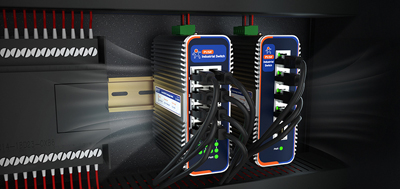
Is the recovery time of industrial switch ring network exceeding the standard? Five key steps to optimize RSTP parameters
In the intelligent workshop of a new energy battery factory, AGV trolleys are transporting cell modules at a speed of 2 meters per second. Suddenly, the main ring network link breaks due to fiber aging. The backup link is supposed to take over within 50 milliseconds, but the actual recovery time is as long as 3 seconds. This 3-second delay causes 3 AGV trolleys to shut down due to communication interruption, the production line to be interrupted for 12 minutes, and direct economic losses exceeding 500,000 yuan. This scenario reflects the core pain point of industrial ring networks: improper RSTP (Rapid Spanning Tree Protocol) parameter configuration leads to excessive ring network recovery time, seriously affecting production continuity.
Industrial ring networks carry core business traffic such as PLC control, AGV scheduling, and visual inspection. When the ring network recovery time exceeds 200 milliseconds (the limit for power automation systems required by the IEC 61850 standard), the following chain reactions will be triggered:
Equipment shutdown: AGV trolleys enter the safety protection mode due to communication interruption and require manual restart.
Data loss: The interruption of motion control commands for welding robots leads to weld seam deviation.
Production capacity loss: Taking a power battery production line as an example, each minute of downtime results in a loss of about 2,000 cell groups.
Configuration complexity: RSTP involves 12 core parameters such as root bridge election, port role assignment, and path cost calculation. Debugging requires comprehensive consideration of network topology and business priorities.
Fault concealment: Incorrect parameter configuration does not directly cause network interruption but will be exposed during link failures, creating a "time bomb".
Responsibility pressure: In a certain automobile factory, the technical team was held responsible for a production accident due to excessive ring network recovery time, which led to a delay in vehicle roll-off.
The essence of the problem: Root bridge election is the basis for RSTP convergence. If the root bridge switches frequently (e.g., due to BPDU loss or priority conflicts), it will lead to repeated calculations of port roles, and the recovery time will deteriorate from milliseconds to seconds.
Optimization plan:Forcibly designate the root bridge: Set the core switch as the root bridge using the stp root primary command to avoid election oscillation. For example, in a port automation project, setting the Master device of the stacked switches as the root bridge reduced the convergence time from 2.3 seconds to 0.8 seconds.
Optimize root bridge performance: Select switches with a backplane bandwidth of ≥10 Gbps and a CPU clock speed of ≥1.8 GHz as the root bridge. The USR-ISG series industrial switches adopt a 4-core ARM Cortex-A72 processor, which can quickly process BPDU packets and reduce election delays.
Step 2: Dynamically adjust path costs to balance link loads
The essence of the problem: The default path cost calculation standard of RSTP (IEEE 802.1t) may cause suboptimal paths to be blocked. For example, the cost difference between gigabit and 10-gigabit links is only 10 times, but the actual bandwidth difference is 100 times, which may lead to link congestion.
Optimization plan:Customize path costs: Adjust link weights using the stp cost command. For example, set the cost of 10-gigabit links to 1, gigabit links to 10, and 100-megabit links to 100 to force traffic to take high-bandwidth paths preferentially.
Enable ECMP (Equal-Cost Multi-Path): Configure stp load-balance on USR-ISG switches to achieve multi-link load sharing. A blast furnace monitoring system in a certain steel enterprise increased bandwidth utilization from 40% to 85% through ECMP.
Step 3: Enable P/A rapid negotiation to skip redundant waiting
The essence of the problem: The traditional STP/RSTP mechanism requires ports to transition from the Blocking→Listening→Learning→Forwarding states, which involves 2 Forward Delays (30 seconds by default). Although RSTP introduces the P/A (Proposal/Agreement) mechanism, it needs to be manually enabled.
Optimization plan:Force point-to-point links: Set the interconnection ports of switches to Trunk mode using the port link-type trunk command to trigger P/A negotiation. For example, in a certain semiconductor factory, this operation reduced the link recovery time from 1.2 seconds to 0.3 seconds.
Configure edge ports: Set ports connected to terminal devices (such as PLCs and sensors) as edge ports (stp edged-port enable) to skip state transitions and directly enter the Forwarding state. USR-ISG switches support batch configuration of edge ports, reducing the risk of manual operations.
Step 4: Deploy TC-BPDU protection to defend against attack storms
The essence of the problem: Malicious attacks or configuration errors may cause switches to frequently receive TC (Topology Change) packets, triggering MAC address table refreshes and further extending the recovery time.
Optimization plan:Enable TC protection thresholds: Limit the number of TC packets processed per second using the stp tc-protection threshold 3 command. For example, in a certain smart park project, this configuration reduced the recovery delay caused by TC storms from 5 seconds to 0.5 seconds.
Configure BPDU filtering: Enable stp bpdu-filter on edge ports to prevent illegal BPDUs from entering the production network. USR-ISG switches support port-based BPDU filtering, which can precisely isolate attack sources.
Step 5: Implement real-time monitoring to proactively warn of risks
The essence of the problem: Traditional RSTP debugging relies on post-mortem analysis and is difficult to identify parameter configuration risks in advance.
Optimization plan:Deploy a network monitoring system: Collect key indicators such as port status and the number of BPDU packets in real time through the SNMP interface of USR-ISG switches. For example, the monitoring system in a certain automobile factory found that the BPDU packet loss rate of a certain port consistently exceeded 5%, and the fiber optic module was replaced in advance to avoid failures.
Configure log alarms: Enable logging buffered and logging trap informational on switches to push RSTP events (such as root bridge switching and port status changes) to the operation and maintenance platform in real time. USR-ISG supports the Syslog protocol and can seamlessly interface with third-party operation and maintenance systems.
In a ring network reconstruction project of a certain power battery enterprise, the USR-ISG series switches significantly improved RSTP performance through the following characteristics:
Hardware acceleration: Equipped with a 4-core 1.8 GHz processor and supporting 200,000 MAC address table entries to ensure zero packet loss of BPDU packets.
Protocol compatibility: Natively support RSTP/MSTP and can be mixed and networked with switches from brands such as Huawei and Cisco.
Environmental adaptability: Operate in a wide temperature range of -40°C to 85°C and have an IP40 protection level, adapting to the high-temperature and dusty environment of new energy workshops.
Simple operation and maintenance: Remote configuration and firmware upgrades are achieved through the USR Cloud platform, reducing on-site debugging time.
The stability of industrial ring networks is directly related to the "lifeline" of intelligent manufacturing. By optimizing RSTP parameters, enterprises can compress the ring network recovery time from seconds to milliseconds, achieving "zero perception of faults". The USR-ISG industrial switches, with their dual advantages of "hardcore performance + intelligent management", provide more reliable underlying support for industrial networks. When technical teams no longer worry about excessive ring network recovery time, they can devote more energy to business innovation and drive the manufacturing industry to upgrade towards intelligence and flexibility.