MAC Address Binding for Industrial Switches: How to Defend Against ARP Spoofing Attacks Using Static Entries?
In today's era of rapid industrial automation and intelligence, industrial networks have become the "nerve center" of production systems. However, ARP spoofing attacks, like viruses lurking in the shadows, can cause severe consequences such as network paralysis and data breaches at any time. A car manufacturing plant once experienced a communication interruption between welding robots and visual inspection systems due to an ARP spoofing attack, resulting in a 2-hour production line shutdown and direct economic losses exceeding one million yuan. A substation monitoring system missed recording critical fault images due to an ARP spoofing attack, narrowly avoiding a major safety incident. The root cause of these cases lies in the lack of an effective MAC address binding mechanism. This article will provide an in-depth analysis of the technical principles of MAC address binding, combined with practical cases and configuration tips, to offer a systematic solution for enterprises to build secure industrial networks.
ARP (Address Resolution Protocol) is a Layer 2 protocol used in local area networks to resolve IP addresses into MAC addresses. Attackers can bind their own MAC addresses to target IPs (such as gateways) by forging ARP response packets, causing legitimate devices to send traffic to the attacker and enabling traffic hijacking, data tampering, or denial-of-service attacks. In industrial scenarios, the harm is particularly severe:
Control Command Tampering: Attackers can intercept control commands between PLCs and robots, causing abnormal device actions.
Monitoring Data Loss: Critical information such as substation meter data and traffic camera footage may be tampered with or discarded.
Network Paralysis: Large-scale ARP spoofing can trigger broadcast storms, overloading the switch's CPU and causing a complete network communication interruption.
Scenario 1: Gateway Impersonation
Attackers forge ARP responses for the gateway, causing all devices to send traffic to the attacker and enabling man-in-the-middle attacks. For example, an ARP spoofing attack caused by an employee's unauthorized device connection in a factory's office network resulted in the theft of financial system data.
Scenario 2: Device Isolation
Attackers bind the MAC address of a critical device (such as a PLC) to an incorrect port by forging ARP packets, preventing other devices from communicating with it. A chemical enterprise once experienced a reactor control failure incident due to this type of attack.
Scenario 3: Traffic Flooding
Attackers send a large number of forged ARP requests, consuming the switch's CPU resources and causing network delays or interruptions. A smart city traffic monitoring system once experienced a collective offline incident of tunnel cameras due to an ARP flooding attack.
MAC address binding prevents illegal ARP response packets from modifying device ARP caches by forcibly binding IP addresses, MAC addresses, and switch ports. Its core principles include:
Static ARP Table: Manually configure IP-MAC-port binding relationships, and the switch only allows traffic from these binding relationships to pass through.
Dynamic ARP Inspection (DAI): Combines with DHCP Snooping functionality to dynamically verify the legitimacy of ARP packets.
Port Security: Limits the number of MAC addresses that can be learned on a switch port to prevent MAC address table overflow attacks.
| Technical Type | Static Binding | Dynamic Binding (DAI) |
| Configuration Method | Manually configure IP-MAC-port bindings | Automatically learn based on DHCP Snooping |
| Applicable Scenarios | Core devices (such as PLCs and gateways), static IP devices | End-user devices, dynamic IP environments |
| Advantages | High security, simple configuration | High flexibility, adapts to device changes |
| Limitations | Requires manual maintenance, poor scalability | Relies on DHCP services, complex configuration |
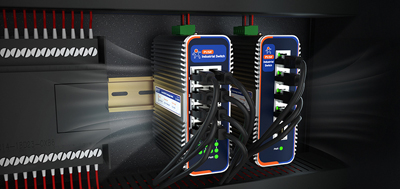
The USR-ISG series switches are designed specifically for industrial environments and offer the following features:
High Reliability: Supports a wide operating temperature range of -40℃ to +85℃, IP40 protection rating, and 6000V lightning protection.
Flexible Networking: Provides combinations of 5, 8, and 16 ports, as well as optical ports, and supports PoE power supply.
Intelligent Management: Supports multiple configuration methods including Web, CLI, and SNMP, with built-in watchdog and ESD protection.
Security Protection: Supports MAC address binding, port speed limiting, ACL access control, and other functions.
Step 1: Log in to the switch management interface
Enter the switch's IP address in a web browser and log in using an administrator account.
Step 2: Configure static ARP entries
bash
# Enter system viewsystem-view# Configure static ARP binding (IP 192.168.1.100, MAC 00:e0:fc:12:34:56, port GigabitEthernet0/1)arp static192.168.1.100 00e0-fc12-3456 GigabitEthernet0/1# Verify the configurationdisplay arp static
Step 3: Enable port security function (optional)
Limit the number of MAC addresses that can be learned on a port to prevent MAC address table overflow attacks:
bash
# Enter port viewinterface GigabitEthernet0/1# Enable port security and limit the maximum number of MAC addresses to 1port-securityenableport-security max-mac-num1
Step 4: Configure ARP speed limiting and anti-flooding (optional)
Prevent attackers from consuming switch resources with a large number of ARP packets:
bash
# Enter port viewinterface GigabitEthernet0/1# Limit the ARP packet rate to 10 packets per second with a burst of 5 packetsarp rate-limit105# Enable broadcast storm suppression (128 Kbps per second)storm-control broadcast cir128
3.3 Dynamic ARP Inspection (DAI) Configuration Steps
Step 1: Enable DHCP Snooping function
bash
# Enable DHCP globallydhcpenable# Enable DHCP Snooping globallydhcp snoopingenable# Configure trusted ports (such as the port connected to the gateway)interface GigabitEthernet0/1
dhcp snooping trust
Step 2: Enable dynamic ARP inspection
bash
# Enter port viewinterface GigabitEthernet0/2# Enable DAI functionarp anti-attack check user-bindenable# Optional: Configure an alarm threshold (trigger an alarm when the number of discarded ARP packets exceeds 100)arp anti-attack check user-bind alarmenablearp anti-attack check user-bind alarm threshold100| Layer | Protection Measures | Technical Means |
| Access Layer | Port security, MAC address binding | Static ARP binding, port speed limiting |
| Aggregation Layer | VLAN isolation, dynamic ARP inspection | DAI, DHCP Snooping |
| Core Layer | Traffic monitoring, abnormal behavior analysis | SNMP alarms, traffic log analysis |
Requirements: Prevent communication interruptions between welding robots and visual inspection systems due to ARP spoofing.
Solution:
Configure static ARP binding for the ports of PLCs and robot controllers.
Enable dynamic ARP inspection for camera ports.
Configure the ERPS ring network protocol on the core switch to achieve 50ms fault self-healing.
Results: 100% interception rate of ARP attacks and a 90% reduction in production line downtime.
Requirements: Ensure the reliability of meter data collection and camera monitoring.
Solution:
Configure static ARP binding for the ports of meter data collection devices.
Enable port security function for camera ports to limit the number of MAC addresses that can be learned.
Use redundant power supply design for switches to avoid security policy failures due to power failures.
Results: A 40% improvement in data integrity and a 70% reduction in fault troubleshooting time.