Multi-Link Redundancy Design for Ethernet Switch: How to Ensure High Communication Availability?
In today's era of rapid industrial automation and intelligence development, the stability of communication networks has become the "lifeline" of enterprise production and operations. An unexpected interruption of a critical link can lead to production line shutdowns, data loss, and even safety accidents. A certain automobile manufacturing enterprise once experienced a 3-hour shutdown of its entire assembly line due to a network failure, resulting in direct losses exceeding 5 million yuan. Another energy enterprise failed to detect equipment abnormalities in a timely manner due to a monitoring network interruption, ultimately triggering a fire and causing incalculable losses. These cases serve as a warning: high communication availability is not an "optional configuration" but a "fundamental necessity" in industrial scenarios.
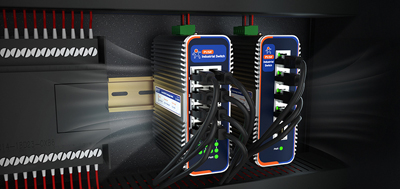
This article will provide an in-depth analysis of the core logic, technical implementation, and selection strategies of multi-link redundancy design, and offer practical solutions for enterprises by combining real-world cases involving the Ethernet switch USR-ISG. If you wish to obtain a customized redundancy configuration tutorial, please contact us, and our expert team will tailor a high-availability network architecture for you.
Physical Link Risks: Risks such as optical fiber severance, electromagnetic interference, and equipment aging. A certain chemical enterprise once experienced a 2-hour factory-wide communication interruption due to accidental severance of its optical fiber during construction.
Protocol Compatibility Risks: Incompatibility of device protocols from different manufacturers. A certain wind farm experienced data acquisition delays exceeding 10 seconds due to a mismatch between the switch and PLC protocols.
Management Configuration Risks: Risks such as misoperations and configuration conflicts. A certain rail transit project experienced a 15-minute signal system shutdown due to incorrect VLAN configuration on the switches.
Zero-Interruption Switching: When the primary link fails, the backup link must take over within 50ms (ERPS standard) to ensure that real-time services such as production line control instructions and video surveillance remain uninterrupted.
Load Balancing: Multiple links simultaneously carry traffic to avoid single-link overload. A certain electronics manufacturing enterprise increased its network bandwidth utilization from 40% to 85% through load balancing.
Intelligent Operations and Maintenance: Real-time monitoring of link status and automatic fault warnings. A certain energy enterprise shortened its fault response time from 2 hours to 10 minutes through an intelligent operations and maintenance system.
Dual Fiber Ring Networks: Achieve 50ms self-healing in the event of a link failure through ERPS (Ethernet Ring Protection Protocol). A certain rail transit project used this to ensure zero interruption of its signal system.
Multi-Operator Links: Simultaneous access to multiple operators such as China Mobile, China Unicom, and China Telecom. A certain chain retail enterprise used this to avoid a nationwide POS system shutdown due to a single operator failure.
Dual Power Input: Automatic switching between primary and backup power supplies. A certain substation used this to withstand municipal power interruptions and ensure continuous operation of its monitoring system.
Key Component Redundancy: For example, the fans and optical modules of the USR-ISG Ethernet switch support hot-swapping. A certain steel enterprise used this to achieve online maintenance of equipment without shutdowns.
VRRP (Virtual Router Redundancy Protocol): Multiple switches are virtualized into a single logical device. A certain manufacturing enterprise used this to achieve gateway redundancy and avoid single points of failure.
STP/RSTP/MSTP: Spanning Tree Protocol prevents Layer 2 loops. A certain energy enterprise used this to manage the topologies of over 100 switches and avoid broadcast storms.
Strategy 1: Tiered Redundancy Based on Business Priority
Core Business (e.g., production line control): Adopt a three-tier redundancy approach of "dual fiber ring network + dual power supply + VRRP" to ensure zero interruptions.
Secondary Business (e.g., office networks): Adopt a two-tier redundancy approach of "dual-operator links + single power supply" to balance cost and reliability.
Strategy 2: Combining Dynamic Load Balancing with Static Path Planning
Real-Time Services (e.g., video surveillance): Bind fixed links through static path binding to avoid delay fluctuations caused by dynamic switching.
Non-Real-Time Services (e.g., data acquisition): Dynamically allocate traffic through ECMP (Equal-Cost Multi-Path) to improve bandwidth utilization.
Strategy 3: Intelligent Operations and Maintenance with Automated Alerts
Real-Time Monitoring: Collect link status through protocols such as SNMP and NetFlow. A certain enterprise used this to detect an abnormal increase in packet loss rate on a certain link and replaced the optical fiber in advance.
Automated Alerts: Set thresholds (e.g., latency > 100ms, packet loss rate > 1%) to trigger email/SMS alerts. A certain logistics enterprise used this to shorten fault discovery time from 30 minutes to 1 minute.
In multi-link redundancy solutions, the choice of Ethernet switches directly determines network stability and scalability. Taking the USR-ISG series as an example, its core advantages can be summarized as "three specialized features and three ease-of-use aspects":
Wide Temperature Operation: Supports extreme temperatures ranging from -40℃ to 85℃. A certain new energy enterprise deployed the USR-ISG1005 in an outdoor photovoltaic power station, where it operated continuously for 2 years without failure.
Lightning Protection and Interference Resistance: 6000V lightning protection and Level 3 EFT/surge protection. A certain substation used this to withstand lightning strikes, reducing equipment damage rates to 0.
Redundant Power Supply: Dual power input with automatic switching in the event of a primary power failure. A certain rail transit project used this to ensure zero interruption of its signal system.
ERPS Ring Network Redundancy: Supports 50ms self-healing. A certain chemical enterprise used this to build a dual fiber ring network and avoid factory-wide shutdowns due to single-link failures.
VRRP Gateway Redundancy: Multiple switches are virtualized into a single logical gateway. A certain manufacturing enterprise used this to achieve zero single points of failure in its core network.
Static Link Aggregation: Binds multiple physical links into a single logical link. A certain electronics enterprise used this to increase bandwidth to 10Gbps while achieving link redundancy.
Plug-and-Play: Non-managed devices require no configuration and automatically negotiate port speed and duplex mode. A certain chain enterprise used this to quickly deploy networks in its nationwide stores.
Cloud Platform Management: Remotely monitor device status and configure redundancy parameters through the USR Cloud Platform. A certain energy enterprise used this to manage switches in over 50 wind farms, reducing operations and maintenance costs by 60%.
Visual Topology: Automatically generates network topology diagrams. A certain rail transit project used this to quickly locate fault points and shorten repair times by 80%.
Real-Time Requirements: Scenarios such as production line control and video surveillance require Ethernet switches that support ERPS and VRRP (e.g., the USR-ISG 8-port managed switch).
Data Volume: Big data acquisition and high-definition video transmission require devices that support link aggregation and high backplane bandwidth (e.g., the USR-ISG 16-port switch).
Budget Range: Enterprises with initial cost sensitivity can first pilot redundancy in core areas and gradually expand to the entire factory.
Small Networks (< 20 devices): Choose basic managed switches that support ERPS and VRRP (e.g., the USR-ISG 5-port switch).
Medium Networks (20-100 devices): Choose enhanced managed switches that support static link aggregation and multiple VLANs (e.g., the USR-ISG 8-port switch).
Large Networks (> 100 devices): Choose core switches that support Layer 3 switching and dynamic routing protocols (e.g., the USR-ISG 16-port switch), paired with access layer switches.
Technical Capability: Choose suppliers with industrial protocol compatibility and redundancy design experience.
Service Support: Prioritize vendors that offer 7×24-hour operations and maintenance and regular inspections.
Success Stories: Refer to redundancy solutions used by industry benchmark enterprises (e.g., a certain automobile manufacturing enterprise used the USR-ISG to achieve factory-wide network redundancy).
A certain electronics manufacturing enterprise had three intelligent production lines, with its original network using a single optical fiber link to connect the control center to the production line equipment. In May 2023, accidental severance of the optical fiber during construction led to a 2-hour shutdown of the entire production line, resulting in direct losses exceeding 3 million yuan. More critically, the enterprise planned to add two more production lines in the next six months, and if the network reliability issue was not resolved, losses would further increase.
Physical Layer Redundancy: Deploy two independent fiber ring networks (Ring Network A, Ring Network B), each containing two USR-ISG1008 managed switches, and achieve 50ms self-healing through the ERPS protocol.
Device Layer Redundancy: Configure all switches with dual power input and connect them to UPS uninterruptible power supplies to ensure continuous network operation during municipal power interruptions.
Protocol Layer Redundancy: Configure VRRP on the core switches to virtualize two devices into a single logical gateway and avoid single points of failure.
Zero-Interruption Operation: After the solution was implemented, when Ring Network A failed due to a lightning strike, Ring Network B took over within 50ms, and the production line was unaffected.
Reduced Operations and Maintenance Costs: By centrally managing all switches through the USR Cloud Platform, the number of operations and maintenance personnel was reduced from 5 to 2, saving 400,000 yuan in annual operations and maintenance costs.
Improved Scalability: When adding new production lines, equipment only needs to be connected to any ring network, eliminating the need to replan the network. The expansion time was shortened from 3 days to 2 hours.
Multi-link redundancy design is not a "technical show-off" but a "must-have course" for enterprises to resist risks and enhance competitiveness. Whether it is zero-interruption protection for core production lines or unified management of distributed factories, the key lies in choosing a solution that suits business needs, is technologically mature, and offers reliable services.
If you wish to:
Obtain a customized redundancy configuration tutorial within 30 minutes;
Experience the redundancy functions of the USR-ISG Ethernet switch for free;
Have in-depth discussions with industry experts on high-availability network architectures;
Please contact us, and our team will get in touch with you within 2 working hours to provide full-process support from solution planning to implementation. Let technology no longer be a bottleneck for business development but an engine driving growth!