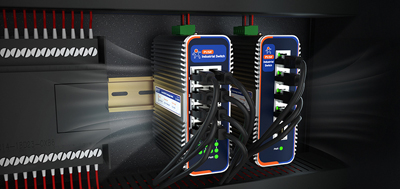
Multi-RS485 to Ethernet Converter Channel Conflict Warning: How to Achieve RS485 Bus Isolation and Burnout Prevention?
In numerous fields such as industrial automation, energy management, and smart cities, multi-RS485 to Ethernet converters play a crucial role as the core hub connecting traditional serial port devices with modern networks. However, the RS485 bus, as a commonly used communication bus, is highly prone to issues like channel conflicts and device burnout due to its half-duplex communication characteristics, long-distance transmission, and coexistence of multiple nodes. These problems severely impact data transmission efficiency and system stability. This article will deeply analyze the root causes of these issues and elaborate on effective solutions for achieving RS485 bus isolation and burnout prevention, helping customers address deep-seated pain points and ensuring the reliable operation of industrial communication networks.
Analysis of Pain Points Related to RS485 Bus Channel Conflicts and Burnout
1.1 Channel Conflicts: Data Disorder Caused by Multiple Node Competition
The RS485 bus adopts a half-duplex communication mode, which means that only one node is allowed to send data at the same time. However, in practical applications, when multiple nodes attempt to send data simultaneously, bus conflicts occur. For example, in a smart energy project, 20 electricity meters were connected to an RS485 to Ethernet converter via an RS485 bus. Due to the lack of a reasonable polling protocol, multiple electricity meters sent data at the same time, resulting in frequent data collection errors. After investigation, it was determined that the conflicts were caused by simultaneous data transmission from multiple nodes. Such conflicts can lead to packet loss or garbled data, seriously affecting data accuracy and integrity, and thereby impacting the normal operation of the entire system.
1.2 Common-Mode Voltage Overlimit: Ground Potential Difference Causing Device Damage
When the RS485 bus connects devices across different grounding points, the ground potential difference is superimposed on the signal lines in the form of common-mode voltage. Transceiver chips usually have a certain tolerance range, typically from -7V to +12V. If the common-mode voltage exceeds this range, the chip will be directly burned out. In an industrial control project, due to poor equipment grounding, the common-mode voltage on the bus reached 25V, resulting in permanent damage to the interface chips of three RS485 to Ethernet converters. This not only increased equipment maintenance costs but also led to system downtime, causing huge economic losses to the enterprise.
1.3 Surge and Electrostatic Discharge (ESD) Impacts: Environmental Factors Causing Sudden Failures
RS485 buses are often deployed outdoors or in strong electromagnetic environments, where sudden energy such as lightning strikes and ESD may intrude into the equipment through cables. For example, in a smart agriculture project, due to the lack of surge protection devices, during a thunderstorm, the bus voltage suddenly surged to 50V, burning out the RS485 to Ethernet converter interfaces along the entire bus. Such sudden failures are often difficult to predict and prevent, posing a great threat to the stable operation of the system.
Solutions for Achieving RS485 Bus Isolation and Burnout Prevention
2.1 Hardware Isolation: Blocking Conflicts and Interference from the Source
2.1.1 Isolated RS485 Chips: Integrated Protection Solutions
Using RS485 chips with integrated isolated power supplies and signal isolation is an effective way to achieve hardware isolation. Taking some high-quality chips on the market as examples, they have many advantages. High isolation withstand voltage is one of their important characteristics, capable of supporting an isolation voltage of 5kVrms, effectively blocking the conduction of ground potential differences. Meanwhile, the built-in ESD protection function can integrate ±16kV system-level contact discharge protection to resist electrostatic impacts. In addition, the fail-safe circuit is also a major highlight. When the bus is idle or open-circuited, it can automatically output a logic high level to avoid communication interruptions.
In practical applications, a sewage treatment plant adopted an RS485 to Ethernet converter equipped with chips having these characteristics. Devices with a distance of 200 meters and different grounding points were connected across the bus. At this time, the common-mode voltage reached 18V, but the equipment still operated stably without chip damage. This fully proves the effectiveness of isolated RS485 chips in solving common-mode voltage problems.
2.1.2 External Isolation Devices: Flexible Adaptation to Different Scenarios
If the equipment has already adopted non-isolated chips, it can also upgrade protection by using external isolation devices. Digital isolators such as ADuM1301 support a communication rate of 100Mbps and are suitable for high-speed buses. Optocoupler isolation has relatively low cost, but high-speed optocouplers such as 6N137 need to be selected to meet baud rate requirements. Isolated power supply modules can provide independent power supplies for the isolated side circuits to avoid power common grounding.
During actual configuration, it is recommended to install isolation modules at the first and last nodes of the bus and selectively deploy them at intermediate nodes according to the distance and potential difference conditions. This allows for flexible hardware isolation according to different application scenarios and requirements, improving system stability and reliability.
2.2 Communication Protocol Optimization: Avoiding Multiple Node Competition
2.2.1 Master-Slave Polling Protocol: Forced Sequential Access
Formulating a master-slave communication protocol is an effective method to avoid multiple node competition. The master node (such as an RS485 to Ethernet converter) polls the slave nodes (such as sensors and electricity meters) in a fixed order to ensure that only one node sends data at the same time. When setting up the polling protocol, multiple parameters need to be considered. The polling cycle should be set according to the number of nodes and data update frequency, for example, polling one node every 100ms. Meanwhile, a timeout retransmission mechanism should be set up. If a slave node does not respond, the master node retransmits the request after 300ms. In addition, the polling order can be dynamically optimized according to bus load to improve communication efficiency.
In a smart building project, by adopting a polling protocol, the data collection error rate was reduced from 12% to 0.3%, significantly improving data collection accuracy and stability. This fully proves the effectiveness of the master-slave polling protocol in solving channel conflict problems.
2.2.2 Token Ring Protocol: Distributed Fair Access
For scenarios with a large number of nodes (>32), the token ring protocol is a more suitable choice. This protocol determines the sending right by passing a token. The token is regularly generated by the initial node (such as an RS485 to Ethernet converter). The node holding the token sends data and then passes the token to the next node. Meanwhile, the system has a conflict detection mechanism. If a node does not receive the token for an extended period, it automatically initiates a token recovery process.
The advantage of the token ring protocol is that it avoids single-point failures of the master node and improves system fault tolerance. In large-scale industrial networks, adopting the token ring protocol can ensure that each node has a fair opportunity to send data, improving the communication efficiency and stability of the entire system.
2.3 Protection Circuit Design: Resisting Surge and Electrostatic Discharge
2.3.1 Hierarchical Protection Architecture: Weakening Impact Energy Layer by Layer
Adopting a three-level protection architecture of "Gas Discharge Tube (GDT) + Polymeric Positive Temperature Coefficient (PPTC) + Transient Voltage Suppressor (TVS)" can effectively resist surge and electrostatic impacts. The first-level protection (GDT) is deployed at the bus entrance and can withstand lightning surges, such as a surge current of 3kA 8/20μs. The second-level protection (PPTC) can limit overcurrent and prevent subsequent circuits from being burned out when the GDT shorts. The third-level protection (TVS) clamps the residual voltage to a safe range. For example, SMBJ12CA can limit the voltage to below 14.7V.
In a photovoltaic power station project, by adopting a three-level protection design, it successfully withstood a 4kV surge impact during a lightning strike test, with no equipment damage. This fully proves the effectiveness of the hierarchical protection architecture in protecting equipment from surge and electrostatic impacts.
2.3.2 Terminal Matching Resistors: Eliminating Signal Reflection
Paralleling 120Ω terminal resistors at the first and last nodes of the bus can match the characteristic impedance of the transmission line and reduce power consumption spikes and data errors caused by signal reflection. For long-distance buses (>100m), terminal resistors must be installed; for short-distance buses (<50m), they can be omitted, but the signal quality needs to be verified with an oscilloscope. Reasonable configuration of terminal matching resistors can improve signal transmission quality and ensure accurate data transmission.
Product Assistance: Advantages of the USR - N540 RS485 to Ethernet Converter
In the process of achieving RS485 bus isolation and burnout prevention, choosing a high-quality RS485 to Ethernet converter is crucial. The USR - N540 RS485 to Ethernet converter is such a reliable product. It has excellent isolation and protection performance, with a built-in high-isolation withstand voltage RS485 interface that can effectively block common-mode voltage and protect equipment from the influence of ground potential differences. Meanwhile, it also supports multiple protection designs to resist surge and electrostatic impacts, providing all-round protection for the stable operation of the equipment.
In addition, the USR - N540 RS485 to Ethernet converter has intelligent protocol support functions, allowing for easy configuration of master-slave polling or token ring protocols to meet communication needs in different scenarios. Its industrial-grade reliability design enables it to work stably in harsh environments, with a wide operating temperature range and passing strict EMC certification. Whether in the fields of smart energy, industrial automation, or smart cities, the USR - N540 RS485 to Ethernet converter can provide customers with reliable communication solutions.
Implementation and Verification: Ensuring Solution Effectiveness
4.1 Hardware Deployment Process
When implementing the RS485 bus isolation and burnout prevention solution, a certain process needs to be followed for hardware deployment. First, insert isolated RS485 to Ethernet converters or isolation modules at the first and last nodes of the bus to achieve hardware isolation. Then, solder protection devices such as GDT, PPTC, and TVS according to the three-level protection architecture to build a complete protection circuit. Next, parallel 120Ω terminal resistors at both ends of the bus to eliminate signal reflection. Finally, carry out grounding design, adopting a single-point grounding method and placing the grounding point at the central node to ensure good grounding.
4.2 Verification and Testing Methods
To ensure the effectiveness of the solution, strict verification and testing are required. Use an oscilloscope to measure the voltage of bus A/B lines to ground and confirm that the common-mode voltage is less than 12V to ensure the safety of the transceiver chip. Apply a 4kV impact through a lightning surge generator and check whether the equipment can work normally to verify its ability to resist surge impacts. Run continuously for 72 hours and count the packet loss rate, which should be less than 0.1%, to evaluate communication stability.
The stability issue of the RS485 bus is a challenging problem that needs to be systematically solved from multiple aspects such as hardware isolation, protocol optimization, and protection design. By deploying isolated chips, formulating reasonable communication protocols, designing hierarchical protection circuits, and choosing high-quality RS485 to Ethernet converters such as the USR - N580, channel conflicts and burnout risks can be completely eliminated, ensuring the safe and efficient operation of industrial communication networks.