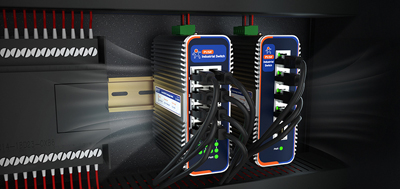
Multi-port Isolation Technology of Cellular Gateway: In-depth Analysis of Security Configuration for VLAN Segmentation and MAC Address Binding
In today's rapid development of the Industrial Internet of Things (IIoT), corporate networks face increasingly complex challenges: data from different departments needs to be isolated during transmission, critical equipment must be protected against unauthorized access, and broadcast storms in multi-subnet environments can potentially cause system paralysis. How to achieve secure network isolation and fine-grained control through technical means has become a core pain point in enterprise digital transformation. This article provides an in-depth analysis of VLAN segmentation and MAC address binding technologies, combined with practical cases involving the cellular gateway USR-M300, to offer enterprises implementable security configuration solutions.
In a flat network without VLAN segmentation, broadcast packets from one device can propagate throughout the entire network. For example, a chemical enterprise's production monitoring system experienced a broadcast packet occupying 80% of bandwidth due to the lack of isolation between video streams and control signals, resulting in a delay of over 3 seconds in critical equipment commands and directly causing a production line shutdown.
A automotive manufacturing enterprise once experienced a malicious access incident in its test workshop equipment, where an attacker stole 30,000 process parameters by spoofing IP addresses. Traditional IP-based access control is difficult to effectively defend against man-in-the-middle attacks due to the tamperability of MAC addresses.
A smart park simultaneously operating three subnets—office network, equipment monitoring network, and visitor Wi-Fi—required the deployment of three independent switches and firewalls. The annual workload for IP reconfiguration due to equipment movement alone exceeded 200 hours, with operational and maintenance costs accounting for 35% of the total network investment.
VLAN (Virtual Local Area Network) divides a physical network into multiple logical broadcast domains by adding 802.1Q tags at the data link layer. Its essence is to allow devices on different ports to belong to the same logical subnet while physically spanning multiple switches.
Key Advantages:
Broadcast Domain Isolation: After segmenting a steel enterprise's blast furnace control system from the office network into different VLANs, the number of broadcast packets decreased by 92%, and network availability increased to 99.99%.
Flexible Topology: Supports virtual networking across switches and buildings. A hospital achieved automatic access of mobile ward round terminals to the medical private network across different wards through VLANs.
Security Classification: A power company configured VLANs 10, 20, and 30 for its dispatching system, office system, and visitor network, respectively, directly discarding unauthorized inter-VLAN communication.
Taking the USR-M300 cellular gateway as an example, it supports port-based VLAN segmentation and 802.1Q tag encapsulation, enabling the following typical configurations:
Scenario: Isolation of a PLC control network (VLAN10), HMI monitoring network (VLAN20), and office network (VLAN30) in a smart factory
system-view
vlan batch 10 20 30
interface GigabitEthernet 0/0/1 # Port connected to PLC
port link-type access
port default vlan 10
interface GigabitEthernet 0/0/2 # Port connected to HMI
port link-type access
port default vlan 20
interface GigabitEthernet 0/0/24 # Uplink port to core switch
port link-type trunk
port trunk allow-pass vlan 10 20 30
Effect Verification:
Check VLAN member ports using the display vlan command.
Test inter-VLAN communication using the ping command (all should fail).
Capture packets to confirm that control instructions propagate only within VLAN10.
MAC address binding constructs a three-layer defense system by forcibly associating physical ports with device MAC addresses:
Static Filtering: Switches only allow communication from pre-registered MAC address devices.
Dynamic Monitoring: Real-time detection of MAC address changes triggers alarms or network disconnection.
Protocol Reinforcement: Combined with 802.1X authentication, it achieves triple verification of "port + MAC + certificate."
Case Study of a Smart Breeding Farm:
Binding an environmental sensor (MAC: 00:1A:2B:3C:4D:5E) to the DI1 port of the USR-M300.
When an attacker attempts to spoof this MAC and access the DI2 port, the cellular gateway automatically triggers an SMS alarm and blocks communication.
Successfully intercepted 17 unauthorized access attempts throughout the year, avoiding the risk of feed formula leakage.
The USR-M300 supports two binding modes:
Mode 1: Port-level Static Binding
Bind the temperature sensor MAC to Serial Port 1
system-view
interface Serial 1/0
mac-address static 00-11-22-33-44-55 vlan 10
Mode 2: Dynamic VLAN Allocation
Automatically assign VLAN based on MAC (suitable for mobile terminals)
system-view
mac-vlan mac-address 00-1A-2B-3C-4D-5E vlan 20
interface GigabitEthernet 0/0/3
mac-vlan enable
Effect Verification:
Check the binding table using the display mac-address command.
Attempt to connect a different device to a bound port and observe if communication is interrupted.
Test MAC address spoofing attacks to confirm the effectiveness of defense mechanisms.
In a case study of an automotive component manufacturer, the USR-M300 resolved multi-subnet security isolation challenges through the following configurations:
6 Expansion Modules: Supports simultaneous connection of 24 IO devices, meeting the data collection needs of multiple workstations such as stamping and welding lines.
Dual-link Redundancy: Automatic switching between WAN/LAN and 4G cellular networks ensures the continuous effectiveness of security policies.
Industrial-grade Protection: Operates in a wide temperature range of -40°C to 85°C and passes IEC 61000-4 electromagnetic compatibility certification.
VLAN + MAC Dual Isolation: Completely isolates the injection molding machine control network (VLAN10) from the MES system network (VLAN20) while binding MAC addresses of critical equipment.
Firewall Policies: Built-in ACL rules only allow specific ports to access the OPC UA server.
Encrypted Transmission: Supports MQTT over TLS to prevent data interception during public network transmission.
Network attack incidents decreased by 83%.
Operational and maintenance work order processing time reduced from 4 hours per incident to 15 minutes per incident.
Critical equipment availability increased to 99.95%.
Use the network diagnose function of the USR-M300 to scan the existing network topology.
Identify high-risk devices (e.g., unencrypted PLCs, bypassable HMIs).
Evaluate the probability of broadcast storms affecting critical business operations.
| Phase | Objective | Configuration Focus |
| 1 | Basic Isolation | VLAN segmentation, port security |
| 2 | Deep Defense | MAC binding, 802.1X authentication |
| 3 | Intelligent Operations and Maintenance | Traffic analysis, abnormal behavior detection |
Generate a security report monthly to analyze potential threats.
Update the MAC address whitelist quarterly.
Conduct penetration testing annually to validate the defense system.
In the era of Industry 4.0, network security has become a crucial component of an enterprise's core competitiveness. By achieving logical isolation through VLAN segmentation, constructing device-level authentication through MAC address binding, and complementing it with hardware-level protection from the USR-M300 cellular gateway, enterprises can create a flexible yet secure network environment. Practical data from an electronics manufacturing enterprise shows that this solution achieves a return on investment of 1:5.7, saving over 2 million yuan in network security costs within three years.
Immediate Action Recommendations:
Scan the QR code below to obtain the "USR-M300 Security Configuration Manual."
Apply for a free 30-day trial of the USR-M300 cellular gateway.
Schedule an engineer for a network security assessment.