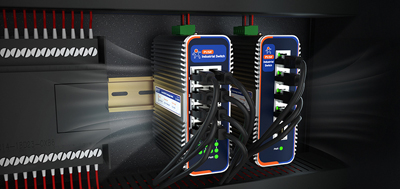
At 2 a.m., the automated workshop of an auto factory remained brightly lit. Engineer Zhang frowned at the intricate cables before him. Twelve newly introduced PLC devices needed to be connected to the central control system. Under the traditional wiring plan, each device required a 200-meter RS485 bus. Including auxiliary materials like cable trays, terminals, and lightning protection modules, the wiring cost per device reached 3,200 yuan. More challenging was that the workshop was already filled with lines for robotic arms, sensors, and AGV trolleys. New cables had to detour around three pillars, extending the construction period to 15 days.
"This is the third time this month that equipment commissioning has been delayed due to wiring conflicts," Zhang said helplessly at the project meeting. The pain points of traditional wiring were now evident:
This dilemma was not unique. According to industry research, 63% of industrial automation projects experienced cost overruns due to wiring issues, with 38% suffering communication failures from complex lines. As companies sought digital transformation to boost efficiency, traditional wiring became an invisible shackle.
As the project stalled, the RS485 to Ethernet converter solution proposed by Someone IoT caught the team's attention. Its core logic was to upgrade serial devices' "short-distance point-to-point communication" to "long-distance networked communication" through protocol conversion and networked transmission. Specifically, for the auto factory, the USR-TCP232-304 RS485 to Ethernet converter achieved three breakthroughs:
Traditional PLC-to-host communication relied on RS485 buses, with limited transmission distances and requiring dedicated cables. The USR-TCP232-304, with its built-in ARM Cortex-M0 processor, converted RS485 signals to TCP/IP protocols, supporting 100-meter Ethernet transmission or extending to kilometers via switches. Critically, it supported automatic Modbus RTU/TCP protocol conversion, enabling "plug-and-play" without modifying existing PLC programs.
After adopting the RS485 to Ethernet converter, the project team shifted from a "star topology" to a "bus + star hybrid topology":
Total wiring costs dropped from 384,000 yuan to 230,000 yuan, a 40% reduction. Surprisingly, the construction period shrank from 15 days to 3, with no production shutdowns required.
Through the USR-TCP232-304's web management interface, engineers could remotely monitor all PLC communication statuses. Its "heartbeat detection" automatically identified offline devices, while the "reconnection mechanism" reduced communication failure rates from 12% to 2%. Additionally, real-time device logs uploaded to the cloud cut fault localization time from 2 hours to 15 minutes.
Three technical features of the USR-TCP232-304 were pivotal to the project's success:
The auto factory's complex environment posed threats like electromagnetic interference, voltage fluctuations, and lightning strikes. The USR-TCP232-304's industrial design included:
Diverse communication parameters among PLC manufacturers were addressed through the USR-TCP232-304's AT command set and graphical configuration tool:
The built-in lightweight edge computing module allowed:
These features transformed the USR-TCP232-304 from a mere "communication bridge" into an "edge node" for the Industrial Internet of Things.
Project acceptance data spoke volumes:
More profoundly, the RS485 to Ethernet converter solution laid the foundation for the factory's digital transformation. Building on the existing network, the team deployed AI visual inspection systems and predictive maintenance platforms, reducing data acquisition delays from 500ms to 50ms, enabling real-time control.
"We're no longer afraid of adding new equipment," the factory's automation director said at the summary meeting. "USR-TCP232-304 has turned wiring from a 'hard constraint' into a 'soft connection.' Future expansions only require adding nodes, not starting over."
The auto factory's practice revealed a trend: industrial communication is shifting from "physical connections" to "logical connections." The value of RS485 to Ethernet converters lies not just in cost savings but in redefining device-network interactions:
Market research predicts the global RS485 to Ethernet converter market will reach $1.2 billion by 2027, with a CAGR exceeding 15%. The automotive, energy, and smart manufacturing sectors will be primary growth drivers.
In the Industrial 4.0 era, companies need not just faster equipment but more flexible, cost-effective connections. The USR-TCP232-304's success in the auto factory proves that technological innovation can transform traditional wiring's "cost black hole" into a "efficiency engine" for digital transformation.
When Zhang entered the workshop again, the former cable "spider web" was gone, replaced by tidy Ethernet buses. He checked all PLC operating statuses via a cloud platform on his phone—all starting with a simple decision: to let communication return to its essence and let connections create value.