PUSR 5G Cellular Router: The "Nerve Center" and "Safety Guardian" of Industrial Automation Production Lines
In the era of Industry 4.0 sweeping across the globe, industrial automation production lines are undergoing a profound transformation from "mechanization" to "intelligence". However, the network architectures of traditional production lines generally suffer from three major pain points: data silos caused by incompatible device protocols, poor network stability in complex environments, and high data transmission security risks. These issues directly restrict the improvement of production efficiency, quality traceability capabilities, and intelligent decision-making levels. Leveraging its multi-protocol compatibility, military-grade environmental adaptability, and financial-grade security protection capabilities, the PUSR 5G cellular router has emerged as a key technological carrier to address these pain points. This article will take the USR-G816 as an example to deeply analyze how it empowers industrial automation production lines and assists enterprises in achieving cost reduction, efficiency enhancement, and digital transformation.
Industrial automation production lines typically integrate devices such as PLCs, sensors, robots, and AGV carts from different manufacturers, employing dozens of communication protocols such as Modbus, Profinet, CAN, and OPC UA. For instance, in a certain automotive parts production workshop, KUKA robots from Germany use the Profinet protocol, FANUC devices from Japan adopt the FINS protocol, and domestic PLCs rely on Modbus RTU. Protocol incompatibility prevents direct communication between devices, necessitating manual data export and import for data flow, which is inefficient and prone to errors.
The USR-G816 is equipped with an internal library of over 20 industrial protocols, supporting bidirectional conversion of mainstream protocols such as Modbus RTU/TCP, Profinet, CAN, and OPC UA. Its core functions include:
Protocol transparent transmission: Directly connecting traditional devices through RS485/RS232 serial ports and transparently transmitting Modbus RTU data to the cloud;
Protocol mutual conversion: Converting the Profinet protocol into TCP/IP format to enable seamless integration of KUKA robot data into the MES system;
Edge computing preprocessing: Cleaning, aggregating, and compressing data at the router end to reduce cloud load.
Case: After deploying the USR-G816, a certain electronics manufacturing enterprise witnessed an 80% increase in production line data collection efficiency, a reduction in device collaboration response time from minutes to seconds, and a 15% decrease in product defect rates.
Industrial automation production lines often face extreme environments such as high temperatures, high humidity, strong electromagnetic interference, and vibrations. For example, the temperature in a steel plant's steelmaking workshop can reach 60°C, the humidity in a textile mill exceeds 85%, and the electromagnetic interference intensity in an automotive welding workshop reaches 10V/m. Traditional commercial routers are prone to issues such as crashes and data packet loss in such environments, leading to production interruptions.
The USR-G816 adopts a full-metal casing and sheet metal process, achieving stable operation in extreme environments through the following designs:
Wide temperature operation: Supports a temperature range of -35°C to 75°C, adapting to outdoor and high-temperature workshop scenarios;
Electromagnetic interference resistance: Passes IEC 61000-4-6 Level 3 electrostatic protection and surge pulse group tests to withstand power fluctuations and lightning strikes;
Dust and water resistance: IP30 protection rating, with an optional IP65 outdoor version for dusty and humid environments;
Redundant power supply: Supports DC 9-36V wide voltage input and dual power backups to prevent network disconnections due to power failures.
Case: After deploying the USR-G816 on a certain oil drilling platform, it operated continuously for 2 years without failure in a -20°C low-temperature and strong salt-fog environment, achieving a 99.99% data transmission success rate and reducing maintenance costs by 60%.
The data on industrial automation production lines includes core assets such as device parameters, process recipes, and production plans. If stolen or tampered with, it could lead to device malfunctions, production accidents, or even the leakage of commercial secrets. For example, a certain chemical enterprise once experienced a reaction kettle temperature runaway due to a cyberattack, triggering an explosion accident.
The USR-G816 constructs a three-dimensional security protection system from the physical layer, network layer, and application layer:
Physical security: Built-in hardware watchdog for fault self-detection and self-repair to prevent physical tampering with devices;
Data encryption: Supports SM2/SM4 national cryptographic algorithms and AES-256 international standards for end-to-end encryption of transmitted data;
Access control: Prevents illegal device access through MAC address binding, IP whitelisting, and firewall rules;
Security auditing: Records all operational logs and supports uploading to a security management platform via the Syslog protocol to meet the requirements of the Classified Protection 2.0 standard.
Case: After deploying the USR-G816, a certain military enterprise achieved "absolute security" in data transmission through quantum key distribution (QKD) technology and successfully passed the security review by the State Cryptography Administration.
The network devices on industrial automation production lines are widely distributed, and traditional operation and maintenance rely on manual inspections, which suffer from issues such as slow response times, high costs, and high missed detection rates. For example, a certain large-scale manufacturing enterprise with 500 devices needed to employ 10 operation and maintenance personnel, with annual operation and maintenance costs exceeding 2 million yuan.
The USR-G816 enables remote centralized management through the "Youren Cloud" platform, supporting the following functions:
Remote configuration: Batch modification of router parameters through the Web or APP, with new devices automatically connecting to the network upon power-on;
Fault warning: Real-time monitoring of device status, signal strength, and data traffic, with alerts pushed via WeChat/SMS/email in case of abnormalities;
Firmware upgrades: Supports OTA remote upgrades to fix vulnerabilities and optimize performance;
Big data analytics: Mines historical data to predict device failure risks and guide preventive maintenance.
Case: After deploying the USR-G816, a certain logistics enterprise reduced its operation and maintenance personnel by 70%, shortened fault response times from 2 hours to 10 minutes, and reduced annual operation and maintenance costs by 1.5 million yuan.
As the flagship product of the PUSR 5G cellular router, the USR-G816 offers the following core advantages:
5G high-speed rate: Achieves an actual download rate of 700Mbps, supporting real-time transmission of 4K video streams and large-scale sensor data;
Multi-network intelligent backup: Supports dual SIM cards, wired, and Wi-Fi multi-link redundancy to ensure "uninterrupted network connection";
Rich interfaces: Integrates 3LAN+1WAN/LAN, RS232/485, dual-band Wi-Fi, and GNSS positioning to meet diverse scenario requirements;
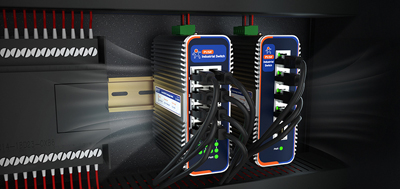
Easy deployment: Supports DIN rail, wall-mounted, and desktop installations to adapt to different industrial environments.
In the digital transformation of industrial automation production lines, the stability, security, and intelligence level of network communication have become core factors determining enterprise competitiveness. The PUSR 5G cellular router USR-G816 provides a "full-scenario, highly reliable, and zero-risk" network solution for industrial automation production lines with its multi-protocol compatibility, military-grade environmental adaptability, financial-grade security protection, and intelligent operation and maintenance capabilities.