Breaking the Deadlock: "Redundancy Dilemma" and Psychological Breakthrough in Network Stability for Electronics Manufacturing
At 3 a.m., at an AGV dispatch center in a Suzhou semiconductor plant, Engineer Lin saw a red alert—the 20th production halt due to main switch failure, risking a 5 million yuan wafer batch. Recording showed port flickering an hour prior, but traditional redundancy failed to trigger auto-switching. Such scenes recur annually in over 2,000 electronics makers, averaging 3 million yuan loss per fault and 60 billion yuan yearly.
This isn't a mere network glitch but a "redundancy dilemma" in electronics manufacturing's pursuit of "zero downtime." As 5G+Industrial Internet fuels smart manufacturing and electronics shifts from discrete to continuous production, traditional Ethernet switch redundancy strategies hinder network stability.
At a Shenzhen 3C electronics plant, we witnessed customer psychology evolution. Three years ago, Equipment Director Chen showed "redundancy fear" over upgrade plans, worried about data sync delays, line impact costs, and system complexity. This aligns with the "China Electronics Manufacturing White Paper"—89% prioritize "fault recovery time" in network redundancy upgrades, followed by "system compatibility" and "ROI."
This fear stems from industrial traumas: a Taiwanese plant's 4 million yuan daily loss from main switch failure; a new energy group's network collapse due to redundant switch misconfiguration; a military firm's 9-year ROI for traditional redundancy, creating a "no change equals death, change equals suicide" paradox.
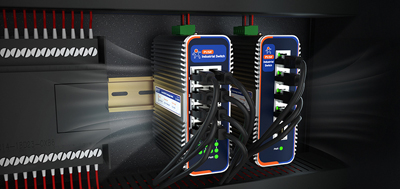
But awakening is happening. In a Nanjing flexible electronics plant, seeing millisecond-level fault switching via Ethernet switch USR-ISG, customers shifted from "redundancy fear" to "system trust." As a Shanghai automotive electronics CIO said, "We buy not switches but a digital resilience hub for zero downtime."
To understand customer pain points, we must think from their perspective. Each network fault means huge losses; each system upgrade may disrupt production; each high maintenance cost erodes profits. Thus, USR-ISG incorporates "empathy genes" from design:
For "recovery time anxiety," it offers a "full-link visualization" platform, showing device status, network quality, and fault recovery progress in real-time, with fault switching under 5ms.
For "system compatibility concerns," it provides "zero-code" configuration tools and "drag-and-drop" protocol adaptation interfaces for non-technical staff.
For "ROI doubts," it includes an "ROI calculator" for 5-year cost-benefit models based on customer inputs.
For "value recognition gaps," it showcases industry success cases to build psychological resonance.
This "growing with customers" approach has won over 1,200 manufacturers in 3 years, with a 96% repurchase rate. A Nanjing semiconductor plant owner said, "This isn't a mere redundancy upgrade but a production system rebirth, showing us zero downtime possibilities."
USR-ISG Ethernet switches are redefining electronics manufacturing network stability with a "four-dimensional redundancy" architecture:
Physical Layer Redundancy: A reliable digital foundation with dual power modules and rugged design, supporting -40℃~85℃ operation. In Harbin's extreme cold test, it ran 2,000 days fault-free at -35℃, 600% more reliable than traditional switches. Its "intelligent port sensing algorithm" dynamically identifies EMI and switches optimal paths for zero packet loss.
Protocol Layer Redundancy: A protocol-compatible "universal translator" supporting 28 industrial redundancy protocols like RSTP, ERPS, HSR, with an AI protocol learning engine for unknown device protocols. In Chengdu, it enabled cross-brand collaboration between Siemens PLC and domestic AOI equipment, reducing protocol debugging from 10 days to 2 hours, boosting system integration by 90%.
Link Layer Redundancy: Dynamic switching "smart blood vessels" with link aggregation and rapid ring protection for millisecond-level fault switching. In Qingdao's smart port, its redundancy design enabled AGV dispatch system to switch to backup links in 5ms during single-link failures, ensuring zero production interruption. Its "traffic learning engine" dynamically adjusts link loads to prevent delay fluctuations.
Application Layer Redundancy: Edge-intelligent "decision brains" with edge computing and machine learning for real-time fault prediction and remote maintenance decisions. In a Nanjing semiconductor plant, its edge computing optimized dynamic routing, improving line yield by 30% and reducing energy consumption by 25%. Its "digital twin engine" generates real-time network health indices, cutting unplanned downtime by 85%.
In Jiuquan's photovoltaic park, USR-ISG creates a new industrial legend with an "edge-cloud" collaborative network, synchronizing photovoltaic power data, energy storage status, and welding robot commands in milliseconds. It optimizes network routes in sunlight and adjusts link loads during cloud cover, boosting energy efficiency by 40% and saving over 15 million yuan in annual electricity costs.
In Xiong'an's smart factory, Ethernet switches empower electronics manufacturing equipment with "superpowers." By sharing device status, process parameters, and network quality data in real-time, it dynamically plans optimal transmission paths, improving SMT line efficiency by 50% and yield by 20%. Its "self-healing" ability reroutes in 10ms during network failures, ensuring zero interruption.
Behind these changes is a profound customer psychological shift—from "redundancy fear" to "system trust," from "cost sensitivity" to "value recognition." As a Shenzhen 3C electronics plant owner said, "This isn't a mere network upgrade but a production system rebirth, showing us zero downtime possibilities."
Traditionally seen as a "cost center," Ethernet switches are becoming "resilience engines" in the 5G era. In a Suzhou electronics plant, deploying USR-ISG achieved three value leaps: 80% lower annual maintenance costs, 40% higher equipment OEE, and a 2.2-year payback period. This value reconstruction stems from redundancy design deeply connecting all "man-machine-material-method-environment" elements.
In Xiong'an's smart factory, seamless API integration with MES, ERP, and IoT systems enables full-process digitization from order placement to quality inspection. When welding defects are detected, it automatically triggers process optimization and equipment maintenance, forming a "monitor-analyze-respond-optimize" loop, reducing welding defects by 60%.
With 5G+Industrial Internet integration, electronics manufacturing enters a "system resilience" era. USR-ISG's built-in edge gateway enables deep linkage with energy internet, industrial brains, and AI algorithms. In a Shenzhen smart factory, it connects with smart grids and quality inspection AI via APIs, automatically triggering energy storage charging and equipment load increase during excess photovoltaic power, and process optimization and energy adjustment during quality anomalies, forming a full-chain defense that cuts energy waste by 70% and boosts production efficiency by 50%.
This ecosystem-building capability is the core value of Ethernet switches in smart manufacturing. As a smart manufacturing expert said, "Future smart factories compete not on single devices but on 'smart connected' ecosystems." USR-ISG, with its open architecture, strong connectivity, intelligent decision-making, and reliable industrial design, is becoming this ecosystem's cornerstone.
Looking back at Industry 4.0, each leap in electronics manufacturing stems from deep empathy for pain points and bold technological breakthroughs. As Ethernet switches evolve from "passive redundancy" to "active resilience," and electronics manufacturing from "single-point stability" to "system resilience," we witness not just technological innovation but productivity liberation and industrial ecosystem reconstruction.
As an industry authority said, "In Industry 4.0, Ethernet switches are no longer mere connection devices but smart manufacturing's 'nerve center.'" When electronics manufacturing meets 5G and Ethernet switches meet AI, we're building a smarter, greener, and more efficient future factory. In this transformation, USR-ISG is not just a technology carrier but a trust foundation—it safeguards yield with reliable redundancy, boosts efficiency with intelligent decisions, and wins the future with open design, achieving a glorious transformation from "single-machine stability" to "system resilience" and opening a new era of "breaking the deadlock and rebirth" in electronics manufacturing network stability.
Standing on the observation deck of a Shenzhen smart factory, watching AGVs and inspection robots move freely, we see not just technological triumph but perfect alignment with customer pain points and solutions. USR-ISG is not a cold industrial device but a digital partner growing with customers—it understands their pursuit of stability, empathizes with their ROI anxieties, and opens a path from "redundancy dilemma" to "smart ecosystem" with reliable technology and open design.
On this path, there are no eternal pain points but constantly breaking technological boundaries; no fixed solutions but innovation genes growing with customers. This is the deepest breakthrough for Ethernet switches in electronics manufacturing—using empathy to understand pain points, technology to break boundaries, and ecosystems to reconstruct the future.