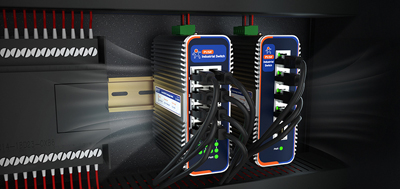
Selection Guide for RS232 to Ethernet Converter: Reliability Design in High-Temperature and Dusty Environments of Welding Workshops
In the welding workshop of an automotive component manufacturing enterprise, 30 welding robots are performing precision operations such as spot welding and arc welding at a frequency of 120 times per minute. However, Workshop Director Wang is deeply troubled—these devices, worth millions of yuan, generate over 20GB of data daily, yet this data remains scattered like pearls on isolated islands, unable to be linked into a valuable decision-making chain.
Wang's anxiety is not an isolated case. In welding workshops, high temperatures, dust, and strong electromagnetic interference are the norm. Traditional RS232 to Ethernet converter often fail frequently due to their inability to adapt to extreme environments: In one instance, a batch of car body welds exhibited porosity defects, and it took the quality inspection department 48 hours to determine that the welding torch temperature of Robot No. 3 was abnormal. The equipment logs had already recorded temperature fluctuation data, but the isolated system failed to provide timely warnings. Another critical bearing failed unexpectedly within its normal cycle, resulting in a downtime loss of 500,000 yuan, simply due to a lack of linked equipment health data. Optimizing the welding process for a new type of high-strength steel took three months, while similar enterprises achieved it in just two weeks through data linkage...
These scenarios reflect the common pain points in welding workshops: Data generated by equipment forms "data islands" due to protocol differences and system barriers, leading enterprises into the paradox of being "rich in data but poor in value." The deepest fear customers have before selecting a product is that, after investing significant funds, the equipment will still become an "expensive decoration" due to insufficient environmental adaptability.
Traditional commercial communication devices typically support an operating temperature range of only 0°C to 40°C, but the actual needs of welding workshops far exceed this standard. In steel smelting workshops, equipment surface temperatures can reach 70°C in summer and drop to -30°C outdoors in northern regions in winter. Temperature fluctuations can lead to electronic component failure, signal transmission attenuation, and even communication interruptions.
Solution: The RS232 to Ethernet converter needs to adopt a wide temperature design of -40°C to 85°C, achieved through the following technologies:
High and low-temperature-resistant electronic components: Industrial-grade capacitors and MLCC ceramic capacitors are selected, whose temperature drift characteristics ensure reliable low-temperature startup and high-temperature continuous operation.
Thermal design balance: Metal casings have 40% higher heat dissipation efficiency than plastic materials. Combined with thermal conductive silicone grease and heat sinks, rapid heat dissipation is achieved. In low-temperature environments, built-in heating modules or low-power designs maintain device temperature.
Power isolation and protection: Supports 8-60V DC wide voltage input to withstand voltage dips; power isolation voltage reaches 1500VDC to prevent equipment damage caused by ground potential differences.
Case: A steel plant deployed RS232 to Ethernet converters supporting a wide temperature range of -40°C to 85°C in its steelmaking workshop, connecting smelting furnaces and conveying equipment with RS-485 interfaces to achieve high-definition real-time monitoring of equipment operation data. After the system went live, fault response time was reduced by 60%, and on-site inspection frequency decreased by 35%.
Welding workshops have high dust concentrations, and metal particles can easily infiltrate equipment interiors, causing short circuits, poor contact, and other issues. Traditional dustproof solutions rely solely on casing sealing, but long-term use can still lead to failures due to aging sealing rings and clogged heat dissipation holes.
Solution: The RS232 to Ethernet converter needs to adopt an IP65 or higher protection rating, achieved through the following designs:
Fanless heat dissipation structure: Natural heat dissipation through metal casings and heat sinks avoids dust intake by fans.
Three-proof coating: Three-proof paint (moisture-proof, salt spray-proof, and mildew-proof) is sprayed on the surface of PCB boards to isolate dust from circuit boards.
Modular design: Key components (such as serial port interfaces and power modules) are housed in independent sealed compartments, facilitating local replacement during maintenance and reducing the risk of whole-machine scrapping.
Case: An IP67-protected RS232 to Ethernet converter was deployed on a new energy vehicle battery box welding production line, operating continuously for two years without failure in an environment with a dust concentration of 10mg/m³, achieving a data transmission stability of 99.99%.
Welding workshops contain strong interference sources such as frequency converters and high-power motors. Ground potential differences and transient surges can damage communication equipment or cause data errors. Traditional non-isolated RS232 to Ethernet converters frequently experience data loss and communication interruptions in power monitoring, rail transit, and other scenarios.
Solution: The RS232 to Ethernet converter needs to adopt a fully isolated architecture, achieved through the following technologies:
Signal isolation: The RS-485 interface uses 3500VDC optoelectronic isolation to block ground potential differences between field devices and control systems, preventing loop currents from damaging data integrity.
Power isolation: The power system achieves 1500VDC isolation, cutting off interference conduction paths from the power side and ensuring that system power fluctuations do not affect communication quality.
Channel-to-channel isolation: Independent isolated channels are used between multiple serial ports to prevent single-channel failures from spreading to the entire system.
Case: A rail transit signaling system deployed RS232 to Ethernet converters supporting 3500VDC isolation, ensuring data transmission security under lightning surge impacts and controlling the bit error rate below 10^-9.
Welding workshop equipment comes from various brands, with KUKA robots using the KRL protocol, FANUC adopting the KAREL language, ABB relying on the RAPID system, and domestic robots possibly based on Modbus or custom protocols. Traditional RS232 to Ethernet converters only support a single protocol, requiring additional gateway development for device interconnection, increasing costs and delays.
Solution: The RS232 to Ethernet converter needs to support multi-protocol conversion, achieved through the following functions:
Basic protocol conversion: Supports industrial protocols such as Modbus RTU/TCP, TCP/UDP, and HTTP to achieve interconnection of heterogeneous devices.
Edge computing capabilities: Built-in data processing engines support local preprocessing such as scaling operations, bit operations, and logical judgments, reducing cloud load.
Custom protocol development: Provides SDK development kits to support users in customizing conversion logic based on device protocols.
Case: An automotive component enterprise used the edge computing function of an RS232 to Ethernet converter to perform real-time filtering and threshold judgment on welding current and voltage data, uploading only abnormal data to the MES system. This reduced data volume by 60% and tripled cloud response speed.
Welding workshop data has low value density, with raw data containing significant redundancy and noise. Directly uploading it to the cloud not only occupies bandwidth but also increases cloud processing burdens.
Solution: The RS232 to Ethernet converter needs to have data governance capabilities, achieved through the following functions:
Data aggregation: Aggregates data by time, device type, and other dimensions to generate statistical reports.
Anomaly detection: Uses rule engines or lightweight AI models to detect equipment anomalies in real-time (such as temperature exceedances and current fluctuations).
Data encryption: Supports SSL/TLS encrypted transmission to prevent data theft or tampering during transmission.
Case: A photovoltaic power plant used the data governance function of an RS232 to Ethernet converter to perform real-time analysis on inverter data, optimizing power generation strategies and increasing annual power generation by 5%.
Among numerous RS232 to Ethernet converters, the USR-TCP232-302 stands out as an ideal choice for welding workshops due to its high cost-effectiveness, strong environmental adaptability, and ease of deployment:
Wide temperature design: Supports an operating temperature range of -25°C to 75°C, adapting to high-temperature environments in workshops.
Dustproof protection: IP30 protection rating, combined with a fanless design, resists dust infiltration.
Protocol compatibility: Supports protocols such as Modbus RTU/TCP and TCP/UDP, easily interfacing with welding robots, PLCs, and other devices.
Edge computing: Built-in data processing engine supports local preprocessing such as data filtering and threshold judgment.
Easy deployment: Provides graphical configuration tools, allowing device debugging to be completed in 10 minutes; supports virtual serial port functions, eliminating the need to modify existing host computer software.
Case: After deploying the USR-TCP232-302 in the welding workshop of a home appliance manufacturing enterprise, device networking time was reduced from three days to two hours, data transmission stability reached 99.9%, and annual maintenance costs decreased by 40%.
When selecting an RS232 to Ethernet converter for a welding workshop, customers are advised to evaluate from the following dimensions:
Environmental adaptability: Confirm whether the device's operating temperature range, protection rating, and anti-electromagnetic interference capabilities cover the extreme environments in the workshop.
Protocol compatibility: Prioritize products that support multi-protocol conversion to reduce technical barriers for future system expansions.
Edge computing capabilities: For scenarios with large data volumes or limited network bandwidth, edge computing can significantly improve system response speed.
Operational and maintenance convenience: Support for remote management, firmware upgrades, fault diagnosis, and other functions reduces on-site maintenance costs.
Brand and case studies: Choose suppliers with successful case studies in welding workshops to ensure technical accumulation and industry experience.
Breaking the data islands in welding workshops essentially involves breaking physical, protocol, and cognitive boundaries. The RS232 to Ethernet converter, as a "bridge" connecting field devices and control systems, derives its value not only from technical implementation but also from helping enterprises build data-driven new production relationships. When welding sparks dance with data flows, the manufacturing industry will truly step into the intelligent era. High-reliability products like the USR-TCP232-302 serve as the "light cavalry" in this transformation, carrying significant missions with their small size and safeguarding the digital transformation of welding workshops.