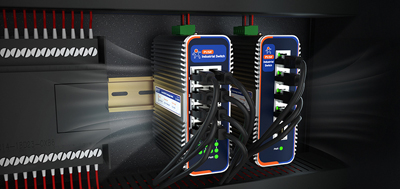
Stop Laying Fiber! Cellular Router + 5G Solution Saves Auto Parts Factories 60% on Networking Costs — Production Lines Keep Running
Not the monthly broadband fee. The cable itself.
Last year, Old Zhang at an auto parts factory needed to network his newly built Workshop No. 2. He called the carrier and asked about laying fiber — from the nearest server room to the workshop, 1.2 kilometers. Quote: 48,000 RMB. Construction timeline: two weeks. Trenching, conduit laying, wall penetration, drilling. Production lines couldn't move during that time.
Old Zhang didn't sign.
He went with a different solution instead. One cellular router. One 5G SIM card. Total investment: less than 8,000 RMB. Installed and online the same day.
One year later, he ran the numbers:60% cheaper than the fiber option.
Production lines never stopped for a single day.
This isn't a story about saving money. This is a story aboutstop letting fiber hold you hostage.
Let's start with a reality you probably know all too well:
Your factory is expanding. Your production lines are relocating. Your warehouse is being rearranged. Every time something moves, the network has to move with it.
But fiber doesn't move.
Once fiber is laid, it's there. You want to change it? Re-lay it. You want to add a node? Re-trench. You want to switch workshops? Get a new quote.
Inseego put it plainly in their tech blog:"Cellular routers are an invaluable tool for businesses operating in rural or remote areas."That was originally about remote locations. But put it in the context of an auto parts factory, and it's just as accurate —
Your workshop is your "remote area."
Because the carrier's fiber doesn't reach your workshop door.
Let's look at some real data from networking retrofit cost comparisons across multiple domestic auto parts factories:
| Solution | Initial Investment | Construction Time | Cost Per Adjustment | Annual Maintenance | 5-Year Total Cost |
|---|---|---|---|---|---|
| Fiber Leased Line | 30K~80K RMB | 7~15 days | 5K~20K RMB | 6K~12K RMB | 80K~150K RMB |
| Cellular Router + 5G | 5K~15K RMB | 0.5~1 day | Nearly zero | 1K~3K RMB | 15K~30K RMB |
The gap isn't small.It's five times.
Perle Systems has a line on their product page that hits the nail on the head:"In remote and unmanned environments, even one minute of downtime can negatively impact customers, operations, and revenue."
Network adjustments in auto parts factories aren't a question of "can we?" — they're a question of"can we afford to wait?"
Can you wait two weeks for construction? Can you wait for production lines to stop? Can you wait for customers to chase delivery dates?
Fiber gives you stability. But it also gives you shackles.
I know what you're thinking.
You're thinking:"5G? Isn't that for phones? Is it stable? What about latency? What about packet loss?"
You're thinking:"My MES system, PLC data, vision inspection cameras — can these actually run on 5G?"
You're thinking:"What if the 5G signal is bad? What if it drops? What happens to my production line?"
Every single one of these questions is the right question.
Let's go through them one by one.
Yes. And it already is.
Inseego's flagship product FX4200 supports Wi-Fi 7, can connect up to 256 devices simultaneously, and is designed specifically for enterprise-grade high-density environments. Perle's IRG series cellular routers support full 5G/LTE bands, come with built-in GPS/GNSS positioning, and support enterprise-grade protocol stacks including RIP, OSPF, BGP-4, VRRP, OpenVPN, and IPSec VPN.
These aren't "future technology." These are thingsalready running in auto parts factories, manufacturing workshops, and logistics warehouses right now.
5G's low-latency characteristics (theoretical 1ms, actual 10~20ms) fully meet the real-time transmission needs of MES systems, PLC data collection, and vision inspection.
Your CNC machine doesn't need 0.1ms latency.It needs non-stop connectivity.
Perle's IRG cellular routers have a feature calledautomatic failover: when the primary link goes down, it automatically switches to the backup link — zero interruption.
You can configure dual SIM cards — China Mobile + China Telecom, or 5G + 4G. One goes down, the other picks up.
Your production line will never know the network switched paths.
Inseego specifically mentioned this in their blog:"Cellular routers typically have built-in failover capabilities that allow them to automatically switch from their primary connection source to a secondary source, minimizing network disruption."
This isn't a backup.This is seamless switching.
This is the real question.
5G signal can be perfect, but if the cellular router dies, it's all for nothing.
Remember what we said in the last article about the auto parts workshop environment?
| Factor | Real Data |
|---|---|
| Temperature | 42~58°C |
| Humidity | 75~90% RH |
A commercial cellular router in this environment?Average lifespan: 3 months.
The USR-G806w cellular router we recommend is purpose-built for exactly this kind of environment:
| Feature | G806w Performance | Commercial Cellular Router |
|---|---|---|
| Cooling | Fanless, pure passive cooling, large heatsink | Fan-cooled, clogs with dust |
| Temp Range | -40°C ~ 85°C | 0°C ~ 40°C |
| Noise | Zero noise (tested: shell is warm, touchable by hand) | 35~45dB fan noise |
| Interfaces | RS485/CAN/DI/DO/GPIO/Multi-Eth/PoE | Usually just 1 WAN + 2 LAN |
| OS Compatibility | OpenWrt/Linux/Windows | Proprietary firmware only |
| Form Factors | Multiple sizes available | Usually just one |
| MTBF | Industrial-grade, tens of thousands of hours | Consumer-grade, thousands of hours |
Our test engineer ran a 72-hour full-load test on the G806w, then touched the shell:
"Warm. You can literally put your hand directly on it. Zero noise. You don't even feel like it's running."
Zero noise. In a CNC workshop, that means workers won't be annoyed by a "buzzing" sound. More importantly:no moving parts = no failure points = no 2 AM emergency repairs.
Perle's IRG series routers run stably from -40°C to +70°C with MTBF far exceeding commercial devices. G806w follows the same design philosophy —it's not "enduring" harsh environments. It was born for them.
Back to Old Zhang's story.
His Workshop No. 2: 6 CNC machines, 2 inspection lines, 1 MES system, 8 sensor nodes, 4 security cameras.
Fiber option: 48,000 RMB. 10 days of construction. Every future adjustment costs more money.
G806w + 5G option: 8× G806w (~8,000 RMB) + 5G IoT SIM cards (~1,200 RMB/unit/year) + installation (~2,000 RMB) = under 20,000 RMB total. Deployed same day, online same day. Future adjustments? Just change an IP address.
Let's run the full numbers:
| Cost Item | Fiber Option (5 Years) | G806w + 5G Option (5 Years) |
|---|---|---|
| Initial Deployment | 48,000 RMB | 19,600 RMB |
| Annual Network Fee | 12,000 × 5 = 60,000 RMB | 1,200 × 8 units × 5 = 48,000 RMB |
| Adjustments/Expansion (3×) | 15,000 × 3 = 45,000 RMB | ≈ 0 RMB |
| Repair (estimated) | 5,000 × 5 = 25,000 RMB | ≈ 0 RMB |
| Downtime Loss (estimated) | 100 hrs × 2,500 = 250,000 RMB | 10 hrs × 2,500 = 25,000 RMB |
| 5-Year Total | ~428,000 RMB | ~117,600 RMB |
| Savings | — | ~310,000 RMB (60%+ saved) |
You read that right.310,000 RMB saved in five years. And the production line never stopped because of the network.
Inseego says:"Cellular provides a superior failover option compared to cable, fiber, and satellite."
Perle says:"If network availability is critical to your success, choose quality."
We say:If your workshop is still waiting for fiber, you're still paying for a cable, waiting for construction, and carrying the risk.
Not every scenario needs 5G. Here are the ones where it shines:
| Scenario | Why It Fits | What G806w Does |
|---|---|---|
| New/expanded workshop | Fiber not available, can't wait for construction | Deploy same day, plug and play |
| Temporary/seasonal production | Used for months then torn down, fiber not worth it | Move with the line, take it when you go |
| Multi-workshop networking | Laying fiber to each workshop = cost explosion | One G806w = one node, VPN mesh |
| Mobile equipment / AGV / forklifts | Can't run cables, WiFi is unstable | 5G follows the device, GPS positioning |
| Old factory renovation | Walls too thick, cabling is a nightmare | Wireless penetration, no drilling needed |
If your factory matchesanyof the above, stop asking "fiber or 5G?"The answer is already clear.
You're the equipment manager. You're the IT lead. You're the factory owner.
You already worry about enough every day: production downtime, missed delivery dates, customer complaints, equipment maintenance…
You don't need to worry about a network cable on top of all that.
Once G806w is installed, you'll forget it's there. No noise. No maintenance. The heatsink is warm to the touch. It runs for a year without dying. Enough interfaces. Compatible with your systems. 5G signal, rock solid.
Perle wrote something on their product page that we think is perfect:
"Choose Perle. Choose quality. Choose peace of mind."
We're going to tweak it and send it to every one of you who's stressing about workshop networking:
Choose G806w. Choose peace of mind. Choose a production line that never stops because of the network — not even for one minute.
Send us your scenario: workshop area, equipment count, temperature/humidity, list of systems to connect.
We'll run the numbersfor you.
We won't let you lay one extra meter of useless cable. We won't let your production line stop for one extra second.
Because in an auto parts factory,one minute costs 2,500 RMB.And you know how to run that math better than anyone.