From Teach Pendant to All-in-One Computer Touch Screen: A Practical Review of How a 3C Factory Saved 40% Robot Programming Time Through Upgrades
At 7:15 a.m., before the line even started, Engineer Zhang was already squatting beside Station #3.
Teach pendant in hand, eyes locked on the robot's end-effector gripper, muttering: "Two millimeters left… one more millimeter… okay, stop."
This was the fourth robot he had to tune today.
The new batch of phone cases was 0.3mm thinner than the last. Just that 0.3mm, and all the original grip parameters were useless. Too much force and the case deformed; too little and it slipped; a slight angle deviation and the edge got scratched.
Zhang spent forty minutes just to get one cycle barely running.
He glanced up at the line—eleven more robots waiting.
The line supervisor walked over and asked: "Can you finish today?"
Zhang said nothing.
He knew in his heart that even if he finished, it wouldn't matter. Tomorrow they'd switch to a new batch of material, and he'd start all over again.
He'd been living this "forever tuning parameters" life for two years.
3C manufacturing has a pain point outsiders rarely understand: product iteration is too fast, and line changes are too frequent.
From mass production of one phone case to the next generation, there might be only six weeks in between. Every product switch means the robot's grip parameters, vision coordinates, force curves, and cycle timing all have to be re-taught from scratch.
What's the traditional approach?
An engineer takes the teach pendant and teaches point by point. The robot moves to Position A, the gripper closes, record; moves to Position B, opens, record. One full sequence takes at least two hundred points, sometimes over a thousand.
Then what? Connect those points into a trajectory, set the speed, tune the force control, run a test—doesn't work, tune again.
A complete robot program takes a skilled engineer four to six hours. A line with eight to twelve robots, one product change, just programming alone takes two to three days.
That's not counting the collisions, scratches, and scrap during test runs.
Zhang once calculated the numbers for me: their factory averaged twenty-eight product changes per year, each requiring about twenty-two man-days for programming. Twenty-eight times twenty-two—six hundred and sixteen man-days. At an engineer's monthly salary of 15,000 RMB, just the labor cost for programming alone was close to 1.5 million RMB.
And that's before downtime losses.
Each line change meant one day of downtime, with a capacity loss of roughly 120,000 RMB. Twenty-eight times that—3.36 million RMB.
Added together, this one factory burned nearly five million RMB every year just on "teach pendant programming."
Five million RMB was enough to buy twenty robots.
But nobody calculated it that way. Because everyone thought "this is just the cost"—you change products, of course you have to re-tune.
Until last year, someone asked: "Why do we have to re-tune every time?"
The person who asked that question was the factory's new automation director, Old Zhou.
Old Zhou had spent fifteen years in the automotive industry. Auto lines also changed models, but theirs were scheduled by the month, not by the week. The moment he arrived at the 3C factory, something felt off—
"Your robots need re-teaching every time you change a product. That's not automation—that's semi-automation. Real automation means the robot adapts on its own when the product changes."
Zhang thought to himself: Easy for you to say. A robot isn't a person—how does it adapt?
Old Zhou didn't explain further. He just took Zhang to see something.
It was an industrial all-in-one computer touch screen mounted next to a robot, model USR-SH800. Not big—slightly thicker than a book, aluminum casing, fanless, IP65 rated, bolted directly to the side of the robot's control cabinet.
Old Zhou pointed at it and said: "Look—this machine runs vision recognition and force control algorithms. When you change products, you don't need to re-teach points. Just import the new product's 3D model, and it calculates the trajectory, tunes the force, and optimizes the cycle on its own."
Zhang didn't believe it: "No way it's that good."
Old Zhou smiled: "Bring new material tomorrow and try it."
The next day, Zhang brought a batch of new phone cases over, half-skeptical.
He imported the new product's CAD file into the USR-SH800 and clicked a single "Auto Generate" button.
Then he just stood there and watched.
On the screen, the robot's virtual model started moving. The vision system automatically recognized the new phone case's contour, thickness, and center of gravity. The force control module calculated the optimal grip force based on material parameters. The motion planning module generated a pick-up trajectory that avoided the edges.
The whole process: eleven minutes.
Zhang stared at the screen, mouth open, not closing.
Two years of work, done in eleven minutes.
Then the robot ran the actual pick-up. First try—the gripper landed dead center on the phone case, perfect force, no deformation, no slip. The cycle was 0.2 seconds faster than before.
Zhang turned to look at Old Zhou. Old Zhou just said one sentence:
"Now that's a line change."
Later, Zhang rolled this solution out across the entire factory. Three production lines, thirty-six robots, all fitted with USR-SH800 units as edge computing nodes.
Six months later, the data came in.
Programming time dropped from an average of 4.5 hours per robot to 2.7 hours per robot—a 40% reduction.
But what really excited Zhang wasn't that number.
It was three changes he never dared to imagine before:
Before, changing products meant the line had to stop for two days. Now? The new product's parameters were generated on the USR-SH800 and pushed to all robots in one click via the OOB remote management module—then run immediately. Line change time dropped from two days to four hours, and it was done without stopping production—run the old product during the day, push new parameters at night, run the new product the next morning.
Line utilization jumped from 78% to 91%.
Before, teach pendant tuning relied on an engineer's experience and feel. The same product tuned by Zhang and by Xiao Li gave different results. Now the USR-SH800 ran a unified vision-plus-force-control fusion algorithm. Every robot's parameters were calculated from actual sensor data—not guessed by a human.
Pick-up yield improved from 93.2% to 98.7%.
In the 3C industry, a 0.5 percentage point difference in yield means hundreds of thousands of RMB in scrap costs per year.
This one hit Zhang the hardest.
Before, his entire day was spent squatting beside the line—tuning parameters, watching picks, fixing exceptions. Now? He sat in his office, opened the USR-SH800 management dashboard, and monitored every robot's real-time status, pick-up data, and force control curves. If a robot flagged an anomaly, the system auto-highlighted it in red—he just adjusted the parameters remotely.
He told me something I still remember:
"I finally went from fireman to architect."
Before, he ran wherever the fire was. Now, he designed how the entire line ran.
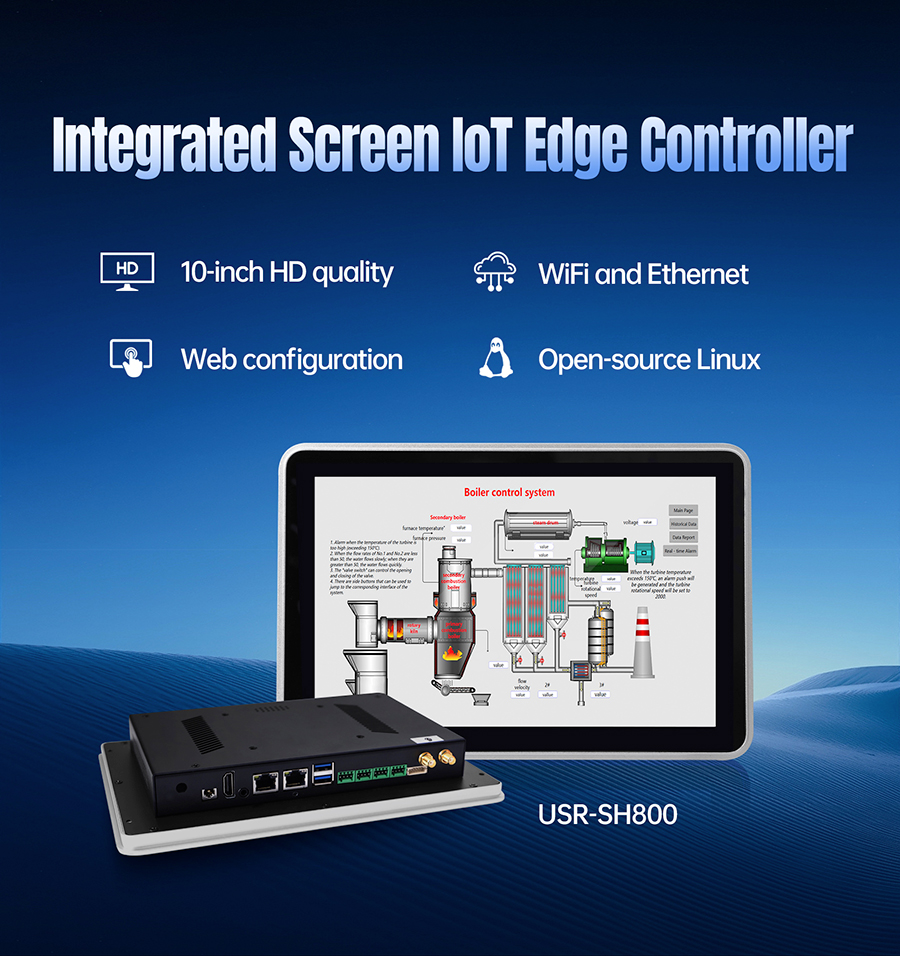
Many people asked Zhang: what's so special about the USR-SH800? Isn't it just an industrial PC running some software?
Zhang studied it thoroughly and told me three key points I think are worth expanding on.
Traditional teaching logic: a human tells the robot "go here, use this force, follow this path." The edge AI running on the USR-SH800 flipped that logic—the robot sees, calculates, and decides for itself.
The vision module captures images in real time, performing local object detection and pose estimation—no cloud transmission needed. The force control module reads the torque sensor at the manipulator's end via RS485, judging grip state in real time. Both data streams undergo sensor fusion within the USR-SH800's heterogeneous computing architecture, generating the optimal grip strategy.
The entire loop is closed locally, with latency compressed to the millisecond level. Premio said something in their AGV/AMR case—"achieving sensor fusion through heterogeneous computing, leveraging dedicated hardware accelerators to integrate IoT sensors, process edge AI workloads, and rapidly store data." That same logic applies perfectly in the 3C robot scenario.
3C production lines are a mess of equipment—new and old mixed together. Some cameras are GigE, some are USB 3.0, some sensors still use RS232. The USR-SH800 has eight GbE ports with PoE to power cameras, plus USB 3.2, RS485, DIO, and CAN Bus. New devices, old devices—all connect directly, no extra conversion modules needed.
Zhang said they had several old robots using serial port sensors from ten years ago. Other industrial PCs couldn't connect to them at all. The USR-SH800 supported them natively—saved a fortune in retrofit costs.
What's a 3C workshop like? Dust, static, huge temperature swings. In winter, stations near the door hit 10°C. In summer, window-side stations hit 45°C. Vibration? Forget about it—the moment a stamping press fires, the whole line shakes.
The USR-SH800 is fanless, passively cooled, fully enclosed aluminum housing. Zhang installed it six months ago—never cleaned dust, never replaced a fan, never had a single crash.
He said the old industrial PCs needed fan replacements every three months, dust cleaning every six months, and in summer they'd overheat and throttle—robot movements slowed, cycles went haywire.
"Now this machine—I install it and forget it exists. That's how it should be."
Zhang told me the hardest part of rolling this out wasn't the technology selection—it was convincing the boss.
When the boss heard they wanted to add an all-in-one computer touch screen to every robot, his first reaction was: "Each robot costs over a hundred thousand. Adding a few-thousand-yuan computer on top—we can't afford it."
Zhang didn't panic. He made a spreadsheet.
Left side: cost of not changing. Annual programming labor: 1.5 million RMB. Downtime losses: 3.36 million RMB. Defect scrap: 800,000 RMB. Total: 5.66 million RMB.
Right side: cost of changing. Thirty-six USR-SH800 units, plus integration and commissioning—one-time investment of about 450,000 RMB. Annual maintenance after that: under 20,000 RMB.
450,000 versus 5.66 million.
The boss read it three times and said one word: "Do it."
Later Zhang told me with feeling: "Many factories aren't short of money to upgrade—they just never ran the numbers. Everyone thinks teach pendant programming is a natural cost. Nobody ever looked at it as waste."
That sentence, I think, is worth every automation professional thinking about.
The time you spend "tuning parameters" every year, the capacity you lose "waiting for downtime," the material you waste "fixing scrap"—added together, it might cost more than your equipment itself.
It's just that these costs are scattered across every day, every shift, every engineer's overtime—invisible.
If right now you're like Zhang two years ago—squatting beside the line at 7 a.m. every morning, teach pendant in hand, teaching the robot point by point, tuning this one then that one, today then tomorrow—
I want to tell you three things.
First, your time is too valuable.
You're an engineer, not an operator. Your value isn't in tuning parameters—it's in designing systems, optimizing processes, solving the truly hard problems. But right now, 80% of your time goes to the thing that needs an engineer the least: repetitive teaching.
Second, your robot is smarter than you think.
It has vision, force control, encoders—it can sense far more than you can. What it lacks isn't capability. It's a local compute node that turns sensing into decision-making.
Third, someone has already done this.
Zhang's factory—thirty-six robots, USR-SH800 as edge compute nodes—programming time cut 40%, yield up 5 points, line change from two days to four hours. Not lab data. Real production line data, running for six months.
You don't need to disrupt anything. You just need to add, next to every robot, an industrial all-in-one computer touch screen that can survive the line environment, run edge AI, and fuse multi-source sensors.
Let the robot see, calculate, and grip on its own.
Let yourself stand up.
On your production line—is there someone squatting on the floor at 7 a.m. every morning, tuning parameters?
Maybe it's time to let them stand up.