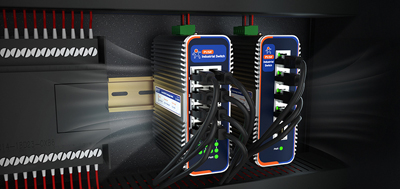
The Application of Industrial Switche in Industrial Security Protection: How to Prevent Cyber Attacks?
In the wave of intelligent manufacturing, industrial networks have become the "nerve center" of production systems. However, with the deep penetration of the Industrial Internet, cyber attacks are spreading from the virtual world to the physical world. A certain automobile manufacturing enterprise suffered a production line shutdown due to vulnerabilities in industrial switche, resulting in daily losses exceeding ten million yuan; a certain energy enterprise experienced equipment misoperation caused by a cyber attack, narrowly avoiding a major safety accident... These cases reveal a harsh reality: the security protection capabilities of industrial switche directly determine the survival threshold of production systems.
Industrial cyber attacks are not simply about data theft but rather implement a dimensionality-reducing attack on production systems through a complete chain of "infiltration-latency-destruction":
Physical Layer Infiltration: Attackers directly access the industrial network by forging MAC addresses or exploiting unclosed default ports on switches, bypassing boundary protections such as firewalls.
Protocol Layer Hijacking: Exploiting the lack of encryption in industrial protocols such as Modbus and OPC UA to tamper with control commands or forge equipment status data.
Application Layer Paralysis: Causing the entire network to collapse by overloading the forwarding plane of switches through DDoS attacks or malicious traffic flooding.
The case of a certain chemical enterprise is highly representative: Attackers scanned and discovered the unclosed Telnet service on the switch, logged in using weak passwords, and tampered with the PLC control logic, causing the temperature of the reaction kettle to get out of control. This process took only 17 minutes but resulted in losses of several million yuan.
Faced with increasingly complex attack methods, industrial switche need to build a three-tier three-dimensional for better understanding in English context, though original Chinese implies layered) protection system of "physical-protocol-application":
Environmental Adaptability Design: Adopting IP40 protection-grade metal casings that can withstand extreme temperatures ranging from -40℃ to 85℃ and resist 6000V lightning surges. For example, the USR-ISG series switches have been running stably for 3 years in an -40℃ environment in an Inner Mongolia coal mine project, with a zero failure rate.
Port Security Mechanisms: Implementing strict control of "one machine per port" through MAC address binding, port isolation, and 802.1X authentication. After deploying USR-ISG, a certain steel enterprise reduced illegal device access incidents by 92%.
Redundant Power Supply Design: Dual power modules automatically switch to ensure zero network interruption in the event of a single power failure. Actual measurements in a certain rail transit project showed that the USR-ISG had a packet loss rate of 0 during power supply switching.
Data Encryption Technology: Supporting TLS/SSL encryption protocols for end-to-end encryption of industrial protocols such as Modbus TCP and OPC UA. A certain power project test showed that the risk of data interception was reduced by 99.7% after encryption.
VLAN Isolation Technology: Physically isolating control networks, monitoring networks, and office networks to prevent lateral attack spread. A certain pharmaceutical enterprise successfully blocked an APT attack targeting the SCADA system by isolating key equipment in independent network segments using the VLAN function of USR-ISG.
Protocol Deep Detection: Built-in industrial protocol parsing engines to detect abnormal commands in real time. For example, USR-ISG can identify and intercept illegal Modbus function codes to prevent malicious write operations to PLCs.
Traffic Monitoring and Anomaly Detection: Real-time analysis of network traffic through technologies such as NetFlow and sFlow to identify abnormal behaviors such as DDoS attacks and ARP spoofing. After deploying USR-ISG, a certain automobile factory successfully intercepted a SYN Flood attack of 400,000 packets per second.
Intrusion Prevention System (IPS): Integrating the Snort rule engine to update the threat signature database in real time. Actual measurements in a certain smart park project showed that the IPS function of USR-ISG could block 98% of known industrial vulnerability exploitation attacks.
Security Auditing and Log Management: Recording all management operations and security events and supporting SIEM system integration. Through the log analysis function of USR-ISG, a certain oil field project detected an attack attempt targeting the HMI system 3 days in advance.
Among numerous industrial switche, the USR-ISG series stands out with its characteristics of "hardcore protection + simplified operation and maintenance":
Wide Temperature Operation Capability: Operating without fear in extreme environments ranging from -40℃ to 85℃ and passing IEC 60068-2-1/-2-2/-2-6/-2-27/-2-32 certification.
Electromagnetic Interference Resistance: Passing IEC 61000-4-2/3/4/5/6/8/16 standards and maintaining stable operation in strong electromagnetic environments.
Fanless Heat Dissipation: Natural heat dissipation design eliminates the risk of fan failures, with an MTBF (Mean Time Between Failures) of up to 300,000 hours.
One-Click Security Hardening: Quickly configuring 12 security policies such as port security, VLAN isolation, and 802.1X authentication through the Web interface.
Automatic Protocol Recognition: Automatically identifying more than 20 industrial protocols such as Modbus TCP, OPC UA, and Profinet and applying targeted protection strategies.
Cloud Platform Management: Supporting remote management through the USR Cloud Platform to achieve batch configuration distribution, firmware online upgrades, and unified security policy control.
Intelligent Manufacturing: In an automobile welding production line, USR-ISG separates the robot control network from the monitoring network through VLAN isolation to ensure zero interference with control commands.
Energy and Power: In a wind farm project, the encrypted communication function of USR-ISG prevents the tampering of wind turbine status data, avoiding equipment misoperations.
Smart Cities: In a traffic signal control system, the redundant power supply design of USR-ISG ensures continuous operation of traffic signals in the event of a single power failure.
Even with high-performance switches, a lack of systematic security strategies may still lead to failure. The following five-step method can help enterprises quickly improve the security of industrial networks:
Regularly check the supplier's official website: Download the latest firmware patches to fix known vulnerabilities. USR-ISG releases security bulletins monthly, providing vulnerability repair guides.
Establish a patch testing environment: Verify patch compatibility in a non-production environment before deployment to avoid business interruptions.
Implement the principle of least privilege: Only allow necessary devices to access critical networks, for example, restricting the PLC control network segment to only allow access by the HMI system.
Enable 802.1X authentication: Implement dynamic key distribution in conjunction with a RADIUS server to prevent unauthorized device access.
Divide VLANs by business: Physically isolate control networks, monitoring networks, and office networks, for example, USR-ISG supports up to 256 VLANs to meet complex networking needs.
Restrict inter-VLAN communication: Control cross-VLAN traffic through ACL rules, for example, only allowing the monitoring network to access specific ports of the control network.
Deploy traffic analysis tools: Real-time monitoring of abnormal traffic patterns through the NetFlow function of USR-ISG.
Set threshold alerts: Trigger alerts for events such as sudden traffic surges and illegal ARP requests, for example, automatically notifying administrators when the traffic on a single port exceeds 100Mbps.
Regularly organize security training: Teach employees to identify common attack methods such as phishing emails and weak passwords.
Simulate attack drills: Conduct red-blue team confrontation drills every quarter to test the effectiveness of security policies. A certain chemical enterprise discovered and repaired 17 security vulnerabilities through drills.
Is your industrial network facing the following risks?
Are switches still using default passwords or have open Telnet services?
Are key devices not isolated from the office network, posing a risk of lateral attacks?
Is there a lack of encryption protection for industrial protocol communications?
Is there no established log auditing and intrusion detection mechanism?
USR-ISG series switches provide you with:
● Military-grade hardware protection to withstand extreme environments
● Intelligent security functions for one-click configuration of 12 protection strategies
● Cloud platform remote management to reduce operation and maintenance costs
● A 5-year warranty and lifetime technical support
Contact us to obtain:
Free access to the "Industrial Switch Security Hardening Guide"
One-on-one solution design by a dedicated engineer
A limited-time trial of USR-ISG industrial switche