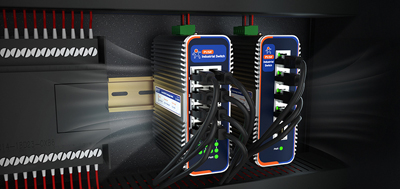
Smart Retail Shelf Management: The Breakthrough Solution with Industrial Gateway RFID Identification and Inventory Early Warning
In today's fiercely competitive retail industry, shelf management has long transcended the physical realm of "product placement" and has become a core battleground affecting sales efficiency, customer experience, and operational costs. The case of a certain supermarket chain is thought-provoking: customer churn rate due to shelf out-of-stock situations reached as high as 23%, while traditional inventory checks took an average of 8 hours per session, with a long-standing discrepancy rate of over 15% between records and actual inventory. Behind these figures lie the deep-seated pain points shared by retail enterprises—how to use technology to break the vicious cycle of "out-of-stock-restocking-overstocking" and achieve intelligent upgrades in shelf management?
- Insight into User Psychology: Anxiety from "Passive Response" to "Proactive Control"
1.1 Operators' "Efficiency Anxiety"
Retail store operators face a daily "time race": the restocking window during morning rush hours is only 30 minutes, shelf adjustments during promotional periods need to be completed within 1 hour, while traditional inventory checks require closing shelves, manual counting, and data entry into the system, making the entire process time-consuming and labor-intensive. A regional manager of a fast-moving consumer goods brand once lamented, "Before every major promotion, we have to mobilize 10 employees for overnight inventory checks, but the next day, discrepancies between shelf and system data still occur."
1.2 Purchasers' "Cost Anxiety"
Overstocking and out-of-stock situations are like two sharp blades that simultaneously刺痛 (this word can be replaced with "prick" or "affect" for a more natural English expression) the nerves of purchasers. Data from a certain clothing brand shows that sales losses due to size out-of-stock situations account for 8% of monthly revenue, while overstocked slow-moving items occupy 25% of storage space. More challenging is that traditional systems cannot provide real-time feedback on shelf dynamics, and purchasing decisions often rely on experience, leading to "what needs restocking isn't restocked, while what shouldn't be restocked piles up."
1.3 Customers' "Experience Anxiety"
When customers pick up a product and find it out of stock or cannot find what they need due to disorganized shelves, brand loyalty is instantly lost. A survey found that 68% of customers will switch to competitors due to shelf out-of-stock situations, while 73% of customers believe that "shelf tidiness" directly affects their trust in the brand. These details are becoming key differentiators in the competitive landscape of retail enterprises. - Breakdown of Technical Pain Points: A Complete Link from "Data Silos" to "Intelligent Linkage"
2.1 Low Identification Efficiency: The "Fatal Flaw" of Traditional Barcodes
Traditional shelf management relies on barcode scanning, but the characteristics of barcodes requiring individual scanning, being prone to wear and tear, and inability to be read in batches result in low inventory check efficiency. A supermarket pilot showed that it took 2 hours to inventory 1,000 items using barcodes, while manual counting took only 1.5 hours, with technology actually becoming a drag on efficiency.
2.2 High Data Latency: The "Post-Mortem" of Inventory Early Warning
Most retail enterprises' inventory early warning systems still rely on the "daily inventory check + system threshold" model, with data update delays of up to 24 hours. When the system issues an out-of-stock alert, the shelf may have been empty for hours, missing the golden sales period. An offline store of an e-commerce platform once experienced a 3-day out-of-stock situation for popular items due to system delays, resulting in direct losses exceeding 500,000 yuan.
2.3 Difficult System Integration: The "Technological Gap" in Multi-Device Collaboration
Shelf management involves various devices such as electronic shelf labels, sensors, cameras, and POS machines, but traditional systems lack unified protocol standards, preventing interconnection between devices. When a retail group attempted to integrate shelf data, they found they needed to interface with 12 protocols from 8 suppliers, resulting in a 6-month project delay and a 40% cost overrun. - Solution: The "Dual-Wheel Drive" Model of Industrial Gateway + RFID
3.1 Industrial Gateway USR-M300: The "Universal Translator" for Device Interconnection
With the USR-M300 industrial gateway as the core, device collaboration challenges are overcome through its multi-protocol support capabilities:
Protocol Conversion: Built-in with over 20 protocol libraries including Modbus, OPC UA, and JSON, it can directly parse data from electronic shelf labels, sensors, cameras, and other devices without custom development;
Edge Computing: Data cleaning, aggregation, and preprocessing are performed at the gateway end, such as aggregating 100 inventory change data points per second into minute averages, reducing cloud load by 90%;
Real-time Transmission: Multi-channel transmission via 5G/WiFi/Ethernet ensures data latency of less than 1 second, supporting high-concurrency scenarios during promotional periods.
Application Case: A certain convenience store chain used the USR-M300 to connect over 2,000 shelf devices, including electronic shelf labels, weight sensors, and cameras, achieving unified data access through protocol conversion, shortening development cycles by 60%, and improving device compatibility by 80%.
3.2 RFID Technology: The "Digital Nerve" of Inventory Management
The batch reading, high fault tolerance, and long lifespan characteristics of RFID tags completely overturn traditional inventory check models:
Batch Identification: Over 200 item tags can be read in a single pass, improving inventory check efficiency by 10 times;
Dynamic Tracking: Real-time tracking of product location and quantity changes is achieved by deploying RFID readers on shelves and in aisles;
Loss Prevention and Theft Deterrence: Combining exit readers with electronic fence technology automatically triggers alarms when unpaid items leave the shelf.
Application Case: After deploying an RFID system on shelves, a certain fast-fashion brand reduced inventory check time from 8 hours to 15 minutes, improved record-actual consistency to 99.8%, reduced out-of-stock rates to 0.5%, and increased clearance efficiency of slow-moving items by 60%.
3.3 Inventory Early Warning System: From "Passive Response" to "Proactive Prediction"
An intelligent early warning model is constructed by integrating RFID real-time data with machine learning algorithms:
Dynamic Thresholds: Safety inventory thresholds are automatically adjusted based on historical sales data, seasonal trends, and promotional activities;
Intelligent Restocking: When inventory falls below the threshold, the system automatically generates restocking orders and triggers AGV robots for restocking;
Sales Forecasting: Based on LSTM neural network analysis of customer behavior data, sales trends for the next 3 days are predicted to adjust inventory structure in advance.
Application Case: Through an intelligent early warning system, a certain fresh food supermarket reduced fresh food loss rates from 8% to 2%, shortened inventory turnover days from 45 to 28, and saved over 2 million yuan in annual costs. - Implementation Path: A Three-Step Approach from "Technology Selection" to "Value Realization"
4.1 Pain Point Diagnosis: Locating Core Issues with Data
Through a 3-day on-site survey, key data in shelf management is collected:
Inventory check frequency and duration
Record-actual discrepancy rate
Out-of-stock frequency and sales losses
Device protocol types and compatibility
Tool Recommendation: Use the free template of the JianDaoYun warehouse management system to quickly generate a pain point analysis report.
4.2 System Integration: Choosing a "Plug-and-Play" Solution
Prioritize industrial gateways and RFID systems that support multi-protocols and low-code development, such as the graphical programming function of the USR-M300, which allows device linkage logic design through drag-and-drop without a professional IT team.
Avoidance Guide:
Avoid gateways that only support a single protocol to prevent future device expansion limitations;
Reject "feature-bloated" systems and focus on core needs such as inventory early warning, dynamic inventory checks, and device collaboration;
Value after-sales service and choose suppliers that provide 7×24-hour technical support.
4.3 Value Verification: Proving ROI with Pilot Projects
Select 1-2 stores for a 3-month pilot, focusing on verifying:
Percentage increase in inventory check efficiency
Decrease in record-actual discrepancy rate
Changes in out-of-stock rates and sales losses
Comparison of system investment and cost savings
Success Criteria: If the pilot stores achieve a 20% increase in inventory turnover rate and a 30% reduction in labor costs, full-scale implementation can proceed. - Future Outlook: Evolution from "Shelf Management" to "Retail Ecosystem"
With the development of 5G, AIoT, and digital twin technologies, smart shelves will evolve to a deeper level:
Virtual Shelves: Construct 3D models of shelves using digital twin technology to simulate display effects and customer movement paths, optimizing space utilization;
Cross-Domain Collaboration: Achieve data interconnection with supply chain, logistics, and marketing systems to realize a full-link closed loop of "shelf out-of-stock-automatic restocking-logistics scheduling-promotional adjustments";
Customer Insights: Combine camera and RFID data to analyze customer dwell time, pickup paths, and associated purchase behaviors, providing a basis for precise marketing. - Empowering Technology to Make Shelves "Come Alive"
The ultimate goal of smart retail shelf management is to transform shelves from "static display tools" into "dynamic data hubs." Through the protocol conversion capabilities of industrial gateways and the real-time identification technology of RFID, we can not only solve the efficiency, cost, and experience pain points of traditional management but also build an intelligent neural network connecting products, customers, and the supply chain. As the CIO of a certain retail group said, "When shelves can 'speak,' the retail industry truly enters the data-driven era." And the key to this era lies in the hands of every manager brave enough to break with tradition.