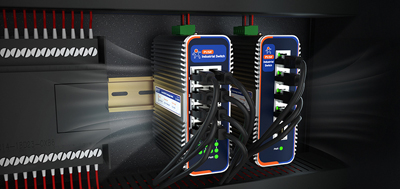
The RS232 to Ethernet Converter Empowers Factory Digital Transformation: Decoding Core Functions and Upgrade Paths
As Industry 4.0 sweeps across the globe, the global penetration rate of the Industrial Internet of Things (IIoT) has surpassed 42%, placing unprecedented pressure on traditional factories to transform. From isolated equipment to interconnected data and from manual inspections to intelligent decision-making, the core needs of factory digital transformation can be distilled into three key questions: How to break down equipment protocol barriers? How to achieve real-time data flow? How to reduce operational and maintenance costs? The RS232 to Ethernet converter, serving as the "nerve center" connecting traditional equipment to smart networks, is becoming a critical infrastructure for factory digital transformation through its core functions such as protocol conversion, edge computing, and remote management.
1. Three Pain Points in Factory Transformation: The Breakthrough Value of RS232 to Ethernet Converters
1.1 Protocol Fragmentation: The "Language Barrier" of Equipment Interconnection
In traditional factories, devices such as PLCs, sensors, and electricity meters often use serial protocols like RS-232, RS-485, and Modbus RTU, while cloud platforms rely on network protocols like TCP/IP and MQTT. A case study from an automotive parts factory is highly representative: its production line features over 200 devices using 12 different protocols, requiring the deployment of seven separate systems for data collection and incurring annual maintenance costs exceeding RMB 3 million. The RS232 to Ethernet converter, through its protocol conversion technology, enables bidirectional translation between protocols such as Modbus RTU and TCP, DL/T645 and MQTT, unifying heterogeneous devices onto a single network and eliminating data silos.
1.2 High Data Latency: The "Timeliness Dilemma" for Decision-Making
In the monitoring system of a photovoltaic power plant, traditional serial communication methods resulted in a data upload delay of 15 minutes, preventing the timely detection of inverter failures and leading to annual power generation losses exceeding 8%. The RS232 to Ethernet converter, through its edge computing capabilities, preprocesses data at the device level (e.g., data filtering, format conversion), uploading only critical information to the cloud. For example, the USR-TCP232-302 supports JSON format conversion, improving raw data compression by 70%. Combined with its 10/100Mbps adaptive Ethernet interface, it achieves millisecond-level data synchronization, supporting real-time decision-making.
1.3 High Operational and Maintenance Costs: The "Efficiency Bottleneck" of Human Dependency
A chemical park once experienced a 12-hour production line shutdown due to delayed equipment failure response, resulting in direct losses exceeding RMB 5 million. The RS232 to Ethernet converter, through its remote management capabilities, allows engineers to debug devices directly from the office using virtual serial port software (e.g., USR-VCOM), reducing fault resolution time from 48 hours to 2 hours. Taking the USR-TCP232-302 as an example, it supports multiple operating modes such as TCP Server/Client, UDP, and HTTPD, adapting flexibly to different scenarios. Its built-in hardware and software watchdog ensures 7×24-hour stable operation, reducing annual operational and maintenance costs by over 60%.
2. Five Core Functions of RS232 to Ethernet Converters: The "Technological Cornerstone" of Factory Transformation
2.1 Protocol Conversion: Building a "Data Highway" for Heterogeneous Devices
Protocol compatibility is a core capability of RS232 to Ethernet converters. The USR-TCP232-302 supports interconversion between RS-232/RS-485 and protocols such as TCP/IP, HTTP, and MQTT, covering over 200 industrial protocols including Modbus, DL/T645, and CJ/T 188. For instance, in a smart park project, the USR-TCP232-302 converted Modbus RTU data from old electricity meters into DL/T645 format, seamlessly integrating with the State Grid platform for automated electricity data reporting and eliminating manual meter reading costs.
2.2 Edge Computing: The "Intelligent Sentinel" Reducing Cloud Load
Edge computing is key to upgrading RS232 to Ethernet converters from "data porters" to "smart nodes." The USR-TCP232-302 features a built-in RISC-V processor, supporting local data cleaning, rule engines, and JSON format conversion. In a stamping machine monitoring project at an automotive factory, deploying an LSTM neural network model on the RS232 to Ethernet converter enabled 36-hour advance prediction of bearing abnormalities, preventing the scrap of two batches of aluminum worth RMB 800,000. This "edge preprocessing + cloud deep analysis" architecture reduced cloud load by 30% and data transmission bandwidth requirements by 50%.
2.3 Remote Management: The "Device Control Console" Across Time and Space
Remote management capabilities have revolutionized factory operational and maintenance models. The USR-TCP232-302 supports up to 16 client connections simultaneously in TCP Server mode, allowing engineers to remotely configure device parameters, upgrade firmware, or debug programs via the "USR Cloud" platform. A multinational manufacturing enterprise leveraged this functionality to enable remote PLC programming across six global factories, reducing fault resolution time from 48 hours to 2 hours and cutting annual maintenance costs by RMB 2 million.
2.4 Data Security: The "Digital Shield" Protecting Industrial Networks
Amid growing industrial internet security threats, the security protection capabilities of RS232 to Ethernet converters are critical. The USR-TCP232-302 employs AES-256 encryption algorithms and Chinese national cryptographic SM2/SM4 algorithm chips, supporting VPN tunnel encryption and access control lists (ACLs) to prevent data leaks and unauthorized access. Its metal casing and fanless cooling design, with IP66 protection and EMC Level 3 certification, ensure stable operation in harsh environments ranging from -40°C to 85°C, safeguarding factory data security and device reliability.
2.5 Multi-Device Access: The "Modular Hub" for Flexible Expansion
As factory scale expands, device access demands grow exponentially. Although the USR-TCP232-302 is a single-serial-port device, it can easily scale to hundreds of nodes through cascading or pairing with multiple RS232 to Ethernet converters (e.g., USR-N720). For example, a logistics park deployed USR-TCP232-302 devices to network weighing instruments, barriers, and printers, enabling real-time data upload to a management platform. The system automatically generated electronic weight slips and synchronized them with the financial system, reducing manual intervention by 90% and tripling weighing efficiency.
3. The USR-TCP232-302 RS232 to Ethernet Converter: A "Lightweight Tool" for Factory Transformation
Among numerous RS232 to Ethernet converter products, the USR-TCP232-302 stands out with its "compact size, high cost-effectiveness, and strong compatibility," making it the preferred solution for small and medium-sized factories undergoing digital transformation:
Hardware Specifications: 1 RS-232 serial port, 1 10/100Mbps Ethernet port supporting AUTO-MDIX direct cable connection;
Protocol Support: Modbus gateway, MQTT, HTTP, etc., compatible with mainstream platforms like Alibaba Cloud and Tencent Cloud;
Edge Functions: JSON data reporting, custom script expansion, local data caching;
Management Methods: Web/AT command/network protocol configuration, supporting virtual serial port software USR-VCOM;
Environmental Adaptability: -40°C to 85°C wide temperature operation, IP40 protection rating, MTBF (mean time between failures) exceeding 100,000 hours.
Typical Application Scenarios:
Legacy Equipment Upgrades: A textile factory converted RS-485 data from 20 water-jet looms into TCP/IP protocol using the USR-TCP232-302, enabling real-time production data monitoring and improving equipment utilization by 15%;
Distributed Energy Management: A photovoltaic power plant deployed USR-TCP232-302 devices to collect inverter data, optimizing power generation efficiency with cloud AI algorithms and increasing annual power output by 8%;
Remote Operational and Maintenance: A pump manufacturer enabled remote diagnostics for 5,000 global devices using the USR-TCP232-302, reducing fault response time to 30 minutes and improving customer satisfaction by 40%.
4. Upgrade Path for Factory Transformation: From Device Networking to Intelligent Decision-Making
4.1 Step 1: Device Networking and Data Collection
Objective: Connect all serial devices to the network for centralized data storage;
Solution: Deploy USR-TCP232-302 or USR-N720 multi-RS232 to Ethernet converters, configuring Modbus TCP/RTU protocol conversion;
Outcome: Data collection delay reduced from minutes to seconds, eliminating manual meter reading costs.
4.2 Step 2: Edge Computing and Real-Time Analysis
Objective: Preprocess data at the device level to extract key metrics;
Solution: Deploy rule engines in the USR-TCP232-302 to filter invalid data and convert formats;
Outcome: Cloud load reduced by 50%, data transmission bandwidth requirements decreased by 70%.
4.3 Step 3: Remote Control and Intelligent Operational and Maintenance
Objective: Enable remote device configuration, firmware upgrades, and fault prediction;
Solution: Manage USR-TCP232-302 devices via the "USR Cloud" platform, integrating AI predictive maintenance models;
Outcome: Fault response time reduced by 80%, equipment downtime decreased by 60%.
4.4 Step 4: Digital Twin and Optimized Decision-Making
Objective: Build digital twins of equipment to optimize production processes;
Solution: Feed data collected by USR-TCP232-302 into a digital twin system to simulate different operating conditions;
Outcome: Production efficiency improved by 20%, energy consumption reduced by 15%.
5. Contact Us: Unlock the "Smart Era" of Factory Transformation
With industrial internet penetration exceeding 50% by 2025, RS232 to Ethernet converters have become a "standard feature" for factory digital transformation. The USR-TCP232-302, with its "high cost-effectiveness, easy deployment, and strong scalability," offers small and medium-sized factories a low-cost, high-efficiency transformation path.
Contact us now to receive:
Free Customized Solutions: Design a tailored digital transformation architecture based on your factory size, equipment types, and business needs;
Device Trials: Opportunity to test USR-TCP232-302 samples and experience their stable performance and ease of use firsthand;
Technical Training: One-on-one guidance from dedicated engineers on device configuration, protocol conversion, and edge computing rule setup.
Contact Us: Obtain the "Factory Digital Transformation White Paper" and industry case library.