Three Core Differences Between Industrial Gateways and Commercial-Grade Gateways: A Guide to Avoiding Selection Pitfalls
In the wave of digital transformation, industrial gateways serve as a bridge connecting the physical and digital worlds, with their performance and stability directly impacting the operational efficiency and data security of production systems. However, amidst the myriad of gateway products on the market, enterprises often fall into selection pitfalls by confusing "industrial-grade" and "commercial-grade" labels. This article delves into the essential differences between the two types of gateways from three core dimensions: environmental adaptability, reliability design, and functional extensibility. It also provides scenario-based selection advice to help enterprises accurately match their needs and avoid wasteful investments.
1.2 Redundant Design of Communication Methods
Industrial scenarios demand near-stringent requirements for network continuity. Industrial gateways commonly adopt a "wired + wireless" dual-link redundant design. For instance, the USR-M300 supports simultaneous operation of Ethernet and 4G/5G cellular networks, with link detection functionality enabling millisecond-level switching. When the wired network is interrupted due to construction, the wireless link seamlessly takes over, ensuring uninterrupted data transmission. In contrast, commercial-grade gateways mostly rely on a single wired or Wi-Fi connection, requiring manual intervention for recovery in case of network failures, which can easily lead to production halts in scenarios such as AGV scheduling in logistics warehouses.
Technical Comparison: The redundant self-healing time of industrial gateways is typically less than 50ms, whereas commercial-grade gateways relying on the STP protocol have a self-healing time of 10-30 seconds, failing to meet real-time control requirements.
Reliability Design: The Lifespan Difference from "Short-Term Usability" to "Long-Term Stability"
2.1 Redundant Protection for Power Supply and Hardware
Power supply failures are the primary cause of equipment downtime (accounting for over 35%). Industrial gateways employ dual power supply redundant designs, supporting wide voltage inputs (e.g., 9-36V DC) and equipped with overvoltage, overcurrent, and reverse connection protection. For example, the power module of the USR-M300 supports hot-swapping, allowing for the replacement of faulty power supplies without interrupting business operations. Additionally, its metal casing and IP65 protection rating can withstand dust intrusion and low-pressure water jet sprays, whereas commercial-grade gateways often feature plastic casings and only support IP20 protection, making them vulnerable to environmental damage.
Data Support: The mean time between failures (MTBF) of industrial gateways exceeds 100,000 hours, while that of commercial-grade gateways is typically 30,000-50,000 hours.
2.2 Anti-Interference and Security Protection Capabilities
In industrial environments, electromagnetic interference generated by devices such as frequency converters and high-frequency welding machines can reach hundreds of volts per meter. Industrial gateways suppress interference by over 95% through metal shielding casings, filtering circuits, and grounding designs. Simultaneously, they support TLS/SSL encryption, firewalls, and access control lists (ACLs) to prevent data interception or tampering. Although commercial-grade gateways also possess basic security functions, they mostly focus on office scenarios and have weaker protection capabilities against industrial protocols (e.g., Modbus TCP, EtherNet/IP), making them vulnerable entry points for attacks.
Risk Warning: In 70% of global industrial wireless gateway attack incidents in 2024, unencrypted wireless signals were intercepted, leading to abnormal equipment shutdowns or data breaches.
Functional Extensibility: The Scenario Difference from "Single Function" to "Flexible Adaptation"
3.1 Protocol Support and Edge Computing Capabilities
Industrial gateways need to be compatible with various fieldbus protocols (e.g., Profibus, CANopen) and industrial IoT protocols (e.g., MQTT, OPC UA) to achieve seamless device integration. For example, the USR-M300 supports Modbus RTU/TCP and OPC UA protocol conversion and incorporates an edge computing engine for local data preprocessing, aggregation, and analysis, reducing cloud load. Commercial-grade gateways mostly focus on general-purpose protocols such as HTTP/HTTPS and TCP/UDP, lacking in-depth support for industrial protocols and struggling to meet the demands of smart manufacturing scenarios.
Application Scenario: In the stamping workshop of an automobile manufacturing enterprise, the USR-M300 can collect data from over 200 sensors in real-time, filter key indicators (e.g., mold temperature, hydraulic pressure) through edge computing, and upload them to the cloud, reducing data transmission volume by 90%.
3.2 Installation Methods and Modular Design
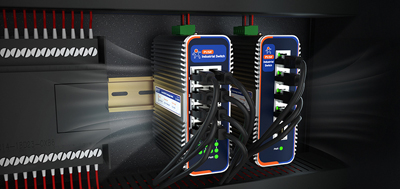
Industrial gateways need to adapt to diverse deployment environments, supporting various installation methods such as DIN rail, rack-mounted, and wall-mounted. For instance, the USR-M300 features a building block design, with the main unit supporting 2 DI/DO and 2 AI ports and expandable with up to 6 expansion units, each providing 8 IO interfaces, flexibly matching the IO quantity requirements of different scenarios. Commercial-grade gateways are mostly designed for desktop or rack-mounted installation, with limited extensibility, making them ill-suited for space-constrained or equipment-dense industrial scenarios.
User Feedback: An electronics manufacturing enterprise reduced equipment deployment time from 3 days to 6 hours and lowered maintenance costs by 60% through the modular design of the USR-M300.
Selection Advice: A "Four-Step Decision-Making Method" Based on Scenarios
4.1 Scenario Classification: From "Stability First" to "Flexibility Supreme"
High-stability demand scenarios: Such as chemical reactor control and power substation monitoring, require prioritizing industrial gateways or dual-link redundant devices like the USR-M300.
Flexible deployment demand scenarios: Such as AGV scheduling in logistics warehouses and temporary production line setups, wireless gateways are a better choice.
Hybrid scenarios: Such as machining workshops (with both fixed equipment and mobile robots), the USR-M300 can balance stability and flexibility.
Budget-sensitive scenarios: Such as small electronics workshops, if stability requirements are not high, low-cost wireless gateways can be chosen, but security protection must be strengthened.
4.2 Performance Benchmarking: "Three Looks" at Key Indicators
Transmission rate: Wired gateways should be ≥1Gbps, and wireless gateways should be ≥100Mbps (4G/5G mode).
Latency: Real-time control scenarios require ≤10ms, while monitoring scenarios can tolerate up to 100ms.
Anti-interference capability: Wired gateways should pass EMC certification (e.g., IEC 61000-4-6), and wireless gateways should support signal enhancement technologies (e.g., external antennas).
4.3 Security Assessment: From "Passive Defense" to "Active Protection"
The security of industrial gateways should meet the following requirements:
Data encryption: Support AES-256 or TLS/SSL encryption.
Identity authentication: Support device fingerprint recognition or digital certificates.
Remote management: Support firmware remote upgrades and vulnerability fixes.
4.4 Cost Analysis: From "Initial Investment" to "Full Lifecycle"
Industrial gateways have higher initial costs, but considering their longer lifecycle, higher reliability, and lower on-site maintenance costs, their total cost of ownership (TCO) can be competitive in specific scenarios. Although the USR-M300 has a higher unit price, its dual-link design reduces production losses caused by network interruptions, making it more cost-effective over its full lifecycle.
Contact Us for Customized Solutions
Selecting the right gateway is the first step towards success in the factory's digital transformation journey. Whether you are facing the dilemma of choosing between wired and wireless options or need a hybrid solution that balances stability and flexibility, our professional team can provide free consultations and customized selection advice. The USR-M300, as a high-performance, scalable comprehensive edge gateway, is becoming a powerful assistant for intelligent upgrades in smart factories, smart farming, and other fields, thanks to its powerful data collection, edge computing, network communication, and flexible hardware design.
Take Immediate Action:
Scan the QR code below, fill in key information such as factory environment, equipment type, and network requirements, and submit the consultation form.
Visit our official website to download the "White Paper on Industrial Gateway Selection" for more technical details and case studies.
From wired to wireless, from stability to flexibility, the evolution of industrial gateways never stops. Choose the USR-M300 to equip your factory with both the "rock-solid" reliability and the "adapt-as-needed" flexibility in the wave of digital transformation, opening a new chapter in smart manufacturing!