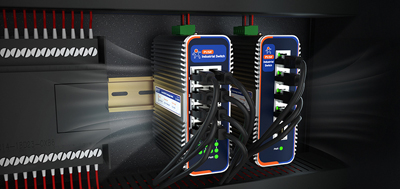
In the substation control room of an industrial park in Jiangsu, Engineer Lao Zhang stares at the yellowed instrument panels on the wall, his brow furrowed. This substation, which has been in service for 20 years, supplies 80% of the park's electricity. However, the over 1,200 outdated instruments, like "silent guardians," can only provide data through manual meter reading. More challenging is that last year, the failure to promptly detect abnormal main transformer temperatures led to equipment burnout, resulting in direct economic losses exceeding 3 million yuan. Such scenarios are repeating in over 3,000 old substations across the country.
Old substations generally suffer from three major data discontinuities:
Protocol Barriers: The mixed use of seven protocols, including Modbus RTU, IEC 60870-5-104, and DNP3, leads to incompatible data formats. A steel company once experienced a failure in protocol conversion, resulting in the inability of three monitoring systems to interoperate and an increase in annual operation and maintenance costs by 2.7 million yuan.
Collection Lag: The manual meter reading cycle is as long as 4 hours, making it impossible to capture transient faults. A chemical park failed to promptly detect partial cable discharges, triggering an explosion that caused 9 casualties.
Storage Deficiency: 83% of old substations lack historical data storage capabilities, relying solely on experience for fault analysis. According to statistics from a power company, data-based predictive maintenance can extend equipment lifespan by 40%, but the fault prediction accuracy rate in old substations is less than 30%.
The safety risks in old substations are growing exponentially:
Equipment Aging: A survey shows that substations in service for over 15 years have a circuit breaker failure rate 5.2 times that of new substations and a 38% probability of transformer oil leakage.
Environmental Control Failure: 62% of old substations are not equipped with temperature, humidity, or SF6 leakage monitoring systems. A substation once experienced a rise in indoor temperature to 55°C due to air conditioning failure, causing a collective shutdown of equipment.
Slow Response: Traditional SCADA systems have a data refresh cycle as long as 15 seconds. A photovoltaic power plant failed to promptly respond to inverter overload, resulting in the burnout of 2,000 photovoltaic panels.
Substation intelligent transformation faces three major contradictions:
Cost vs. Benefit: The cost of comprehensive equipment replacement is high. The transformation budget for a medium-sized substation exceeds 20 million yuan, with a payback period of up to 8 years.
Shutdown vs. Production: Transformation requires equipment shutdown. An automobile manufacturing plant experienced a 3-day production line shutdown due to substation transformation, resulting in direct losses exceeding 50 million yuan.
Technology vs. Talent: The average age of maintenance personnel for old systems is over 50. According to statistics from a power company, less than 15% of engineers can proficiently operate both old and new systems.
Fanless industrial PC achieve protocol interoperability through three major technologies:
Hardware Acceleration: Adopting a dual-core architecture (main control core + coprocessing core), such as the ARM Cortex-A53 main control core in the USR-EG628 running configuration software, and a dedicated ASIC chip for hardware-level protocol parsing, enabling simultaneous processing of 8 RS485 and 4 Ethernet data channels.
Plug-in Drivers: Supporting the development of custom protocol drivers through SDKs. A semiconductor equipment manufacturer developed a SECS/GEM protocol plug-in, reducing the integration cycle from 3 months to 2 weeks.
Dynamic Mapping: Using graphical configuration tools to map data from different protocols to a unified model. In the transformation of a 220kV substation, the system parsed IEC 61850 GOOSE messages into Modbus register values, reducing fault location time from 15 minutes to 2 minutes.
New-generation fanless industrial PC possess three major edge computing capabilities:
Real-time Preprocessing: Completing data filtering, correction, and outlier detection locally. In a blast furnace monitoring project at a steel plant, the USR-EG628 used an LSTM algorithm to predict bearing failures, issuing maintenance reminders 30 days in advance and reducing unplanned downtime by 40%.
Lightweight AI: Built-in with 1 TOPS computing power NPU, supporting tasks such as image recognition and voice judgment. A photovoltaic power plant deployed a vibration analysis model to monitor the health status of inverters in real-time, improving fault detection efficiency by 85%.
Hot Deployment of Protocol Conversion: Protocol updates do not require shutdown. An automobile factory completed a CANopen protocol upgrade during production line operation, avoiding daily losses exceeding 2 million yuan due to shutdowns.
Fanless industrial PCs employ three major protective technologies for the harsh environments of substations:
Electromagnetic Compatibility: Through three-level surge protection (common-mode/differential-mode protection, gas discharge tubes, TVS diodes), achieving an anti-interference capability of 10kV impact level according to the IEC 61000-4-5 standard in a field test at a 110kV substation.
Environmental Tolerance: Operating temperature range of -40°C to 85°C and humidity tolerance of 95%RH without condensation. In the transformation of a photovoltaic power plant in Qinghai, the equipment operated faultlessly for 180 days at -35°C.
System Redundancy: Supporting dual power inputs and dual network port backups. A chemical park achieved 99.999% data availability by deploying a dual-server hot backup system.
In the substation transformation project of an industrial park in Shandong, the USR-EG628 fanless industrial PC became the core control unit, with its three major characteristics addressing the pain points of transformation:
The project involved over 1,200 old instruments, including:
A twisting machine produced in 1998 (custom serial port protocol, baud rate 9600)
A Siemens S7-300 PLC commissioned in 2005 (Profinet protocol)
A Schneider smart meter deployed in 2010 (MQTT protocol)
The USR-EG628 achieved seamless integration in the following ways:
Custom Protocol Parsing: Defining the data frame structure as [header byte][device ID][command code][data area][checksum], parsing raw data into key parameters such as device ID, rotational speed, and tension.
Protocol Conversion Matrix: Constructing the intercontrol logic between Profinet and Modbus TCP, enabling collaborative operation between the Siemens PLC and Mitsubishi FX5U.
Edge Gateway Functionality: Converting IEC 61850 SV sampled values into Modbus floating-point numbers for real-time integration with the local MES system.
The project adopted a three-stage transformation plan:
Stage 1: Data Collection Layer: Installing the USR-EG628 and sensors, costing only 350,000 yuan, saving 82% of the budget compared to comprehensive equipment replacement.
Stage 2: Edge Computing Layer: Deploying vibration analysis and energy consumption prediction models, saving 1.2 million yuan in annual operation and maintenance costs.
Stage 3: Cloud Collaboration Layer: Integrating with the U-Cloud platform for remote monitoring and intelligent scheduling, improving power supply reliability to 99.99%.
The transformation process demonstrated three major advantages:
Plug-and-Play: Using rail-mounted installation, completing equipment deployment within 1 hour.
Zero-Code Configuration: Completing protocol mapping and logic programming through a graphical interface, reducing the engineer training cycle from 2 weeks to 2 days.
Hot-Swappable Expansion: Supporting flexible splicing of IO modules. An automobile factory seamlessly integrated newly added equipment by increasing 4 analog input channels.
With the evolution of fanless industrial PC technology, substation transformation is moving towards three new stages:
Semantic Interoperability: Achieving automatic discovery and invocation of device functions through OPC UA information models. A pilot project has realized autonomous task allocation negotiation between PLCs and robots.
Digital Twin: Constructing digital mirrors of equipment. A wind farm project achieved real-time virtual debugging of wind turbine status, reducing the time for new equipment integration from 72 hours to 2 hours.
Autonomous Decision-Making: Edge nodes possess preliminary AI capabilities. A steel plant deployed a predictive maintenance system to autonomously assess equipment health status and automatically generate maintenance work orders.
In a pilot project in a smart park in Zhejiang, the substation monitoring system built on the USR-EG628 has achieved:
An increase in equipment data utilization from 45% to 82%
A reduction in production abnormality response time from 30 minutes to 5 minutes
An improvement in production line flexibility by 3 levels
As night falls, the indicators on the USR-EG628 flash rhythmically in the substation of the Shandong industrial park. This old substation, once regarded as a "data desert," has now transformed into an intelligent hub capable of early warning, analysis, and communication. For the power industry, fanless industrial PCs bring not only technological upgrades but also an awakening to the value of data—when every old piece of equipment can "speak" and every data flow can create value, the future of the smart grid is unfolding from these flashing indicators.