What to Do When AGV Crashes? In-Depth Analysis of Heat Dissipation and Anti-vibration Design of Fanless Industrial PC
In the wave of intelligent manufacturing, AGVs (Autonomous Mobile Robots) have become core equipment for logistics automation and flexible production lines. They shuttle between warehouses and production lines, completing tasks such as material handling and assembly 24/7. However, when an AGV crashes suddenly during operation, the entire production process may come to a halt—production lines stop, orders are delayed, and costs soar. This "silent collapse" is becoming a major headache for many manufacturing companies.
As the "brain" of AGVs, the stability of fanless industrial PC directly determines the reliability of the robots. Heat dissipation and anti-vibration design are the two cornerstones for the stable operation of fanless industrial PC in complex industrial environments. This article will start from the real pain points of AGV users, deeply analyze the technical logic of heat dissipation and anti-vibration of fanless industrial PC, and provide practical solutions.
Zhang, the AGV operation and maintenance supervisor at an auto parts factory, once described: "Our AGVs started to lag occasionally after six months of operation, such as delays in path planning and loss of sensor data. Initially, we thought it was a software issue. Restarting could temporarily restore it, but later the crash frequency increased, and even the whole machine became unresponsive, requiring manual power-off and restart."
Behind this "progressive collapse" often lie two key issues:
Heat dissipation failure: AGVs operate under high loads for long periods, causing the internal temperature of fanless industrial PCs to soar, leading to CPU throttling and accelerated hardware aging.
Insufficient anti-vibration: Vibrations generated by high-frequency starts and stops and sharp turns of AGVs loosen memory modules and shift hard drive heads, triggering data read/write errors.
During the AGV selection phase, users often focus more on explicit indicators such as navigation accuracy and load capacity, while lacking awareness of the heat dissipation and anti-vibration design of fanless industrial PCs. This "information gap" leads users to easily fall into two psychological误区 (misconceptions):
Luck psychology: "Our AGV operating environment is not that harsh, so the crash probability should be low."
Anxiety psychology: "Once it crashes, the losses from production line shutdown far exceed equipment costs, so we must choose the most 'reliable' solution."
This contradictory psychology essentially reflects users' concerns about "hidden risks"—they need an AGV that "won't crash" rather than one that is "the most powerful but may collapse."
When an AGV operates continuously for 8 hours in a high-temperature workshop, the internal temperature of a fanless industrial PC may rise from 40°C to over 70°C. At this point, the CPU will trigger throttling protection, causing a decline in computing performance; if the temperature continues to rise, hardware may be permanently damaged, triggering a crash.
Typical case: An electronics factory's AGVs used traditional fan-cooled fanless industrial PCs. After one year of operation, dust accumulation on the fans reduced their rotational speed, decreasing heat dissipation efficiency by 30%. During summer high temperatures, the fanless industrial PCs frequently crashed due to overheating, eventually necessitating a switch to a fanless heat dissipation solution.
Traditional fan-based heat dissipation relies on airflow, but in dusty, high-temperature industrial environments, fans can easily become failure points. Fanless heat dissipation achieves efficient thermal management through the following technologies:
Heat pipe technology: Utilizes phase-change heat transfer of the working fluid inside copper pipes to quickly conduct CPU heat to heat sinks. For example, a certain model of fanless industrial PC uses 6mm heat pipes to support stable operation of a 65W TDP processor.
Heat sink cooling: Increases the heat dissipation area through aluminum alloy fins, combined with natural convection or auxiliary air duct design to achieve fanless heat dissipation. Tests by an AGV manufacturer show that a heat sink cooling solution can keep the surface temperature of a fanless industrial PC within 15°C of the ambient temperature.
Phase change materials: Fills the chassis with phase change materials (such as paraffin) to absorb sudden heat, buying buffer time for the heat dissipation system. A certain wide-temperature fanless industrial PC can operate stably in environments from -20°C to 60°C after adopting phase change materials.
Excellent heat dissipation design not only reduces crash risks but also extends hardware lifespan and lowers maintenance costs. For example:
Increased hardware lifespan: For every 10°C decrease in temperature, the lifespan of electronic components can double.
Extended maintenance cycle: Fanless design eliminates the hassle of fan cleaning and replacement, extending the maintenance cycle from 3 months to 1 year.
Energy efficiency optimization: After heat dissipation efficiency improves, the CPU does not need to throttle frequently, reducing overall energy consumption by 15%-20%.
AGVs experience various vibrations during operation:
High-frequency vibrations: Tiny vibrations (frequency 10-1000Hz) generated by motor starts and stops and gear meshing in reducers.
Low-frequency impacts: Instantaneous impacts (acceleration up to 5g) from sudden braking and collision with obstacles.
Continuous vibrations: Long-term low-frequency vibrations (frequency 1-10Hz) caused by uneven production line floors.
These vibrations may lead to:
Poor hardware contact: Loosening of memory modules and hard drive data cables, triggering system crashes.
Loss of stored data: Shifting of mechanical hard drive heads, causing bad sectors or data damage.
Structural fatigue damage: Cracking of chassis welds and deformation of motherboards, leading to permanent hardware damage.
Typical case: An AGV in a logistics warehouse used an ordinary fanless industrial PC. After three months of operation, vibrations caused the memory module to loosen, frequently resulting in blue screen crashes. After switching to an anti-vibration reinforced fanless industrial PC, the failure rate decreased by 90%.
Soldered-on memory: Directly solders memory chips onto the motherboard to eliminate contact failure risks.
Wide-temperature solid-state drives: Replace mechanical hard drives, increasing shock resistance by more than 10 times.
Anti-vibration brackets: Design independent anti-vibration brackets for hard drives and expansion cards to absorb vibration energy.
Thickened chassis: Uses steel plates over 2mm thick to enhance overall rigidity.
Shock-absorbing materials: Fills silicone pads between the chassis and mounting brackets to reduce vibration transmission.
Ear-hanging design: Adds ear-hanging holes on both sides of the chassis, securing it with bolts to prevent shifting during operation.
Vibration sensors: Continuously monitor vibration intensity and trigger system protection (such as reducing operating speed) when acceleration exceeds a threshold.
Intelligent temperature control: Combines heat dissipation and anti-vibration design to automatically adjust CPU frequency when temperature or vibration exceeds standards, balancing performance and stability.
Different AGV application scenarios have significantly different anti-vibration requirements:
Warehouse handling: Mainly low-frequency vibrations, requiring key protection for hard drives and memory.
Production line collaboration: Coexistence of high-frequency vibrations and instantaneous impacts, requiring fully reinforced design.
Outdoor operations: Need to consider dust and water resistance along with anti-vibration, choosing IP65-rated fanless industrial PC.
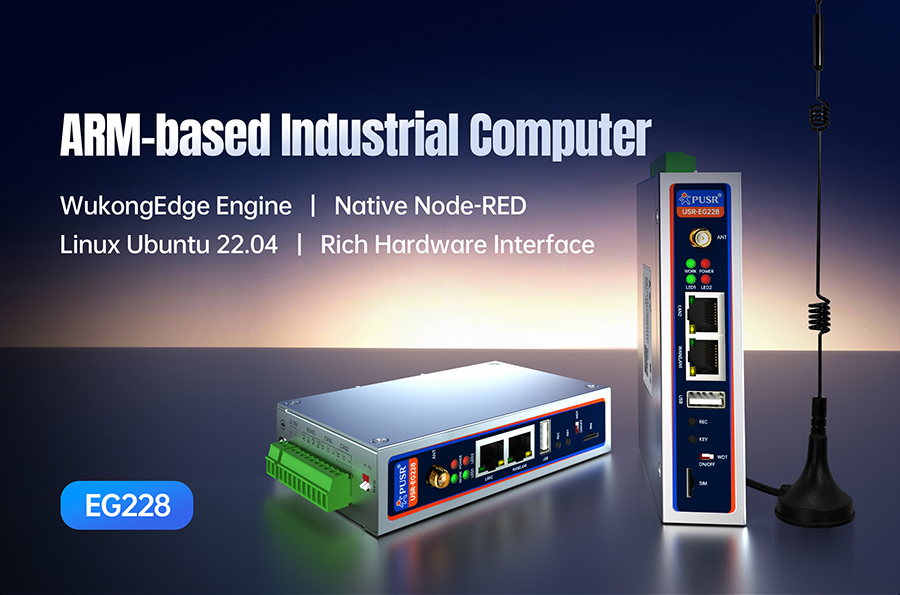
Among numerous fanless industrial PCs, the USR-EG228 stands out as an ideal choice for AGV users with its "extreme heat dissipation + anti-vibration reinforcement" design. This embedded ARM fanless industrial PC is designed for industrial edge computing, with core advantages including:
Fanless heat dissipation: Uses aluminum alloy fins + heat pipe technology to support stable operation of a 65W TDP processor in a 55°C environment.
Anti-vibration reinforcement: Triple protection with soldered-on memory, wide-temperature solid-state drives, and anti-vibration brackets, with shock resistance up to 5g.
Compact design: Small size of 212×165×63mm, easy to embed in the narrow space of AGVs.
Low power consumption and high performance: RK3506J triple-core processor + 512MB memory, meeting AGV navigation and path planning computing needs.
Tests by an AGV manufacturer show that AGVs equipped with the USR-EG228 can operate continuously for 30 days in high-temperature, high-vibration environments with a crash rate of 0 and maintenance costs reduced by 60%.
In the competition of intelligent manufacturing, the stability of AGVs has become a key indicator of a company's core competitiveness. Although heat dissipation and anti-vibration design are "hidden technologies" of fanless industrial PCs, they directly determine whether AGVs can operate stably in complex environments over the long term.
For AGV users, choosing a "crash-free fanless industrial PC" is not only protection for equipment investment but also a guarantee for production efficiency, order delivery, and brand reputation. Products like the USR-EG228 are turning "stability" from a slogan into reality through technological innovation, injecting strong momentum into the popularization and upgrading of AGVs.
In the future, with the deepening of Industry 4.0, AGVs will face harsher challenges—higher temperatures, stronger vibrations, and more complex scenarios. The continuous evolution of heat dissipation and anti-vibration technologies will undoubtedly safeguard the "stable path" of AGV.

















