When deploying edge computing for the first time, the wrong device usually isn't about slow chips or unsupported protocols—it's about basic deployment conditions that were never verified upfront.
A factory installed a gateway alongside its production line and saw frequent restarts within three months. Opening the cabinet revealed the real issue: interior temperatures exceeded 70°C during peak summer, far beyond what the gateway's cooling could handle. The problem wasn't software, wasn't protocol, was temperature. This kind of "software-first, hardware-second" thinking is common in the early stages of edge computing projects.
Here are ten questions to help sort through the critical parameters before purchasing an industrial gateway.
Industrial environments and data centers are worlds apart. Vibration, dust, electromagnetic interference, unstable power—these factors' impact on equipment stability is often underestimated.
A gateway's operating temperature range determines whether it can run reliably at the deployment site over the long term. Wide-temperature design is a baseline requirement for industrial gateways; an operating range of -25°C to 75°C covers most manufacturing scenarios. When confirming the temperature range, also consider the installation location—if the gateway sits inside an enclosed cabinet, summer heat dissipation will be worse than the nominal spec.
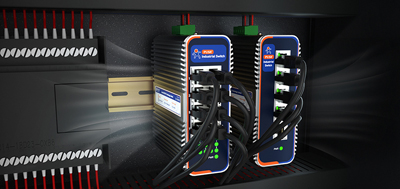
DIN rail mounting and wall mounting are the two most common installation methods for industrial gateways. The chosen mounting method directly affects on-site wiring, cabinet space, and maintenance convenience.
Mounting isn't a minor option. Choosing the wrong one will show up immediately as installation headaches and project delays.
One of the core tasks of an edge gateway is collecting data from various devices. Serial ports (RS232/RS485) connect to PLCs, sensors, and meters; Ethernet ports connect to upstream systems or cloud platforms.
The USR-M300, for example, comes with one RS232/485 port, one RS485 port, one WAN/LAN port, and one LAN port. The number of ports should be confirmed against the actual number of devices to be connected on-site—leaving one extra Ethernet or serial port often avoids additional procurement during later expansion.
An edge gateway is not a data transparent-transmission device. Local processing capability determines whether data filtering, protocol conversion, and alarm triggering can happen at the source, reducing bandwidth consumption and cloud latency.
The USR-M300 features a dual-core processor running at up to 1.2GHz, executes Linux, and supports simultaneous data collection from serial ports, Ethernet ports, and I/O devices—up to 2,000 data points. For scenarios requiring local data aggregation or conditional logic, this level of compute is the basic entry threshold.
Node-RED is a widely used visual tool in the industrial IoT space. Data flows and automation logic can be configured by dragging and dropping nodes, allowing engineers without a programming background to get up and running quickly.
A gateway that supports visual programming means future functional adjustments don't require relying on the vendor or a third-party developer—production engineers can modify logic, add rules, and adjust workflows themselves.
MQTT is the de facto standard protocol for industrial IoT. Confirming whether a gateway natively supports MQTT, and which cloud platforms it integrates with, directly affects the development cost of subsequent integration.
The USR-M300 supports standard MQTT and TCP protocols, enabling quick connectivity to platforms such as PUSR Cloud, Alibaba Cloud, AWS, ThingsBoard, and Azure. The broader the platform support, the more flexible the gateway is for future switching or expansion.
The maximum data point count is a key indicator of a gateway's throughput capacity. Requirements vary significantly by scenario—small installations may need only a few hundred points, while medium-sized production lines may require thousands.
The USR-M300 supports concurrent collection of 2,000 data points, which is generally sufficient for moderate-scale device connectivity. If many devices need to be connected on-site, confirm the gateway's concurrent processing capability—not just the theoretical maximum.
DI (digital input), DO (digital output), AI (analog input), and AO (analog output) are the most commonly used I/O types in industrial settings.
The USR-M300 natively provides 2 DI channels, 2 DO channels, and 2 AI channels (current type). If temperature, pressure, or other analog signals need to be collected on-site, these interfaces accept direct connections, eliminating the need to purchase separate acquisition modules.
Power outages are not uncommon in industrial environments. Whether a gateway can automatically boot and resume normal operation after power is restored is one of the most frequently overlooked issues in real-world deployment.
Confirm that the gateway supports power-loss auto-recovery—meaning it runs automatically after power is reapplied, with no manual intervention required. This is especially critical for unattended sites.
Certifications are more than documents—they're proof that a product has passed relevant tests during its design phase. Different markets and industries require different certifications:
The USR-M300 has passed 3C, CE, FCC, ROHS, WEEE, and other certifications, and complies with the EU EN 18031 cybersecurity standard. Choosing products certified for your target market helps avoid downstream compliance risks.