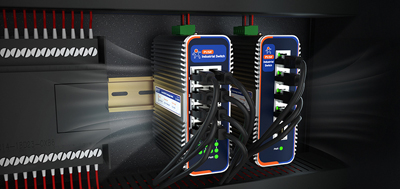
4G Lte Router are key devices in the industrial Internet of Things. They enable wireless data transmission on the industrial site through built-in
4G communication modules, providing stable and high-speed network connectivity for various networking applications. This article will analyze the functions of
4G Lte Router in detail and introduce how to accurately select models based on business needs.
The main functions of 4G Lte Router
Data Collection and Transmission:
4G Lte Router can collect data from on-site devices through various interfaces such as serial ports and Ethernet.
Data is sent to the remote platform wirelessly through the built-in 4G module to ensure real-time and accurate data.
Data processing:
The router has data caching, security verification and other functions to ensure the integrity and security of data transmission.
Some routers also have data analysis and prediction capabilities, using big data and artificial intelligence technology to optimize equipment operation.
Remote monitoring and control:
Users can remotely monitor and control the industrial site through terminal devices such as mobile phones and computers.
The router supports remote control functions, such as remote switch and valve adjustment, to achieve efficient and convenient management.
Abnormal alarm:
The system monitors the status of the equipment in real time through algorithms, and triggers an alarm immediately if abnormal data is detected or if the preset threshold is exceeded.
Alarm information can be notified through multiple channels such as SMS, email, and WeChat to ensure that problems are addressed in a timely manner.
Parameter configuration and status monitoring:
Users can remotely configure the router's parameters, such as APN and heartbeat packets.
The router supports status monitoring functions, monitoring signal strength, data traffic, and other status to ensure transmission quality.
Remote maintenance and fault diagnosis:
The router supports remote maintenance and fault diagnosis, reducing the time and cost of on-site maintenance.
The intelligent operation and maintenance mode improves the reliability and stability of the equipment.
Industrial-grade protection features:
The router has industrial-grade protection features such as anti-interference and high and low temperature resistance, making it suitable for use in various harsh environments.
It provides stable and reliable communication support for outdoor or industrial environments.
How to accurately select models based on business requirements
Define business requirements:
First, it is necessary to clarify the specific requirements of the project, including data transmission rate, interface type, operating temperature range, and so on.
For example, in the outdoor industrial production projects in the northeast region, routers that can adapt to the low temperature environment of -40 °C need to be selected.
Consider operator compatibility:
Select a router that supports the corresponding network standard based on the network conditions of the operator in your area.
Generally, routers that support multi-mode and multi-frequency, such as five-mode and twelve-frequency, are selected to meet the needs of most projects.
Pay attention to the data transmission speed:
Ensure that the router can provide high-speed and stable network connections to meet the efficiency and real-time requirements of data transmission.
Especially in projects with high requirements for data transmission rate, it is necessary to choose a router with a high transmission rate.
Assess the stability of connection and the capacity of the belt machine:
Pay attention to the maximum number of connections and connection stability of the router to ensure that it can support multiple devices connected simultaneously.
In large-scale projects or environments with many connected devices, it is necessary to choose a router with a high capacity.
Consider remote management and monitoring functions:
Choose a router with remote management and monitoring capabilities to facilitate remote monitoring, configuration, and management of devices at any time.
This helps improve production efficiency and facilitate troubleshooting.
Focus on durability and reliability:
The router should have good durability and reliability, and be able to adapt to the harsh conditions of the industrial environment.
The product structure should be sturdy and durable, with dustproof, waterproof, vibration-proof and other characteristics.
Consider after-sales service:
Choose brands and manufacturers with good after-sales service to ensure timely technical support and maintenance services during use.
4G Lte Router play an important role in industrial IoT. By analyzing its functions in detail and selecting the right model based on business requirements, we can ensure the smooth progress of the project and the stable operation of the equipment.