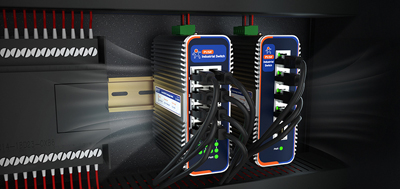
In the complex network architecture of the Industrial Internet of Things (IIoT), cross-subnet communication is a common and crucial requirement. Different devices are often distributed across various subnets. To enable data interaction and collaborative work among these devices, the cellular gateway, a core device, is indispensable. This article will delve into how a cellular gateway achieves cross-subnet communication from the perspective of seasoned industry experience.
A cellular gateway is a networking device specifically designed to convert different types of network connections in industrial scenarios, thereby facilitating communication and interconnection between diverse networks. It acts as a bridge, connecting otherwise isolated subnets, enabling various network devices in industrial settings to communicate with each other and facilitating the monitoring and management of the entire system.
In the IIoT, the cellular gateway serves as the connection hub between field devices and system platforms. It can connect to different network protocols, linking devices such as sensors, meters, and PLCs in the industrial field to the gateway through industrial bus interfaces (e.g., RS485, CAN), wireless interfaces, or network interfaces. Subsequently, it transmits the collected data to the system platform via 4G/5G, industrial bus interfaces, or network interfaces, achieving data interconnection and maximizing the value of the data.
In complex industrial network architectures, devices are distributed across different subnets. Traditionally, modifying device IP parameters is cumbersome and may affect the stability of the existing system. The cellular gateway supports IP address cross-subnet conversion, allowing seamless connection of Ethernet communication devices in different subnets without the need for complex parameter adjustments to the original devices.
For example, in a large factory workshop, newly introduced smart sensors and existing PLCs belong to different subnets. With the help of a cellular gateway, the subnet barriers can be easily broken, enabling data interaction between the two and significantly enhancing the flexibility of device networking.
In addition to subnet issues, differences in communication ports often hinder device communication. The cellular gateway features communication port conversion capabilities, allowing it to adapt and convert device communication ports according to actual needs, ensuring stable data transmission even when ports are incompatible.
In enterprise informatization transformation projects, the ports of old devices may not match the requirements of new systems. By using a cellular gateway for port conversion, old devices can be seamlessly integrated into the new network, fully protecting the enterprise's previous device investments.
There are various network protocols in industrial settings, such as ModbusTCP/IP, Profinet, EtherCAT, etc. The cellular gateway acts like a "multilingual translator," capable of converting multiple different protocols into protocols that the platform can understand, enabling field devices and the platform to comprehend each other's communications and actions.
For instance, if an enterprise needs to transmit sensor data using the Modbus protocol to a control system that supports the Profinet protocol, the cellular gateway can achieve the conversion between these two protocols, ensuring accurate data transmission.
In the field of industrial automation, PLCs (Programmable Logic Controllers) are one of the core devices. When PLCs in different subnets need to exchange data, a cellular gateway is typically required to achieve cross-subnet communication.
For example, in a power plant, there is a need for cross-subnet communication among multiple PLCs. The data from 10 PLCs located in different subnets at four monitoring points (coal shed, car dumper room, boiler room #1, boiler room #2, and silo control room) needs to be transmitted to the DCS system via a cellular gateway to accomplish centralized monitoring and remote control functions.
In smart factories, a large number of smart sensors are distributed in different areas to collect various production data. These sensors are often in different subnets from the control systems. By using a cellular gateway, cross-subnet communication between them can be achieved.
For example, in an automobile manufacturing factory, smart sensors such as temperature sensors and pressure sensors in the workshop transmit the collected data to the production control system via a cellular gateway. The control system then makes real-time adjustments based on this data to ensure the stability of the production process and the quality of the products.
In some industrial scenarios, there is a need for data interaction between mobile devices and fixed systems. For example, communication between a mobile stacker-reclaimer and the control system in the main control room. Since the stacker-reclaimer is mobile, it is inconvenient to lay cables, and the IP addresses of the two systems are in different subnets. In this case, a cellular gateway can be used to achieve cross-subnet wireless communication.
The cellular gateway supports IP address cross-subnet conversion and communication port conversion, enabling communication between devices in different subnets without the need for complex parameter adjustments to the original devices. This greatly enhances the flexibility of device networking. Enterprises can flexibly adjust the network architecture according to actual needs and quickly respond to market changes.
In enterprise informatization transformation projects, the ports of old devices may not match the requirements of new systems. By using a cellular gateway for port conversion and protocol conversion, old devices can be seamlessly integrated into the new network, fully protecting the enterprise's previous device investments and reducing upgrade costs.
The cellular gateway has data collection and forwarding functions, enabling it to collect data sent by external devices in real time and transmit it to the host computer for processing. Meanwhile, it can store the collected data in its own memory during network outages, forming a dual backup with the platform. When the network communication is restored, it can actively upload the data from the moment of disconnection to the platform, ensuring the integrity of the platform's basic data and thus improving system stability.
The cellular gateway can provide various security measures, such as encrypted data transmission and prevention of network attacks, ensuring the security and reliability of its information. In the IIoT environment, data security is of utmost importance. The security protection functions of the cellular gateway can effectively protect the enterprise's core data from leakage and tampering.
As a core device for achieving cross-subnet communication in the IIoT, the cellular gateway provides reliable solutions for communication between devices in different subnets through core technologies such as IP address cross-subnet conversion, communication port conversion, and protocol conversion. It plays a crucial role in typical application scenarios such as PLC cross-subnet communication, cross-subnet communication between smart sensors and control systems, and cross-subnet communication between mobile devices and fixed systems. Its advantages in enhancing network flexibility, protecting device investment, improving system stability, and enhancing data security make the cellular gateway an indispensable device in the IIoT field. With the continuous development of the IIoT, the application prospects of the cellular gateway will be even broader.