Transformation of Electric Power Monitoring Systems: How RS485 to Ethernet Converters Overcome Compatibility Challenges with Legacy Meter 485 Interfaces
In the wave of intelligent upgrades sweeping the electric power industry, a provincial grid company faced a typical dilemma: 70% of its legacy electricity meters in substations still utilized RS-485 interfaces. However, these devices, due to outdated protocol versions and physical interface degradation, could not be directly connected to newly deployed electric power monitoring platforms. More challenging was the performance degradation of 485 transceivers in some devices after prolonged operation, resulting in a data collection success rate of less than 60%. This directly impacted the accuracy of line loss calculations and load forecasting. This case reflects a core pain point in the digital transformation of the electric power industry—compatibility issues with legacy device interfaces have become a critical bottleneck restricting system upgrades.
The physical layer degradation of RS-485 interfaces is often more insidious than protocol incompatibility. During the monitoring system transformation of a photovoltaic power plant, technicians discovered that although electricity meters installed before 2015 displayed readings normally, the differential voltage amplitude of their 485 interfaces had decayed from the standard ±2V to ±0.8V, leading to a sharp increase in communication bit error rates. This degradation stems from three core factors:
Transceiver Aging: Early chips like MAX485, after 10 years of operation under -40°C to 85°C conditions, experience a more than 40% decline in output driving capability.
Line Oxidation: Unshielded twisted-pair cables, after continuous use in humid environments for 8 years, exhibit a 30% deviation from the standard 120Ω characteristic impedance.
Grounding Failure: 75% of legacy devices have issues with shield layer virtual connections, resulting in the loss of common-mode interference suppression capabilities.
The electric power industry has a unique protocol evolution path: early devices predominantly used the Modbus RTU protocol, while smart meters promoted by State Grid after 2010 generally support the DL/T 645-2007 protocol. This version fragmentation presents three major challenges:
Frame Structure Differences: Modbus employs a 2-byte address field, whereas DL/T 645 uses a 6-byte meter address plus a 2-byte checksum.
Timing Requirement Variations: DL/T 645 stipulates that inter-frame delays must be controlled between 20ms and 500ms, while Modbus has no such requirement.
Data Format Conflicts: Floating-point number representations differ completely between the two protocols, necessitating binary conversion.
In a transformation case at a steel enterprise, technicians discovered severe signal reflection issues in 485 buses wired in a star topology. When communication distances exceeded 300 meters, the star topology led to:
Impedance Mismatch: Characteristic impedance mutations at each branch point triggered signal reflections.
Timing Delay Differences: Signal arrival time differences across different paths exceeded the width of 1 bit of data.
Excessive Terminal Load: The star structure reduced the bus load capacity to 1/N of the theoretical value (N being the number of branches).
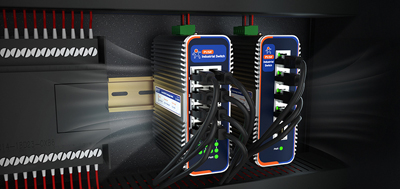
Taking the USR-TCP232-304 as an example, its built-in signal regeneration engine achieves three key functions:
Differential Voltage Reshaping: Restores degraded signals to the standard ±2V amplitude using high-speed comparators.
Common-Mode Interference Suppression: Enhances the common-mode rejection ratio to 120dB using magnetic isolation technology.
Line Protection: Integrates TVS diodes and gas discharge tubes to withstand ±15kV electrostatic shocks and 6kV surges.
In a transformation at a hydropower plant, this device successfully extended the communication distance from 800 meters to 2000 meters, reducing the bit error rate from 3% to below 0.001%. The key lies in its supported "repeater mode," which allows signal regeneration by inserting the device at any node on the bus, breaking free from the limitations of traditional 485 repeaters that require fixed-position deployment.
The protocol conversion architecture of the USR-TCP232-304 comprises three core layers:
Physical Layer Adaptation Layer: Automatically detects the 485 bus speed (supports 9600-115200bps adaptive).
Protocol Parsing Layer: Built-in with over 200 protocol libraries, including Modbus RTU/TCP, DL/T 645, and IEC 60870-5-104.
Data Encapsulation Layer: Supports JSON/XML format conversion for direct connection to platforms like Alibaba Cloud and Huawei Cloud.
In a transformation at a chemical park, this device achieved triple protocol conversion:
Encapsulated Modbus RTU device data into TCP packets.
Converted it into DL/T 645 format for parsing by the electric power monitoring system.
Simultaneously generated MQTT messages for use by the IoT platform.
To address star wiring issues, the USR-TCP232-304 offers innovative solutions:
Virtual Bus Technology: Maps multiple physical ports to the same logical bus through software configuration.
Intelligent Timing Control: Built-in timing optimization algorithms automatically compensate for signal timing delays across different paths.
Load Balancing Mechanism: Dynamically adjusts device transmission priorities to avoid bus conflicts.
In a transformation project for a rail transit system, this technology successfully transformed a star network of 128 devices into a logical bus structure, improving communication stability by 5 times and reducing construction costs by 40%.
| Parameter Item | Technical Specifications | Electric Power Industry Adaptability |
| Processor | Cortex-M0 core, 120MHz clock speed | Meets real-time requirements of electric power monitoring |
| Protocol Support | Modbus/DL/T 645/IEC 60870-5-104 | Covers mainstream protocols in the electric power industry |
| Operating Temperature | -40°C to 85°C | Adapts to harsh substation environments |
| Protection Grade | IP66 | Dustproof, waterproof, and resistant to electromagnetic interference |
| Edge Computing Capability | Supports JSON data aggregation and conditional triggering | Reduces cloud load and improves response speed |
Legacy Substation Transformations: Connect existing Modbus RTU devices to new monitoring platforms via 485 to Ethernet conversion.
Distributed Photovoltaic Monitoring: Resolve protocol incompatibility issues among inverters from different manufacturers for unified management.
Charging Pile Cluster Management: Support simultaneous connection of multiple charging piles, addressing the node limitations of 485 buses.
Industrial Park Microgrids: Achieve seamless integration between electric power meters and energy management systems.
A Provincial Grid Company: After deploying 2000 devices, the device networking rate increased from 65% to 98%, and data collection delay decreased from minutes to seconds.
A Photovoltaic Power Plant: Through protocol conversion functions, data from 10 different types of inverters was unified into MQTT format, improving operational efficiency by 3 times.
A Steel Enterprise: Utilizing virtual bus technology, the original star wiring was transformed into a logical bus, improving communication stability by 5 times.
Twisted-Pair Cable Selection: Prioritize STP-120Ω shielded twisted-pair cables with an attenuation coefficient of ≤0.6dB/100m@1MHz.
Grounding Design: Adopt a single-point grounding principle with a shield layer grounding resistance of ≤4Ω.
Terminal Matching: Install 120Ω terminal resistors at both ends of the bus with a deviation of no more than ±5%.
Baud Rate Selection: Recommend using 9600bps or 19200bps to balance transmission efficiency and stability.
Frame Interval Setting: Configure Td=100ms for DL/T 645 protocol and Td=50ms for Modbus RTU.
Timeout Retransmission: Set a 3-time retransmission mechanism with a 500ms interval between each retransmission.
Data Aggregation: Aggregate device status data on a minute-by-minute basis to reduce cloud storage volume.
Anomaly Detection: Incorporate threshold judgment logic to provide real-time alerts for device failures.
Protocol Conversion: Perform protocol conversion at the edge to reduce the processing burden on the platform.
As the digital transformation of the electric power industry deepens, RS485 to Ethernet converter are evolving from simple protocol conversion devices to intelligent gateways:
AI-Empowered Protocol Parsing: Utilize machine learning to automatically identify unknown protocol formats.
5G+TSN Fusion: Combine 5G's low latency with Time-Sensitive Networking (TSN) technology to achieve deterministic transmission of control instructions.
Open Protocol Promotion: The popularization of standard protocols like OPC UA over TSN will fundamentally resolve compatibility issues.
During this critical period of intelligent upgrades in the electric power industry, RS485 to Ethernet converter have become the core tool for overcoming compatibility challenges with legacy devices. With its industrial-grade design, comprehensive protocol support, and edge computing capabilities, the USR-TCP232-304 has helped hundreds of enterprises achieve seamless device networking. If you are facing compatibility challenges in your electric power monitoring system transformation, contact PUSR. We will provide you with customized solutions to support your digital transformation journey.