— Why Are More and More Stations Using It?
——An Industry Observer's Notes: On Trends, On Choices, On Those Who Are Still Hesitating
In the second half of 2024, I started noticing a shift.
It wasn't a policy document. It wasn't a tech forum. It was the substation O&M managers I talk to — their procurement lists started frequently featuring the same combination:5G module + cellular router.
Three years ago, you mentioned 5G to them, they shook their heads: "Too expensive. We don't need it."
Two years ago, you mentioned 5G, they hesitated: "The tech is good, but we don't need it in our station."
One year ago, you mentioned 5G, they started asking: "Which brand of 5G cellular router works best with 5G?"
Now? They don't ask anymore. They just place the order.
This shift didn't happen overnight. There's a complete logic behind it. Today's article isn't about technical specs. I'm not going to give you a comparison table. I want to talk about three "truths" — about 5G, about 5G cellular routers, and about why they ended up together.
If you're considering substation smart retrofit, if you're hesitating between 5G and 4G, if you think "a 5G cellular router is just a router" —
This article is written for you.
Let's start with a common misconception.
When people hear 5G, the first reaction is usually — "Isn't 4G good enough? Why switch to 5G?"
That question has it backwards.
5G isn't here to replace 4G. 5G is here to liberate your networking mindset.
What do I mean?
Think about it. Over the past ten years, how has remote communication in substations been done? Pull fiber. One fiber from the main station to the ring main unit, then from the ring main unit to the box transformer, then from the box transformer to the terminal… Pull one by one, splice one by one, maintain one by one.
High cost aside, the key problem is —you're chained to the "wire."
Where the fiber can't reach, you have no network. Where the fiber breaks, you lose connection. All your smart devices have to revolve around that fiber.
5G doesn't change the "speed." It changes the fact thatyou no longer need that wire.
Main station to ring main unit? No fiber needed — 5G wireless backhaul. Ring main unit to box transformer? No fiber needed — 5G wireless backhaul. Box transformer to sensor? Still no fiber — 5G.
Your network architecture goes from "wired tree" to "wireless mesh."
What does that mean? It means when you do smart retrofit, you're no longer constrained by physical lines. Want to add a monitoring point? You don't need to ask "how do I run the wire?" You just need to ask "does the signal reach there?"
That's the real value of 5G for substations — not faster, but freer.
But here's the problem.
You have the 5G signal. But who "catches" it? Who converts the 5G signal into data your on-site devices can understand? Who ensures this wireless link doesn't drop, doesn't jitter, doesn't lose packets?
5G is the antenna. The 5G cellular router is the "brain."
Without a 5G cellular router, 5G is a wire with no lightbulb — it has power, but no light.
I know what you're thinking.
"5G cellular router? Isn't it just a router that can operate in harsh environments? How different can it be?"
Hugely different.
Try plugging a 5G module into an ordinary router. Come back in three months — crashes, disconnections, reboots, and the O&M staff's phones are flooding with alarms.
Why? Because ordinary routers are designed for offices. 25°C constant temperature, clean EMI environment, stable power supply.
What's the environment in a substation?
Cabinet temperatures over 60°C in summer, minus 20°C in winter, electromagnetic noise from switchgear operations loud enough to "deafen" ordinary communication equipment, condensation causing short circuits in high humidity…
You throw an office router into that environment. If it survives one summer, consider it lucky.
So 5G landing in substations isn't a question of "can it connect?" It's a question of"once connected, can it survive?"
That's the "survive" problem that the 5G cellular router solves.
It needs to withstand high temperatures — so it needs wide-temperature design. It needs to withstand interference — so it needs EMI protection. It needs to withstand unexpected power loss — so it needs watchdogs and power-fail protection. It needs to withstand "no one to manage it" — so it needs remote management, auto-reboot, and fault self-healing.
You think it's a router. In reality, it's the "lifeline" of the 5G signal.
5G is responsible for "getting the data out." The 5G cellular router is responsible for "keeping the data alive until it reaches its destination."
Remove either one, and the link is broken.
That's why they're the "golden duo" — not because they look good together, but because neither works without the other.
Let me tell you something I saw with my own eyes.
Last summer, a rainstorm hit a provincial capital. Three 110kV substations were affected simultaneously.
Station Aused traditional fiber communication. The storm caused a cable to be dug up and severed. All on-site communication went down. O&M staff rushed to the site in the rain and spent four hours repairing the fiber. During those four hours, every smart device in the station was "offline," and the backend was completely blank.
Station Bused a 4G cellular router. During the storm, the 4G base station was also affected. The signal was intermittent, with data latency spiking to over ten seconds. The backend didn't go completely down, but the data was unusable.
Station Cused 5G + cellular router. During the storm, the 5G base station switched to backup power. The signal fluctuated for less than a minute before recovering. The cellular router automatically switched to the backup carrier link. The entire process was almost imperceptible at the backend.
Four hours vs. ten-plus seconds vs. less than a minute.
That's the difference between "fast" and "stable."
Substation communication doesn't need to be "blazing fast." Your online monitoring data, transmitted once per second vs. once every ten seconds — not much difference. Your status alarms, 500ms latency vs. 5 seconds latency — not very noticeable either.
But "down" vs. "not down" — that's the difference between life and death.
5G gives you not speed, but bandwidth redundancy — even if the primary path fluctuates, the backup link picks up the slack.
The cellular router gives you not forwarding, but link resilience — even if the device malfunctions, the watchdog auto-reboots, power-fail recovery kicks in, and you never have to go to the site.
Fast is icing on the cake. Stable is the lifeline in a snowstorm.
And the greatest value of this "golden duo" is turning your communication link from "afraid of problems" to "not afraid of problems."
You might ask: "5G + cellular router sounds great, but why has it only blown up in the last couple of years? Where was it before?"
Because three conditions all arrived at the same time in 2024.
4.1 The cost of 5G modules finally came down.
Three years ago, an industrial 5G module cost three to four times what it costs now. Back then, if you proposed a 5G retrofit for a station, the communication module cost alone would eat up half the budget. Now, module prices have dropped into a "we can afford it" range.
4.2 The capabilities of 5G cellular routers finally caught up.
Early 5G cellular routers were limited in function, complex to configure, and hard to maintain. You'd buy one and still need to hire someone to tune the parameters — get it wrong, and you have a mess. Today's 5G cellular routers are plug-and-play, remotely manageable, and auto-configuring. O&M staff don't need to understand communications to operate them.
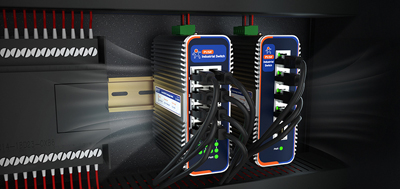
The USR-G806w that some people use is a perfect example — 4G/5G full-network compatible, automatic wired-to-wireless switching, built-in eSIM so you don't need to insert a card. Drop it in the cabinet and forget about it. It's not some "cutting-edge" device, but it hits exactly the sweet spot of "good enough, easy to use, affordable."
4.3 Policies and assessments finally forced the issue.
Provincial companies are getting more and more detailed with their KPIs on unmanned operation and smart O&M. If you don't go smart, it's not a question of "falling behind" — it's a question of "not meeting standards." And what's the foundation of smart? Communication. No communication, no smart.
Cost arrived. Technology arrived. Demand arrived. Three conditions met simultaneously — of course this "golden duo" took off.
It's not that the trend chose them. It's that they happened to be standing right at the intersection where the trend was heading.
I know what you're hesitating about.
You're thinking: "4G still works. Do I really need 5G?"
You're thinking: "There are so many brands of 5G cellular routers. Isn't one as good as another?"
You're thinking: "The project budget is already tight. Let's save where we can on communication."
I understand. Every penny has to be spent where it counts. Every decision has to stand up to scrutiny.
But let me tell you the truth —
Communication is not a place where you "save where you can." It's a place where "if you save, you'll regret it."
The money you saved on that 5G cellular router will come back to you tenfold — 2 AM emergency calls, communication outages during storms, rectification notices for failing assessments…
5G + cellular router isn't about making you "more advanced." It's about making you "more worry-free."
It won't turn your station into a sci-fi movie overnight. But it will let your O&M team finally sleep at night.
If you're still hesitating, why not start with just one point — in your next retrofit project, pick a dependable 5G cellular router, connect it to 5G, and run it for a month.
After a month, you'll have your own answer.
Trends don't wait for anyone. But trends don't lie either.