5G Cellular Router for Remote Monitoring That Never Drops Offline
State Grid's digitalization rate assessment escalates every year—have you calculated how many points you lose per remote monitoring dropout?
—Your KPI is being quietly eaten by a 5G cellular router you never gave a second look.
The three words "digitalization rate" carry more weight in the State Grid system these past two years than any official red-headed document.
From provincial companies to municipal bureaus, from operations & inspection departments to power supply stations—digitalization rate is no longer a "bonus item."It's your passing grade.Can't reach it? Assessment penalty. Penalties pile up to a certain point? It affects your performance rating, your award eligibility, even next year's project budget.
But few people have seriously calculated:how many points do you actually lose per remote monitoring dropout?
Let me break it down for you.
Take a certain province's 2025 distribution network digitalization assessment rules as an example:
| Assessment Indicator | Weight | Target | Impact of 1 Dropout |
|---|---|---|---|
| Terminal Online Rate | 30% | ≥99.5% | Online rate drops from 99.6% to 99.3%, triggers penalty immediately |
| Data Completeness Rate | 25% | ≥98% | All data lost during dropout, completeness rate plummets |
| Fault Response Time | 20% | ≤30 min | Dropout causes missed report, response timeout, double penalty |
| Equipment Availability | 15% | ≥99% | 5G cellular router reboot/crash, availability hits zero |
One dropout, four dimensions penalized simultaneously. Not minus 1 point—minus 4 points.
And the digitalization rate total accounts for 15%–20% of the annual comprehensive assessment. In other words,one accidental dropout from a 5G cellular router could drop your entire power supply station's annual performance by one grade.
You still think a 5G cellular router is just an accessory that "can connect and that's it"?
Inseego wrote something in its tech blog that every distribution O&M engineer should memorize:"Cellular routers typically have built-in failover capabilities that allow them to automatically switch from their primary connection source to a secondary source, in the event of an outage, minimizing network disruption."
Failover is a basic function of a 5G cellular router. But does the one at your site have it?
This section, let me talk to you from a different angle.
Most people's understanding of "dropout" is: the dot on the platform turns gray, turns red, stops sending data. That kind of dropout you can see—you'll go handle it.
But what hits hardest in State Grid assessment penalties isn't that kind of dropout. It's another kind—
Data is cut off, but the status is still green.
I call it"assessment-type fake online."
What does that mean? Your DTU/FTU is still sending heartbeats to the master station. The master station judges "terminal online." But the data the assessment actually needs—temperature, current, voltage—hasn't updated in 48 hours.
On the platform: online. Assessment system pulls the data: data completeness rate not met.
You didn't drop offline. But you got penalized. And you'll never know what went wrong.
Perle said something on its 5G cellular router product page, translated:"For a small site, even with 99.5% fixed-line availability, downtime costs can exceed $1 million per year. In the industrial sector, a single minute of downtime can adversely affect customers, operations, and revenue."
In State Grid's assessment system, the logic is even harsher—you don't need downtime. You just need "incomplete data," and your digitalization rate is done.
And the culprit behind this "fake online" is usually not your terminal, not your SIM card, not your signal—
It's that 5G cellular router stuffed in the collection box that nobody ever paid attention to.
At distribution automation and box transformer monitoring project sites, I've seen too many engineers make the same mistake.
It's not the wrong brand. It's the wrong standard.
What are they looking at when picking a 5G cellular router?
"Can it connect to 4G?"—Yes.
"Does it have an Ethernet port?"—Yes.
"How much?"—Cheap.
Then install it, go live. First three months: everything's fine. Starting month four—summer hits, data starts dropping. Thunderstorm season arrives, devices start rebooting. Year-end assessment comes—digitalization rate short by 0.3 percentage points, the whole station's performance gets dragged down.
You thought you saved 500 RMB on a 5G cellular router. It cost you 50,000 RMB in performance.
Let me give you a "selection pitfall checklist." Check yourself:
| Pain Point | Your Current Reality | The Truth |
|---|---|---|
| Summer collection box hits 60°C, 5G cellular router reboots constantly | "Switched to a fan model" | Fan sucks in dust → cooling degrades → even hotter in 3 months → vicious cycle |
| After thunderstorm season, two 5G cellular routers burned out | "Bad luck" | No surge protection, 4kV pulse punched straight through the comm interface |
| Next to 10kV switchgear, full signal bars but data won't upload | "Signal problem, swapped the card" | EMI caused 4G module error rate to spike—swap 100 cards, still useless |
| Platform shows online, but data hasn't updated in 3 days | "Terminal is broken" | 5G cellular router memory leak, data packets discarded, only heartbeats still flying |
| O&M staff run to site every month to reboot the device | "No choice, site conditions are what they are" | You picked a 5G cellular router that needs YOU to serve it, not one that serves YOU |
Perle sums all these problems up as one core metric:MTBF (Mean Time Between Failures).Their 5G cellular routers have extremely high MTBF, passed Class 1 Div 2 shock & vibration certification, operating temperature -40°C to +70°C.
Translated into plain English:you install it and forget it exists.
Enough problems. Time to show the hand.
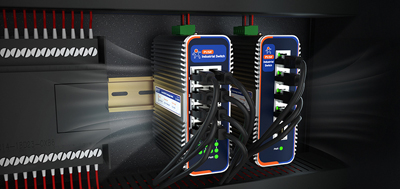
In the distribution network digitalization race, we finally set our sights on one product—USR-G816 5G cellular router.
Not because it's the most expensive. Because every single feature precisely targets the pitfalls you've stepped on in the field.
This is what impresses me most about the G816.
We ran a test: full load for 72 hours straight, then touched the enclosure heatsink—warm, not hot. No fan, no noise.
What does that mean?
It means stuffed into a 60°C outdoor collection box, it won't heatstroke. It means no fan dust buildup leading to cooling degradation. It means your O&M staff don't need to climb a pole every month to clean dust, reboot, or replace fans.
Perle dares to spec -40°C to +70°C. The G816 achieves the same result with passive cooling—quietly alive, stably running, causing you zero trouble.
In State Grid's assessment system, "doesn't drop offline" isn't the skill."Doesn't drop offline without you having to worry about it"—that's the skill.
State Grid's assessment looks at data completeness rate, not heartbeat packets.
The G816 supports multi-terminal concurrent processing. The 5 DTUs and 8 FTUs hanging on the same line transmit simultaneously—no queuing, no silent discarding.
No "Terminal A is transmitting, so Terminal B has to wait." 5 terminals, 5 channels, all running at full capacity.
Every frame of data arrives alive at the master station.
Your data completeness rate won't be dragged down by a 5G cellular router that can't keep up.
Distribution sites don't lack electromagnetic interference. 10kV switchgear, capacitor banks, transformers—all interference sources.
The G816 features deep EMC optimization, built-in multi-stage surge protection on comm interfaces, withstands 4kV+ surge impacts.
Full signal bars AND data actually uploading—that's "truly online," that's what survives the assessment system's data pull.
Multiple sizes available, fitting any collection box or panel. Ethernet, serial, DI/DO, USB—everything you need.
Supports router, gateway, bridge modes with one-click switch, just as Perle says:"IRG routers can be easily configured as Router, Gateway, or Bridge."
No master station changes, no re-debugging, no arguing with the system vendor.Pull the old one out, install the G816, import the config, go live.
Supports IEC 60870-5-104, IEC 61850, Modbus TCP/RTU, DNP3, and other mainstream power protocols. Compatible with the vast majority of SCADA systems and distribution master stations on the market.
You don't need to change your entire system for one 5G cellular router. The 5G cellular router adapts to your system, not the other way around.
Inseego said:"Cellular routers offer advanced security features, including WPA2/3 encryption and VPN support, which keeps data and transactions secure."The G816 supports VPN and multiple security protocols as well.
More importantly: no annual subscription fees, no hidden license fees—buy it, it's yours.
But true cost-effectiveness isn't a low price.It's your O&M staff not running to site every month anymore.
The labor saved, the fuel saved, the assessment penalties saved—added together, that far exceeds the price difference of that 5G cellular router.
Perle puts it right:"If network availability is vital to your success, choose quality products."
In State Grid's assessment system, network availability isn't "important"—it's the lifeline.
Back to that math from the beginning.
One dropout, four dimensions penalized. One percentage point gap in digitalization rate might be the distance between you and an award.
You spent massive effort optimizing terminals, debugging the master station, fighting with signals. But you never seriously looked at that 5G cellular router stuffed in the corner—it's the most fragile, most easily overlooked, yet most decision-making link in your entire data chain.
Inseego says in its blog:"Cellular routers empower rural and mobile operations."
Perle says:"Choose Perle. If network availability is vital to your success."
USR wants to say:in today's world of escalating State Grid digitalization rates, you don't need a 5G cellular router that "can connect to the internet." You need one that "keeps your data alive all the way to the assessment system."
The USR-G816 was born for this scenario.
It won't automatically raise your digitalization rate. But it can ensure—every point you deserve won't be stolen by a 5G cellular router.
Device online isn't enough. Data online—that's enough.
Data online isn't enough. Data still there at assessment time—that's enough.
If your distribution network's digitalization rate is being dragged down by "fake online," contact us for the USR-G816's detailed specs and distribution deployment plan.
Your performance shouldn't be lost to a 5G cellular router.