5G Industrial Network Expansion and Stable Deployment: In-depth Practice to Solve the "Last Mile" Communication Dilemma at Industrial Sites
In the wave of industrial digital transformation, 5G technology was once highly expected to "fully replace wired networks and reshape production processes". However, during its implementation, it encountered far more practical obstacles than anticipated. After attempting wireless transformation, many manufacturing and mining enterprises have found that the core contradiction on site is no longer "whether there is a network", but "whether the network can be used with confidence". The "best-effort" transmission mechanism of traditional public networks completely fails to meet the extreme requirements for communication determinism in industrial scenarios, which has become the "last mile" communication dilemma standing in the way of industrial digitalization.
The network anxiety in industrial scenarios is essentially a trust crisis caused by the lack of deterministic guarantee.
Manufacturing enterprises dare not rashly use 5G to replace wired PLC control, because even a 0.1-second delay fluctuation may trigger an emergency shutdown of the entire production line, resulting in material losses of hundreds of thousands or even millions of yuan. Mining enterprises remain cautious about wireless inspection. Once the communication signal of underground unmanned mining trucks is briefly interrupted, major safety accidents such as equipment loss of control, collision and rollover may occur. Many system integrators face repeated project delivery delays, which root in the strict customer requirement of "7×24 hours zero packet loss". However, the roaming handover time of traditional WiFi generally exceeds 500ms, which cannot meet the continuous communication needs of mobile equipment such as AGVs and robotic arms.
Behind these contradictions lies an established ironclad rule in the field of industrial control: the core links of production must meet the stringent standards of delay ≤ 10ms, reliability ≥ 99.999%, and link handover ≤ 50ms. The transmission logic of ordinary public networks is completely incompatible with such deterministic requirements, leaving many enterprises in a dilemma of "wanting to go wireless but daring not to do so".

With the implementation of the 3GPP Release 16 standard, industrial 5G has officially evolved from the general scenario of "enhanced mobile broadband" to the Industrial Deterministic Network (IDN) oriented to the core links of production. Through a complete technical architecture, it fundamentally breaks the inherent perception that "wireless is unreliable":
5G LAN: Implements Layer 2 networking and direct terminal connection, eliminating the need for additional IP routing and forwarding. It enables industrial equipment such as PLCs, AGVs and vision cameras to be in the same communication network segment, completely removing the performance bottleneck caused by gateways and significantly reducing end-to-end delay.
Network Slicing: Creates completely isolated virtual private networks for different services. Each slice exclusively occupies bandwidth and dedicated QoS policies. The production control slice can stably achieve a 5ms delay and a 10⁻⁶ order of magnitude bit error rate. Meanwhile, it operates in parallel with the high-bandwidth video surveillance slice without interference, truly realizing "one network for multiple uses and service isolation".
UPF Sinking + MEC: Deploys the user plane function directly at the edge node inside the factory area. All production data is processed locally without being uploaded to the remote public network. The end-to-end delay can be reduced from 80ms of the traditional public network to 8ms, fully meeting the high-precision requirements of multi-robotic arm collaborative control.
Full Mesh Core Network: The control plane and user plane nodes are fully interconnected. In case of a single-point fault, millisecond-level automatic path migration can be realized. The overall system availability is directly increased to 99.999%, completely avoiding the full-network service interruption caused by a single-point fault.
5G + Wi-Fi 6 Multi-network Redundancy: Adopts a dual-channel parallel access architecture. Through intelligent algorithms, it predicts changes in signal quality in real time. When the 5G signal attenuates, the Wi-Fi 6 link can take over seamlessly with a handover time of less than 30ms, ensuring zero service interruption throughout the process.
The key breakthrough of this technical system lies in completely breaking away from the idea of "transforming industry with general-purpose 5G", and instead reconstructing network capabilities around the deterministic requirements of industrial production. Network slicing + 5G LAN solves the problems of isolation and low latency in multi-device co-network collaboration. UPF sinking + MEC realizes the security requirement of "core production data not leaving the factory". The multi-network redundancy mechanism adds a "never drop" double insurance for industrial communication.
Multiple benchmark projects selected in the "2025 Typical Application Practices of 5G Factories" issued by the Ministry of Industry and Information Technology have verified the feasibility of this technical path with solid operational data, and let the industry see the real value of 5G industrial networks:
In the scenario of flexible production line changeover, 28 workstations are connected through 5G LAN, paired with an AI adaptive scheduling system. The production line changeover time is reduced from the traditional 30 minutes to 3 minutes, and the overall production efficiency is increased by 95%. In the scenario of industrial visual quality inspection, relying on the 5G+MEC edge AI analysis capability, all high-definition inspection images are processed locally in the factory. The inspection efficiency is increased by 20%, the misjudgment rate is less than 0.01%, and the product yield stably reaches more than 99.9%. In the scenario of unmanned mining truck scheduling, the 5G private network, combined with centimeter-level high-precision positioning technology, achieves 100% networking rate of underground equipment, and the unmanned operation efficiency is directly increased by 40%. In the scenario of AGV intelligent logistics, the 5G private network covers the entire factory area and supports the collaborative operation of AGV clusters. The demand for on-site auxiliary personnel is reduced by 30%, directly driving an increase of 390 million yuan in the annual sales revenue of the enterprise.
Now a general consensus has been formed in the industry: the ultimate goal of 5G industrial networks is never to "simply replace wired networks", but to "fully surpass wired networks". After completing the wireless transformation of "cutting the tethers", the deployment flexibility of on-site equipment can be increased by 300%, and the production line transformation cycle is greatly shortened from several months in the past to several weeks, bringing enterprises flexible production capabilities that traditional wired networks cannot achieve at all.
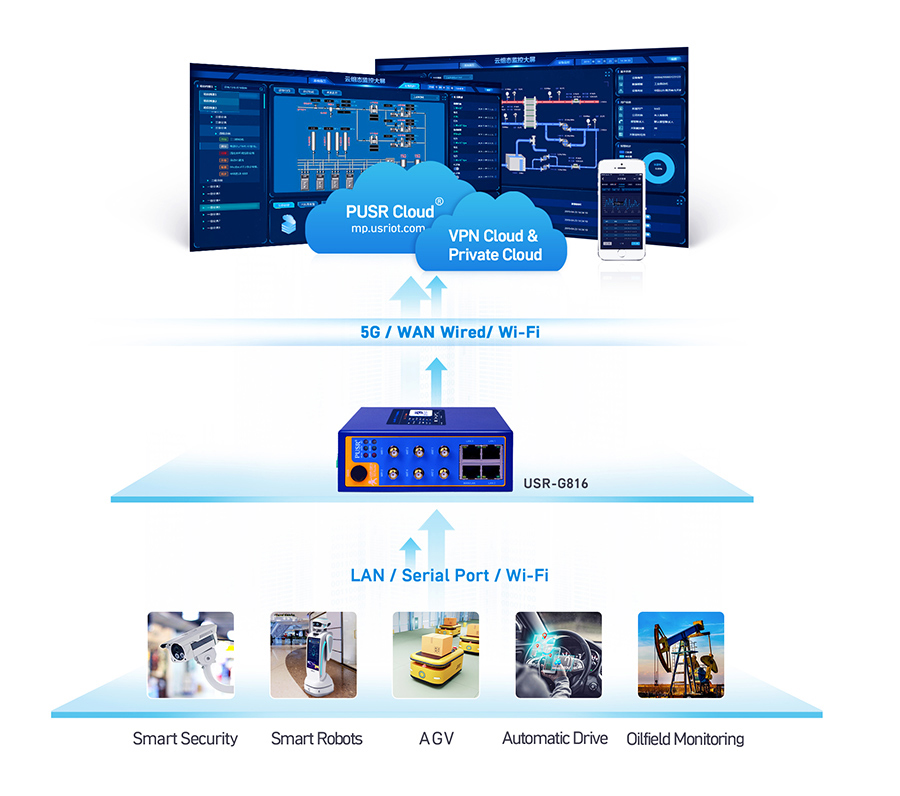
The industrial site environment is complex, and not all general-purpose 5G equipment can be directly adapted. Front-line engineers have summarized a standardized 5-step deployment specification through long-term practice to avoid communication risks from the source:
Scientific Frequency Band Planning: Prioritize the use of the 3.5GHz industrial dedicated frequency band authorized by the Ministry of Industry and Information Technology, strictly avoid the 3.4–3.6GHz interference area of satellite earth stations, and comply with the relevant requirements of the "Interference Coordination Management Measures". For indoor deployment scenarios, the Wi-Fi 6 5.8GHz frequency band can be superimposed to effectively make up for the shortcoming of 5G signal attenuation through walls, realizing no-dead-zone coverage in the factory area.
Refined Slicing Configuration: Create independent network slices for different services, bind dedicated high-reliability QoS policies to the production control slice, and directly assign the corresponding physical interfaces to the control slice, so as to ensure that the core production services always exclusively occupy network resources and are not preempted by other non-critical services.
Intelligent Multi-network Redundancy Handover: Adopt the dual-link architecture of "5G main link + wired broadband backup link". The handover logic does not rely on a simple link disconnection trigger. Instead, through continuous Ping detection, when the link packet loss rate is greater than 5% and lasts for 3 seconds, the smooth link handover is automatically completed to avoid service interruption caused by false triggers.
Full-dimensional Anti-interference Design: The equipment uses a galvanized steel plate shell with conductive sealing strips to realize metal cabinet shielding. During wiring, ensure that the distance between the 5G antenna and high-power motors is more than 3 meters, and use double-shielded network cables throughout the process. All equipment must pass the GB/T 17626 industrial electromagnetic compatibility standard certification to operate stably in industrial sites full of electromagnetic interference.
Full-lifecycle Intelligent Operation and Maintenance: Deploy a real-time network health dashboard to dynamically monitor core indicators such as bandwidth occupancy of each slice, delay fluctuation, and number of link handovers. Establish a fault self-healing mechanism. When an edge node is abnormal, the core control plane can automatically reselect the transmission path, and the service can be quickly restored without manual intervention.
In this deployment system, PUSR's 5G Cellular Router USR-G816 is the core key device supporting multi-network redundancy and stable access. It natively supports the 5G+Wi-Fi 6 multi-network redundancy architecture, which can achieve seamless handover in less than 30ms. At the same time, it is equipped with hardware-level watchdog automatic restart and dual SIM card hot backup functions. The whole device has passed strict industrial electromagnetic compatibility certification, fully adapting to complex industrial sites with metal cabinet shielding and strong electromagnetic interference. It is a reliable access carrier to solve the "last mile" communication dilemma at industrial sites.


















