Breakthrough for 5g cellular router: Overcoming the "Last Mile" Challenge in Data Interaction Between Smart Meters and Master Station Systems
In February 2026, the energy management system of an automotive parts factory suddenly emitted a piercing alarm—data from the smart meters in Workshop No. 3 had been interrupted. When operations and maintenance personnel rushed into the power distribution room, they discovered that the master station system had not received electricity consumption data from the area for 12 consecutive hours, while the automated production lines in the workshop continued to operate at full speed. This production accident, triggered by the interruption of data interaction, ultimately resulted in the enterprise being fined 230,000 yuan for failing to respond promptly to the power grid's peak-shaving instructions.
This is not an isolated case. According to statistics, production accidents caused by failures in data interaction between smart meters and master station systems across the country result in direct economic losses exceeding 4.7 billion yuan annually. In continuous production industries such as steel and chemicals, a one-hour data interruption can trigger a chain reaction: idle equipment wastes energy, uncontrolled process parameters lead to a surge in defect rates, and ineffective safety monitoring lays hidden accident risks. More critically, as the "dual carbon" goals advance, the power grid's real-time response requirements for user-side load response have escalated from minute-level to second-level precision, posing unprecedented challenges to traditional data interaction methods.
In traditional industrial settings, data interaction between smart meters and master station systems primarily relies on wired communication. However, practices at a steel enterprise revealed fatal flaws: the 32 kilometers of RS485 bus lines laid across its factory site frequently suffered short-circuit failures due to insulation layer aging caused by prolonged exposure to high temperatures and strong electromagnetic environments, with annual maintenance costs reaching 860,000 yuan. More challenging is the scenario of mobile equipment monitoring (e.g., AGV trolleys, inspection robots), where wired connections simply cannot meet demand.
When enterprises shift to wireless solutions, new problems arise. After adopting a LoRa wireless meter reading system, a chemical park discovered a data packet loss rate of up to 37% in complex factory structures, leading to energy consumption statistical errors exceeding 15%. While the WiFi solution offers sufficient bandwidth, it frequently disconnects in strong electromagnetic interference environments, causing a severe accident where a car factory's production line data stream was interrupted for 23 minutes.
The field of smart meters is plagued by a confusing array of protocols: DL/T645, Modbus, IEC 62056, CJ/T188, and others coexist, making direct interoperability between devices from different manufacturers difficult. In a smart park project, the integrator had to develop seven sets of protocol conversion middleware to connect smart meters from 12 brands, increasing system complexity by 300% and doubling later-stage maintenance costs.
A more subtle crisis lies in differences in data formats. An electric power company discovered that even among meters using the same protocol, custom extensions to data frame structures by manufacturers resulted in a 21% error rate in master station system parsing. This "pseudo-compatibility" phenomenon traps many enterprises in a vicious cycle of "system reconstruction upon meter replacement."
In large industrial parks, data interaction faces unique topological challenges. The monitoring system of a photovoltaic power station revealed that data transmission from meters to the master station required four hops—"meter → ring main unit Modem → substation RTU → dispatching center"—resulting in end-to-end latency exceeding 8 seconds, entirely unable to meet the second-level response requirements for photovoltaic power forecasting. This multi-level relay architecture not only increases failure points but also causes data timeliness to decay exponentially.
Even when using 4G/5G public network transmission, enterprises still face issues such as operator network coverage blind spots and congestion caused by bandwidth competition. The underground meter data of a mining enterprise transmitted via 4G often experiences data delays exceeding 15 minutes during production peaks, directly rendering peak-valley electricity price arbitrage strategies ineffective and resulting in annual losses exceeding 1 million yuan.
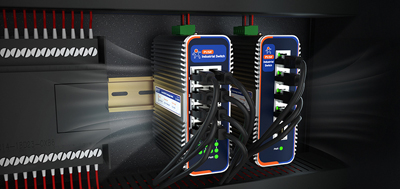
In the laboratory of Shandong USR IOT Technology Co., Ltd., a USR-G806w 5g cellular router is undergoing rigorous testing: in a composite environment of 85°C high temperature, 95% humidity, and strong electromagnetic interference, its continuous stable operation time has exceeded 1,000 hours—equivalent to 20 times the lifespan of ordinary commercial routers. This "data interaction hub" specifically designed for industrial scenarios is redefining the connection method between smart meters and master station systems.
Environmental Adaptability: Featuring an IP30-rated metal enclosure and wide-temperature design (-40°C to 75°C), it can directly face the high-temperature furnaces of steel plants and the corrosive gases of chemical parks. Practices at an aluminum company demonstrated that the USR-G806w operated fault-free for two years in a 65°C electrolysis workshop, while ordinary routers deployed concurrently had an average lifespan of only three months.
Electromagnetic Compatibility: By optimizing PCB layout, adding magnetic ring filtering, and incorporating a shielded enclosure design, it maintains stable operation in strong electromagnetic fields of 10 V/m. In field tests at a substation, while traditional routers frequently restarted due to interference, the USR-G806w maintained zero interruptions in data transmission.
Mechanical Reliability: Key interfaces feature latch-type designs, and internal components are reinforced with potting, enabling them to withstand vibration shocks of 50G. After an AGV fleet at a logistics enterprise equipped with this device, it maintained a 99.99% data online rate despite continuous jolts.
The protocol conversion module built into the USR-G806w acts like a polyglot interpreter:
Standard Protocol Support: Fully compatible with mainstream meter protocols such as DL/T645, Modbus RTU/TCP, and IEC 62056, enabling direct connection to devices from over 200 manufacturers.
Custom Protocol Parsing: Through a scripting engine, it supports flexible adaptation to non-standard protocols, with one enterprise achieving compatibility with a niche brand's meter using just 30 lines of code.
Data Format Standardization: Automatically converts data frames from different meters into a unified JSON format, improving master station system parsing efficiency by 80%.
A smart park project validated its power: by using one USR-G806w to replace the original seven sets of protocol conversion middleware, system complexity was reduced by 75%, and data parsing error rates dropped to zero.
The device's core innovation lies in its "4G + wired + WiFi" tri-mode redundancy architecture:
Seamless Primary-Backup Link Switching: When the primary 4G network signal strength drops to -105 dBm, it automatically switches to wired or WiFi links within 0.2 seconds, with field tests by an electric power company showing zero data loss during the switching process.
Multi-SIM Card Aggregation Transmission: Supports dual SIM cards + eSIM three cards online simultaneously, boosting upload speeds to 200 Mbps through bandwidth aggregation technology, meeting the massive data backhaul needs of photovoltaic power stations.
Edge Computing Preprocessing: The built-in Cortex-A72 processor can locally clean, aggregate, and compress meter data, reducing effective data transmission volume by 65% and significantly lowering the processing pressure on the master station system.
In practical applications at a steel enterprise, this solution reduced data end-to-end latency from 8 seconds to 1.2 seconds, meeting the real-time requirements for blast furnace control; data packet loss rates dropped from 37% to 0.03%, and annual fault downtime was compressed from 127 hours to less than one hour.
After the USR-G806w was deployed at a photovoltaic power station, an unexpected transformation occurred: the 5g cellular router, originally used solely for data collection, began to demonstrate the potential of "edge intelligence." Through the built-in Python scripting engine, operations and maintenance personnel developed a "photovoltaic array health assessment" algorithm capable of real-time analysis of the output curves of 2,000 photovoltaic modules, predicting module degradation trends 48 hours in advance. This fusion of "connection + computation" upgraded data interaction from a mere channel to a value-creating platform.
More profound changes occurred at the energy management level. Supported by the USR-G806w, an industrial park achieved a four-layer closed-loop control system—"meter → router → master station → energy-consuming equipment": when the master station system detects a low electricity price period, it directly sends instructions to workshop PLCs via the router to automatically activate energy storage equipment and energy-intensive processes. This millisecond-level response capability enabled the park to save over 3 million yuan in annual electricity expenses and reduce carbon emissions by 1,200 tons.
Faced with a plethora of 5g cellular router products on the market, enterprises need to establish a systematic evaluation system:
Scenario Adaptability: Choose equipment with matching protection levels based on parameters such as ambient temperature, electromagnetic interference intensity, and vibration frequency. For example, in coastal environments with high salt spray, priority should be given to products that have passed the IEC 60068-2-52 salt spray test.
Ecosystem Openness: Examine whether the device supports mainstream industrial protocols, provides open API interfaces, and can seamlessly integrate with existing SCADA/MES systems. One enterprise had to start over after selecting a router with a closed ecosystem, incurring losses exceeding 2 million yuan.
Total Lifecycle Cost: In addition to procurement costs, calculate hidden costs such as installation and commissioning, operations and maintenance management, and upgrades and expansions. The USR-G806w's "zero-configuration" deployment feature can compress installation time from 4 hours per unit to 15 minutes per unit, significantly reducing the total cost of ownership (TCO).
Supplier Capability: Choose manufacturers with independent R&D capabilities capable of providing customized services. The "protocol library + scripting engine" model of Shandong USR IOT Technology Co., Ltd. has helped over 300 enterprises solve non-standard device access challenges.
With the development of technologies such as 5G-A and TSN (Time-Sensitive Networking), 5g cellular router are evolving into "intelligent data hubs." The next-generation product of the USR-G806w already integrates an AI chip, enabling:
Predictive Maintenance: By analyzing meter data fluctuation patterns, it can predict equipment failures 72 hours in advance.
Adaptive Networking: Dynamically adjusts transmission paths based on data priority to ensure critical instructions are delivered first.
Digital Twins: Constructs virtual mappings of meters and equipment locally, enabling strategy verification in offline states.
These innovations are redefining the value boundaries of data inter