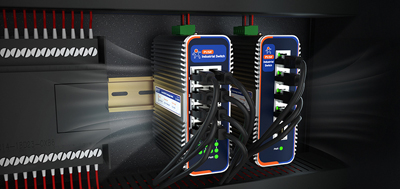
A 1-hour food production line shutdown costing $100,000? The problem may not be your equipment—it's your data link.
In the food manufacturing industry, a medium-sized automated line can produce several tons per hour across baking, beverage filling, meat processing, and other segments. Many plant managers have experienced this: equipment is regularly maintained, core motors and drives are running healthily, yet the line suddenly stops without warning, losing over ¥100,000 in an hour. After lengthy troubleshooting, they finally discover the root cause isn't the equipment itself—it's a hidden fault buried in the data link.
The cost of a food production line shutdown is never just "one less hour of output." Take a medium-sized beverage filling line as an example: when an unplanned stop occurs, the first hit comes from work-in-progress scrap on the entire conveyor line. Filled beverages left outside the sterile environment beyond the specified time no longer meet food safety standards and must be discarded entirely. Prepared raw materials sitting stagnant in pipes can precipitate or spoil, requiring full flushing and cleaning—material losses alone can exceed $3,000. Then there are restart costs: food lines require sterile disinfection, parameter recalibration, equipment preheating, and other procedures, typically taking 2–3 hours—far longer than the downtime itself. Add labor waiting costs and penalties for delayed orders, and the total loss from a one-hour shutdown can easily surpass $10,000.
When maintenance teams troubleshoot, their first instinct is to check motors, sensors, and PLCs—overlooking the "invisible link" of the data network. We worked with a leading bakery company that experienced 11 unexplained short stoppages last year. Each investigation found no equipment issues. The root cause turned out to be an ordinary industrial gateway connecting line equipment to the SCADA system—it intermittently disconnected under the plant's high-temperature, high-humidity conditions, causing the system to misinterpret equipment status and trigger an emergency stop. Those 11 stoppages cost the factory over $0.2 million in direct losses, all traced to an overlooked edge communication node.
Food production environments are far more complex than most ordinary manufacturing settings: plants are hot and humid year-round, with steam, oil fumes, and corrosive food-additive dust in some areas. Equipment brands and protocols are fragmented—imported fillers sit alongside domestic packagers and sterilizers from different eras, with completely inconsistent communication standards. Meanwhile, strict traceability compliance requires complete retention of all production data without any gaps. These unique conditions make ordinary industrial gates a weak link in the data chain.
Many ordinary gateways are designed for standard dry workshops. In the hot, humid food production environment, they develop oxidized interfaces and moisture-damaged PCBs within months. One meat processor encountered this: summer workshop temperatures hit 40°C with over 90% humidity. After three days of continuous operation, the gateway overheated and crashed, preventing sterilizer temperature data from reaching SCADA. The system automatically triggered a shutdown that lasted over 2 hours. Post-incident testing revealed the gateway's maximum operating temperature was only 55°C, with no moisture or dust protection—it simply couldn't handle the harsh conditions.
Food lines are upgraded year by year; a single line might have an older packager from 2015, an imported filler from 2020, and a smart inspection device added in 2023—each with vastly different protocols. Many gateways claim support for hundreds of protocols, but on-site, proprietary protocols of legacy equipment are often only partially adapted, reading only some operating data without full interaction. One beverage plant lost over ¥100,000 when a gateway couldn't fully read filler level data—the system mistakenly thought the tank was empty, stopped raw material feeding, and caused a 1+ hour outage.
Food traceability regulations require 100% complete retention of critical production data—temperature, time, batch IDs, etc. Any gap renders a whole batch unable to produce a compliant traceability report; in severe cases, product recalls are required. Many gateways lack local cache for network outages—during even a brief network glitch, in-flight production data is simply lost. One bakery experienced a 3-second network flash, the gateway had no cache, and the day's 5 tons of bread couldn't be traceability-certified—all destroyed, a loss exceeding $100,000.
To prevent such data-link-induced unplanned stops, the core solution is selecting an IoT gateway device truly suited to food production line conditions—building a robust data link from three dimensions: hardware reliability, protocol adaptation capability, and data caching mechanisms.
① Hardware must meet the special environmental requirements of food plants:
support wide-temperature and wide-voltage operation, achieve IP30 or higher protection ratings, with PCBs treated with moisture and dust protection (conformal coating), ensuring stable long-term operation in hot, humid, oily, dusty workshops, with a whole-unit MTBF reaching million-hour levels to avoid crashes.
② Protocol adaptation must be comprehensive enough:
not only covering common industrial protocols like Modbus and OPC UA, but also addressing proprietary protocols for common food-line equipment such as fillers, sterilizers, and packagers—out-of-the-box connectivity without hidden gaps in data read capability.
③ Large-capacity local cache is essential:
during network interruptions, all production data is stored locally; upon network recovery, automatic resume-from-breakpoint upload ensures 100% retention of all production data, avoiding both compliance risks from data loss and false system triggers caused by data disconnection.
In today's industrial gateway market, the USR-M300 IoT gateway device from Usr-IoT is a strong fit for food production line scenarios. It features comprehensive hardware reinforcement for complex industrial environments, easily handling hot and humid conditions in food plants. It fully covers mainstream protocols for various food-line equipment and supports large-capacity local cache to guarantee zero production data loss. The M300 holds over a dozen authoritative certifications, including 3C, CE, FCC, ROHS, WEEE, CTA, ANATEL, ECAS ROHS, MTC, NBTC, RCM, SRRC Type Approval, TDRA, and Cybersecurity—fully meeting food companies' dual compliance requirements for domestic production and overseas expansion.
For food manufacturers, the IoT gateway device is never an optional "little box"—it is a core node ensuring the stability of the production line's data link. Fix this hidden weak point, and you can eliminate a large number of unexplained unplanned stoppages at their source, protecting your line's profit baseline.