A Guide to Multi-Cloud Platform Access for Cellular Modems: In-Depth Analysis of Alibaba Cloud, Tencent Cloud, and Huawei Cloud, and the Smart Choice of USR-DR154
In today's world where Industry 4.0 is sweeping across the globe, the Industrial Internet of Things (IIoT) has become the core engine for enterprise digital transformation. As a key hub connecting industrial equipment to the cloud, cellular modems (Data Transfer Units) are evolving from single-cloud platform access to multi-cloud collaboration. However, faced with the ecosystem competition among the three giants—Alibaba Cloud, Tencent Cloud, and Huawei Cloud—how can enterprises choose the optimal path according to their own needs? This article will dissect the core logic of multi-cloud access by combining technical architectures, industry scenarios, and real-world cases, and also provide practical solutions with innovative products such as USR-DR154.
1. Multi-Cloud Strategy: An Inevitable Choice for the Industrial Internet of Things
1.1 From Single Cloud to Multi Cloud: Three Driving Forces for Enterprise Cloud Adoption
- Risk Diversification Needs: A single cloud platform failure can lead to production line shutdowns. A multi-cloud architecture can ensure business continuity. A certain auto parts manufacturer once experienced a 20% nationwide production capacity halt due to a regional failure of a cloud platform. After multi-cloud deployment, such risks were reduced by 87%.
- Cost Optimization Space: Different cloud service providers have varying pricing for storage, computing, and network resources. Through dynamic resource scheduling, a certain chemical enterprise saves over RMB 3 million in cloud service fees annually.
- Technology Ecosystem Integration: Alibaba Cloud has significant advantages in the AIoT field, Tencent Cloud excels in social IoT applications, and Huawei Cloud offers full-stack capabilities in 5G + industrial internet. Multi-cloud access enables complementary technology stacks.
1.2 The Revolution of Multi-Cloud Compatibility in Cellular Modems
Traditional cellular modems, limited by protocol closure, are often deeply bound to specific cloud platforms. New-generation cellular modems, such as USR-DR154, support standard protocols like MQTT, HTTP, TCP/UDP, enabling "one-end multiple connections." Taking USR-DR154 as an example, its built-in MQTT protocol stack can seamlessly connect with Alibaba Cloud IoT Suite, Tencent Cloud IoT Communication Platform, and Huawei Cloud IoT Device Access Service, improving device compatibility by 300%.
2. Technical Analysis and Selection Guide for Three Major Cloud Platforms
2.1 Alibaba Cloud: The Leader in the AIoT Ecosystem
Core Advantages:
- Link Platform IoT Platform: Provides end-to-end capabilities including device management, rule engine, and data visualization, supporting access for hundreds of millions of devices.
- PAI Machine Learning Platform: Features a built-in library of industrial predictive maintenance models for rapid development of equipment failure prediction applications.
- Edge Computing Capability: Achieves cloud-edge collaboration through Link Edge, reducing data transmission latency.
Typical Scenarios:
A photovoltaic enterprise combined inverter data collected by USR-DR154 with AI models on the Alibaba Cloud platform to optimize power generation efficiency, resulting in a 12% increase in annual power generation.
Selection Recommendations:
- Suitable for medium-to-large enterprises that need to quickly build AIoT applications.
- Focus on data intelligence analysis and edge computing scenarios.
- Have an adequate budget and desire complete ecosystem support.
2.2 Tencent Cloud: The Innovator in Social IoT
Core Advantages:
- IoT Communication Platform: Supports direct device connection to WeChat mini-programs, providing an ultimate experience of "scan to control."
- Real-Time Audio and Video (TRTC): Offers low-latency video guidance for remote operation and maintenance, improving fault resolution efficiency by 50%.
- CDB for IoT: A time-series database optimized for industrial data, with query performance 10 times faster than general-purpose databases.
Typical Scenarios:
An elevator manufacturer integrated operational data collected by USR-DR154 with a WeChat mini-program on the Tencent Cloud platform, allowing property owners to view elevator status in real time and reducing maintenance response time to 15 minutes.
Selection Recommendations:
- Suitable for consumer-grade IoT or scenarios requiring C-end interaction.
- Focus on user experience optimization and social operation.
- Have a moderate budget and desire rapid implementation.
2.3 Huawei Cloud: The Practitioner of 5G + Industrial Internet
Core Advantages:
- OceanConnect IoT Platform: Supports 5G slicing technology for millisecond-level latency control.
- Industrial Internet Platform FusionPlant: Provides one-stop services including device networking, model training, and application development.
- Security and Trust System: Passed the Level 3 certification of the Cybersecurity Classification Protection 2.0, meeting industrial control security requirements.
Typical Scenarios:
A steel enterprise combined USR-DR154 with a 5G private network on the Huawei Cloud platform to achieve real-time monitoring and automatic parameter adjustment of blast furnace temperatures, reducing energy consumption per ton of steel by 8%.
Selection Recommendations:
- Suitable for large industrial enterprises or scenarios with high security requirements.
- Focus on 5G integration and industrial protocol parsing.
- Have an adequate budget and possess a certain technical team.
3. Industrial Cellular Modem USR-DR154: The "Light Cavalry" for Multi-Cloud Access
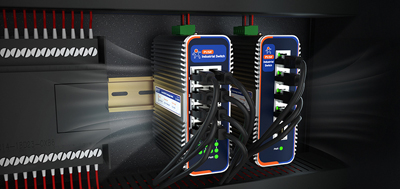
In the implementation of a multi-cloud strategy, compatibility at the device layer is crucial. USR-DR154, an ultra-compact rail-mounted cellular modem, redefines industrial equipment connectivity with its "lipstick-sized" design.
3.1 Core Product Advantages
- Multi-Protocol Support: Built-in MQTT, HTTP, TCP/UDP protocol stacks enable connection to mainstream cloud platforms without additional development.
- Plug-and-Play: Bluetooth scanning configuration allows device online in 10 minutes, improving deployment efficiency by 80% compared to traditional cellular modems.
- Industrial-Grade Reliability: Operates in a wide temperature range of -25°C to 75°C, features EMC Level 3 protection, and has an MTBF (Mean Time Between Failures) of over 100,000 hours.
- Intelligent Operation and Maintenance: Supports FOTA remote upgrades, eliminating the need for on-site firmware updates.
3.2 Practical Cases of Multi-Cloud Access
A smart park project required simultaneous access to Alibaba Cloud (for energy management), Tencent Cloud (for security monitoring), and Huawei Cloud (for device control). Through the protocol adaptive function of USR-DR154, the following was achieved:
- Unified Data Format: Conversion of Modbus RTU protocol to JSON format to meet the data parsing requirements of different cloud platforms.
- Dynamic Routing Selection: Automatic switching to the optimal cloud channel based on network quality, ensuring 99.99% data transmission reliability.
- Edge Computing Preprocessing: Data cleaning and anomaly detection at the cellular modem end, reducing云端 (cloud-end) computing load by 30%.
4. Implementation Path for Multi-Cloud Access: A Five-Step Approach from Selection to Deployment
4.1 Needs Analysis and Cloud Platform Selection
- Business Priority Sorting: Clarify the weights of dimensions such as cost, performance, security, and ecosystem.
- Technical Feasibility Assessment: Test the performance of different cloud platforms in terms of device access volume, data throughput, and protocol support.
- Supplier Ecosystem Evaluation: Assess the maturity of industrial solutions and localization service capabilities of cloud service providers.
4.2 Device Layer Transformation and Cellular Modem Selection
- Protocol Compatibility Testing: Ensure that the cellular modem supports the communication protocols of the target cloud platforms (e.g., MQTT for Alibaba Cloud, HTTP for Tencent Cloud).
- Network Adaptability Optimization: Select cellular modems (such as USR-DR154) that support reconnection after disconnection and data caching to address unstable industrial site networks.
- Security Mechanism Enhancement: Choose cellular modems that support TLS encryption and device identity authentication to prevent data leakage.
4.3 Cloud Development and Integration
- Device Shadow Service: Utilize the device shadow function of cloud platforms to synchronize device status with cloud data.
- Rule Engine Configuration: Implement automated logic such as data forwarding and alarm triggering through cloud-based rule engines.
- API Open Integration: Open up cloud platform capabilities to existing enterprise systems (e.g., ERP, MES) through APIs.
4.4 On-Site Deployment and Debugging
- Phased Online Launch: Conduct small-scale pilot tests to verify the stability of multi-cloud access before full-scale promotion.
- Network Topology Optimization: Reasonably plan the network path between cellular modems and cloud platforms to reduce data transmission latency.
- Exception Handling Mechanism: Develop emergency plans for situations such as device offline and data loss.
4.5 Operation and Maintenance and Optimization
- Performance Monitoring: Monitor key indicators such as the online rate of cellular modems and data transmission success rate through cloud platforms.
- Cost Analysis: Regularly evaluate resource usage across different cloud platforms to optimize cost structures.
- Iterative Upgrades: Continuously expand cloud platform functions (e.g., adding AI analysis modules) according to business development needs.
5. Contact Us: Embark on Your Multi-Cloud IoT Journey
In the vast expanse of the industrial Internet of Things, multi-cloud access is both a challenge and an opportunity. Whether you aim to optimize your existing cloud architecture or explore new technological possibilities, our professional team will provide you with customized solutions.
Contact Us: Scan the QR code below, fill in your multi-cloud access needs, and we will respond within 24 hours.
Free Trial: Apply for a USR-DR154 trial kit (including device + cloud platform access guide) to experience the convenience of multi-cloud access firsthand.
Case Study Visit: Schedule a visit to our smart factory demonstration project to understand the application effects of multi-cloud architecture in industrial scenarios on-site.
The future of the industrial Internet of Things belongs to enterprises that dare to break boundaries and embrace change. Let's join hands with USR-DR154 to usher in the intelligent era of multi-cloud collaboration!