Smart Water Conservancy Water Level Monitoring: A Practical Guide to Industrial Panel PC, NB-IoT Communication, and Solar Power Supply
In the wave of smart water conservancy, water level monitoring, as a crucial link in flood control and disaster mitigation, water resource management, and ecological protection, is undergoing a profound transformation from traditional manual observation to automated and intelligent monitoring. However, in the actual deployment process, customers often face numerous challenges: How to ensure the stable operation of monitoring equipment in harsh environments that are remote, powerless, and network-less? How to reduce operation and maintenance costs while improving the real-time performance and accuracy of data transmission? This article will delve into the core pain points in smart water conservancy water level monitoring, gain insight into customers' psychological considerations before selecting monitoring equipment, empathize with the challenges they face, and then propose a practical solution based on the industrial panel PC USR-SH800 (mentioned but not aggressively promoted), combined with NB-IoT communication and solar power supply technologies, to assist customers in achieving efficient and reliable water level monitoring.
When selecting smart water conservancy water level monitoring equipment, customers primarily expect to achieve full automation monitoring, reduce manual intervention, and improve monitoring efficiency and accuracy. At the same time, they hope that the equipment can operate stably in harsh environments, possess high reliability, and avoid data loss or false alarms caused by equipment failures. Additionally, low operation and maintenance costs are also an important consideration for customers, as they expect the equipment to require minimal maintenance over extended periods, reducing human and material resource investments.
However, alongside their expectations, customers inevitably have concerns. Remote areas often lack stable network coverage, making it a significant challenge to ensure real-time and accurate transmission of monitoring data. Simultaneously, the lack of a power supply is also a challenge faced by customers, as ensuring the continuous operation of equipment without an external power source is a focal point of their concern. Furthermore, data security is an issue that customers cannot overlook, as they worry about the theft or tampering of monitoring data during transmission, which could affect the accuracy of decision-making.
Traditional water level monitoring primarily relies on manual observation, which is not only inefficient but also significantly influenced by factors such as the experience of observers and weather conditions, affecting data accuracy. Manual observation becomes even more difficult in harsh weather or at night, leading to data loss or false alarms.
Remote areas often lack stable network coverage, making it difficult for traditional monitoring equipment to transmit data to the management center in real-time. Even when connected via wired methods, challenges such as difficult wiring and high costs arise. Delayed data transmission leads to delayed decision-making, preventing timely responses to sudden water conditions.
In remote areas without an external power source, traditional monitoring equipment often relies on battery power. However, battery life is limited and requires regular replacement, increasing operation and maintenance costs. Simultaneously, battery performance is significantly affected by temperature, with performance declining in extreme weather conditions, affecting the normal operation of equipment.
Traditional water level monitoring equipment requires regular inspections and maintenance, especially in remote areas. High operation and maintenance costs not only increase the financial burden on customers but also affect the development of other businesses due to significant human and material resource investments.
To address the communication challenges in remote areas, we propose adopting NB-IoT communication technology. As a type of Low Power Wide Area Network (LPWAN), NB-IoT features extensive coverage, multiple connections, low speed, low cost, low power consumption, and an optimized architecture. It enables stable data transmission in remote areas, ensuring real-time and accurate uploading of monitoring data to the management center. Simultaneously, the low power consumption of NB-IoT modules extends equipment battery life, reducing operation and maintenance costs.
To solve the issue of the lack of an external power source, we recommend adopting a solar power supply system. Comprising solar panels, charge controllers, and batteries, the solar power supply system converts solar energy into electrical energy, providing continuous and stable power support for monitoring equipment. In sunny conditions, solar panels can quickly charge, ensuring normal equipment operation; during rainy weather or at night, batteries provide backup power, ensuring uninterrupted equipment operation. The solar power supply system is green and sustainable, eliminating the need for an external power source, reducing operation and maintenance costs, and improving equipment applicability.
In smart water conservancy water level monitoring, the industrial panel PC USR-SH800 (mentioned here solely for functional introduction, not aggressively promoted) serves as the core equipment, integrating various functions such as data collection, processing, display, and transmission. It supports the connection of multiple sensors, enabling real-time collection of water level data and uploading it to the management center via NB-IoT modules. Simultaneously, the USR-SH800 features a touchscreen display function, visually presenting water level change curves, historical data, and other information for easy viewing by on-site personnel. Additionally, it supports remote configuration and upgrades, reducing operation and maintenance difficulty and costs.
To address data security issues, we adopt encrypted transmission technology to ensure that monitoring data is not stolen or tampered with during transmission. Simultaneously, the management center implements permission management functions, allowing only authorized personnel to access monitoring data, enhancing data security. Furthermore, we regularly conduct security vulnerability scans and repairs on the system to ensure stable operation.
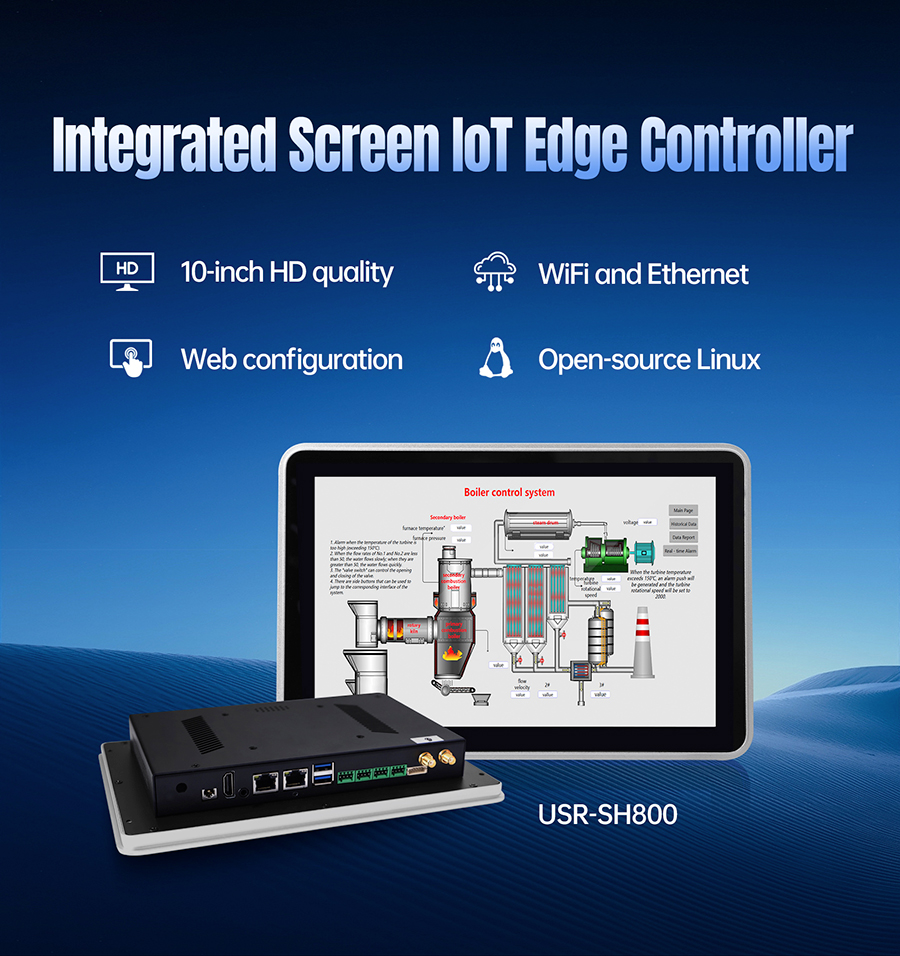
A reservoir located in a remote mountainous area traditionally relied on manual observation for water level monitoring, which was inefficient and limited in data accuracy. To improve water level monitoring efficiency and accuracy, the customer decided to adopt a smart water conservancy water level monitoring system.
We provided the customer with a smart water conservancy water level monitoring solution based on the industrial panel PC USR-SH800 (mentioned for functional introduction purposes), NB-IoT communication, and solar power supply. An industrial panel PC was installed beside the reservoir, connected to a water level sensor to collect water level data in real-time; the data was uploaded to the management center via NB-IoT modules; and a solar power supply system provided power support for the equipment.
After project implementation, the customer achieved full automation water level monitoring, reducing manual intervention and improving monitoring efficiency and accuracy. Simultaneously, NB-IoT communication technology ensured real-time and accurate data transmission to the management center, providing the customer with timely and accurate water level information. The solar power supply system was green and sustainable, eliminating the need for an external power source and reducing operation and maintenance costs. Additionally, the touchscreen display function of the industrial panel PC facilitated easy viewing of water level data by on-site personnel, improving work efficiency.
Smart water conservancy water level monitoring is an important means of flood control and disaster mitigation, water resource management, and ecological protection. By adopting industrial panel PCs, NB-IoT communication, and solar power supply technologies, we have successfully addressed challenges such as communication difficulties, unstable power supplies, and high operation and maintenance costs in traditional water level monitoring. In the future, with continuous technological advancements and expanding application scenarios, smart water conservancy water level monitoring will become more intelligent, automated, and reliable. We will continue to delve into the field of smart water conservancy, providing customers with higher-quality and more efficient solutions to jointly promote the development of the smart water conservancy industry.