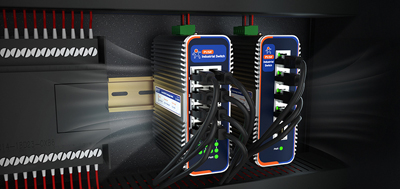
Consider a recent scenario: a newly released cellular router integrates 4G connectivity, routing, switching, and wireless access into a single DIN-rail device, with only two Gigabit ports and one PoE output. Devices like this raise a straightforward question for industrial sites: when should the all-in-one be chosen, and when is it better to deploy a router, a switch, and an AP separately?
Four Costs an All-in-One Saves
The fewer the devices, the lower the costs in four areas: installation space, cabling, power supply, and maintenance.
A typical remote deployment: a camera at a remote site. A cellular router handles the uplink, its PoE output powers the camera and carries data over the same cable, and a VPN connects the data back to the headquarters platform. The device goes into a weatherproof enclosure and sits outdoors directly — IP66-rated, wide-temperature operation, no extra cabinet. This kind of site can be delivered with a single device, skipping the cabinet, cable management, and multiple power feeds.
Two Limits of the All-in-One
Limit one: the port count is fixed. The interfaces of an all-in-one are set at the factory. The device mentioned above has only two Gigabit ports; once the PLCs, controllers, industrial PCs, and cameras at a site exceed three or four wired devices, the ports run out and a switch has to be added. As devices grow, the switch in a separate setup becomes a necessity rather than an option.
Limit two: the built-in wireless is designed to be "good enough." The AP built into an all-in-one is usually entry-level, single-band 2.4GHz. One real-world user reported: in a motorhome, streaming a 32Mbps movie over the built-in Wi-Fi played for about five seconds, then buffered for ten, and the fix was to add a dedicated AP while the all-in-one kept doing the routing. For large coverage areas or high-bandwidth wireless needs, the built-in Wi-Fi does not hold up.
Three Numbers to Count Before Choosing
① Wired endpoints: if the devices that need Ethernet ports are no more than the router's LAN ports (typically 2–4), an all-in-one suffices; if more, plan for a switch. ② Wireless endpoints and bandwidth: a few handheld terminals or sensors are fine with built-in Wi-Fi; dozens of concurrent terminals or HD video calls for a dedicated AP. ③ Mounting space and power: with only one DIN-rail slot and one power feed available, an all-in-one is the only practical choice; with cabinet space and power headroom, a separate setup has more room to breathe.
One point often overlooked: an all-in-one is a single-point architecture — if the device fails, the whole site goes offline. In a separate setup, if the router fails, the LAN formed by the switch and the APs still works. For sites sensitive to reliability, a separate setup leaves room for fault isolation.
Two Paths, and the Products for Each
For the all-in-one path — sites with few endpoints that fit into a single DIN-rail slot — a cellular router with built-in Wi-Fi is the way to go. The USR-G806w offers 1 WAN port, 2 LAN ports, and 300Mbps Wi-Fi on a Qualcomm platform, operates from -20°C to 70°C, supports both DIN-rail and wall mounting, and comes with a hardware watchdog; its remote management platform shows online status and sends offline alarms. When more bandwidth is needed, the 5G cellular router USR-G816 covers the same scenario with multiple ports and multi-network failover, and its -35°C to 75°C range suits harsher environments.
For the separate path — sites with many endpoints, wide coverage, or high bandwidth demands: the Gigabit Edge Router USR-G809s handles the backbone routing, with switches added to expand ports and APs added to extend wireless coverage as needed. Each component can be upgraded independently, and faults are easier to isolate.
An all-in-one and a separate setup are not old versus new — they are two solutions for different constraints. For sites with few devices, tight space, and fast delivery needs, an all-in-one cellular router is the simpler choice; for sites with many devices, large coverage, and high reliability demands, a separate setup is more solid. Count those three numbers before choosing, and the answer usually becomes clear.