Analysis of Edge Computing Capabilities of 4G Modem: How to Achieve Local Data Preprocessing and Filtering?
In the wave of the Industrial Internet of Things (IIoT), data has become a core asset driving production decisions. However, in traditional industrial scenarios, the massive amounts of data generated by sensors, PLCs, and other devices, if uploaded directly to the cloud without processing, will not only cause bandwidth congestion and soaring storage costs but may also lead to delayed responses to critical commands due to network latency, and even obscure real anomalies due to data redundancy. How to enable intelligent filtering and preprocessing of data at the "source" has become an urgent need for industrial digital transformation.
A welding workshop in an automobile manufacturing enterprise is equipped with 500 temperature sensors, generating 2,000 data points per second. However, only 1% of this data (such as temperature exceeding the limit) has practical value for process optimization, while the remaining 99% of redundant data not only occupies storage resources but may also cause the cloud-based analysis system to crash due to excessive data volume.
In petrochemical scenarios, pipeline pressure sensors need to trigger alarms within milliseconds. If relying on cloud processing, the round-trip data transmission delay may exceed 500ms, leading to the inability to promptly block leakage accidents. According to statistics, 32% of the expanded losses in global industrial accidents are attributed to system response delays.
In a smart factory, PLCs use the Modbus RTU protocol, robotic arms use CAN bus, and the monitoring platform requires MQTT access. Incompatible protocols result in "data islands" between devices, with integration costs reaching 15%-20% of the device value.
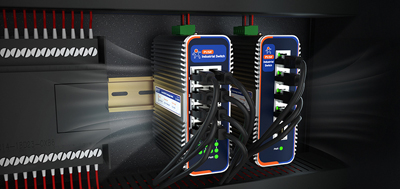
Traditional 4G modem merely serve as data transmission channels, while new-generation 4G modem (such as USR-DR504) integrate edge computing capabilities to perform data cleaning, aggregation, and protocol conversion locally, achieving an integrated "collection-computation-transmission" process. Their core value is reflected in three major aspects:
Dynamic Threshold Triggering: By setting preset rules (such as temperature > 85℃, pressure < 0.2MPa), only abnormal data is uploaded to the cloud. Tests in an electronics factory show that this function can reduce invalid data transmission by 78% and lower bandwidth costs by 60%.
Redundancy Elimination: Local filtering of duplicate data and error codes. For example, in power inspection, 4G modem can automatically transient distortion values generated by sensors due to electromagnetic interference, ensuring the accuracy of uploaded data reaches 99.9%.
Business Rule Filtering: Customizing filtering logic according to scenario requirements. For instance, in smart healthcare, 4G modem can de-identify patient vital sign data and only upload encrypted key indicators to meet HIPAA compliance requirements.
Time Aggregation: Converting data collected 10 times per second into 1-minute averages to reduce cloud storage pressure. After application in a cold chain logistics enterprise, data storage volume decreased by 90%, while still accurately tracking temperature fluctuation trends.
Spatial Aggregation: Integrating data from multiple devices at a regional level. For example, in smart agriculture, 4G modem can aggregate scattered soil moisture sensor data into a "field-level" moisture map to guide precision irrigation decisions.
Logical Aggregation: Through edge computing rule engines, correlating and analyzing data from multiple sensors. For instance, in industrial boiler scenarios, 4G modem can simultaneously monitor pressure, temperature, and flow parameters, triggering alarms when all three exceed limits to avoid misjudgments based on single parameters.
Multi-Protocol Support: USR-DR504 is built with industrial protocol libraries such as Modbus RTU/TCP, OPC UA, and CAN bus, enabling direct parsing of data from PLCs, sensors, and other devices without the need for additional protocol conversion gateways.
Bidirectional Transparent Transmission: Supporting cloud protocols such as MQTT, HTTP, and CoAP to achieve seamless connection between devices and platforms. A photovoltaic power plant converted inverter data into MQTT format via a 4G modem and connected it to the Alibaba Cloud platform, improving operational efficiency by 40%.
Standardized Output: Unifying raw data from different protocols into JSON/XML formats to simplify cloud-based data processing. For example, in smart manufacturing, 4G modem can convert "pulse signals" from robotic arms into "action angles" for easier analysis by AI models.
As an edge computing 4G modem specifically designed for harsh industrial environments, USR-DR504 addresses customer pain points through the following features:
Wide Voltage Input: Supports 9-36V DC power supply, adapting to scenarios with vehicle vibrations or voltage fluctuations.
Vibration-Resistant Structure: Features a dual-installation method with guide rails and hanging ears, along with push-type terminal wiring to prevent contact failures caused by vibrations.
Industrial-Grade Protection: With an IP30 protection rating and a wide operating temperature range of -40℃ to 85℃, it meets the demands of extreme environments such as outdoor and underground utility tunnels.
Low-Latency Processing: Based on an embedded Linux system, local data processing delay is less than 10ms, meeting real-time control requirements.
Large-Capacity Caching: Each connection supports caching of 20 serial data packets to prevent data loss during network interruptions.
Flexible Scalability: Supports FOTA firmware upgrades and can dynamically load data filtering rules according to business needs.
Bluetooth Configuration: Pairing via the mobile app "USR-CLOUD" by scanning a QR code, completing parameter settings in 5 minutes.
Remote Management: Supports access to the USR Cloud platform for remote operations such as device status monitoring, firmware upgrades, and data traffic management.
Multi-Link Redundancy: Features dual SIM card slots, automatically switching to the backup card in case of primary card failure to ensure network continuity.
A automobile parts manufacturer faced the following challenges:
Data Islands: 200 CNC machines used PLCs from different brands, and incompatible protocols made data collection difficult.
Delayed Responses: Equipment failure alarms relied on manual inspections, with an average response time exceeding 30 minutes.
High Costs: Traditional 4G modems required additional protocol conversion gateways, with integration costs exceeding 2,000 yuan per device.
Solution:
After deploying USR-DR504:
The 4G modem directly parsed protocols such as Modbus RTU/TCP and Profinet, converting data into MQTT format for upload to a private cloud platform.
Threshold rules were set locally (such as spindle vibration value > 5g), triggering immediate audible and visual alarms and pushing alarm information to the maintenance personnel's app in case of abnormalities.
A single 4G modem replaced the combination of "4G modem + protocol gateway," reducing integration costs by 65% and shortening deployment time from 3 days to 1 day.
Equipment failure response time was reduced from 30 minutes to 2 minutes, reducing downtime losses by 80%.
Cloud data volume decreased by 72%, lowering storage costs by 55%.
Maintenance personnel inspection frequency was reduced from 3 times a day to once a week, saving 40% in labor costs.
Facing the challenges of industrial data deluges, USR-DR504, with its core capabilities of "edge preprocessing + protocol transparent transmission," provides you with a one-stop solution from data collection to cloud access. Whether you are an enterprise in smart manufacturing, energy management, or smart logistics, you can obtain exclusive support through the following methods:
Submit Requirements: Click the button, fill out the requirement form, and our technical experts will contact you within 2 hours.
Free Trial: Apply for a trial sample of USR-DR504 to personally experience its edge computing performance and stability.
Customized Development: Provide in-depth services such as data filtering rule customization and protocol conversion protocol development according to your business scenarios.
Let USR-DR504 become the "edge brain" for your industrial digital transformation, enabling data to generate value at the source!