After working on projects in the new energy industry for a long time, you will find that problems with wind power equipment do not always occur in the "large systems". As the unit capacity continues to increase, and complex environments such as offshore and mountainous areas become more common, some communication and wiring issues that were not paid much attention to in the past have begun to affect equipment condition monitoring and subsequent maintenance.
A typical example is the data communication between rotating areas such as blades and hubs, and fixed areas such as the nacelle and tower.
Nowadays, a single wind turbine needs to collect more and more data. In addition to the pitch control system itself, monitoring devices for blade vibration, temperature, load, and structural health may also be added.
If all these devices are connected in a wired manner, a very practical problem will arise: the blades and hub are rotating, while the nacelle and tower are relatively fixed.
Ordinary network cables are not suitable for long-term operation directly across the rotating interface. In engineering practice, solutions such as slip rings and rotary connectors can be used, but for some newly added monitoring projects, this means redesigning wiring harnesses, adding interfaces, and even adjusting the original mechanical structure.
This is especially true for existing wind farms that have been in operation for many years. Their early designs did not reserve sufficient communication lines, so adding sensors in the later stage cannot be solved simply by "pulling a network cable".
Moreover, the operating environment of wind turbines is harsh. Long-term vibration, temperature differences, humidity, and salt spray in offshore projects will all increase the maintenance pressure on connectors, wiring harnesses, and interfaces. Once the communication line across the rotating area malfunctions, the cost of high-altitude troubleshooting and maintenance is very high.
Therefore, the value of wireless communication in wind power equipment is not to convert the entire wind turbine to wireless, but to wirelessize the small section of link that is the most difficult to wire and most restricted by the rotating structure.
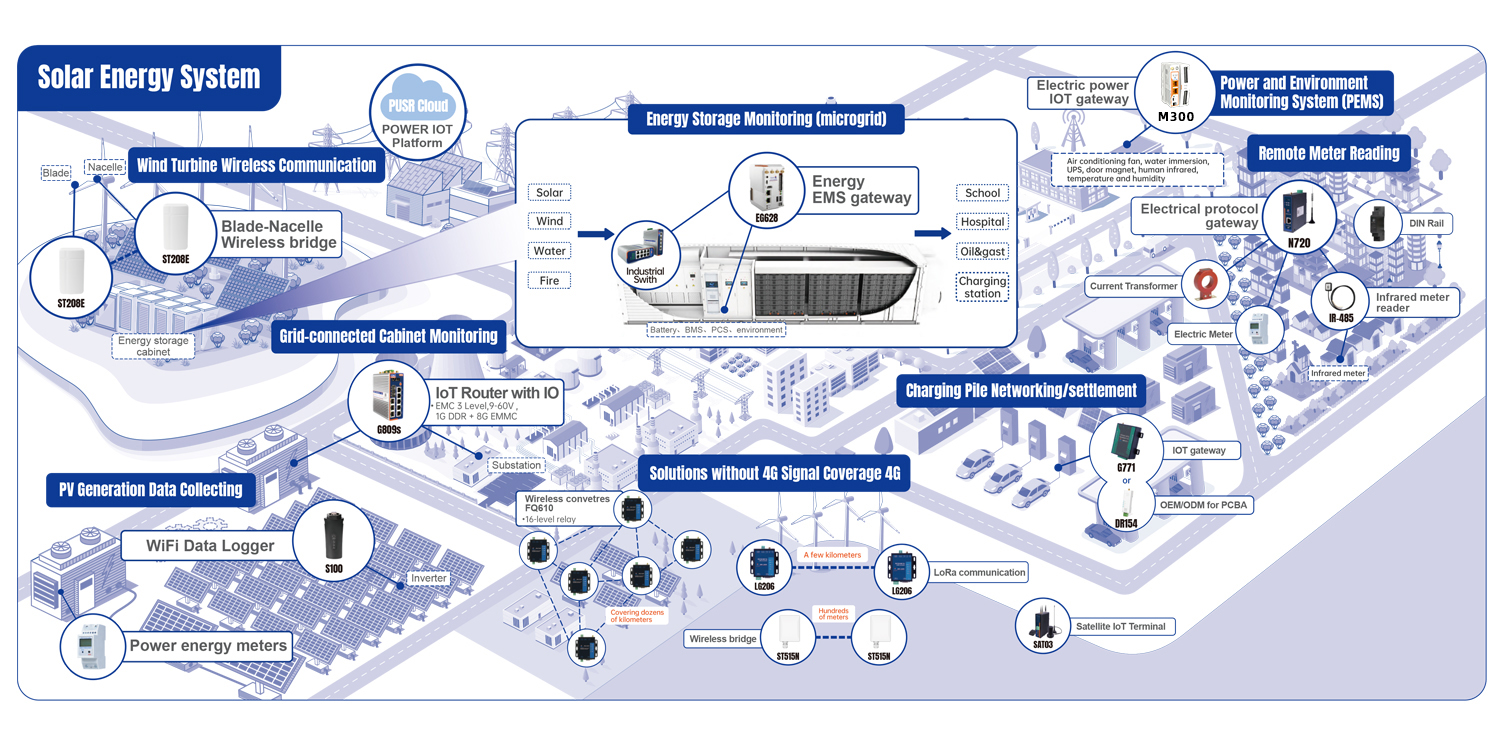
Taking blade condition monitoring as an example, sensor data can be collected first at the blade root or in the hub area, and then transmitted to the nacelle side through an industrial Wireless bridge.
The overall link can be understood as:
Blade sensor → Data acquisition device → Wireless bridge ST208E (rotating side) → Wireless link → Wireless bridge ST208E (nacelle side) → Industrial switch/PLC → Tower network → Wind farm monitoring system.
In this way, the parts inside the blades that can be wired fixedly still use wired communication, and the original industrial network in the nacelle and tower is also retained. Only the most troublesome communication link from "blade/hub to nacelle" is converted to wireless.
For new unit designs, this can reduce the complexity of communication wiring harnesses across rotating areas. For existing unit retrofits, it can avoid large-scale re-wiring just to add a few condition monitoring points.
During on-site deployment, the ST208E should not be simply understood as "one installed in the blade and the other at the bottom of the tower".
A more reasonable approach is to minimize the wireless communication distance as much as possible.
The Wireless bridge on the rotating side can be installed near the blade root or hub, close to the blade acquisition terminal. The Wireless bridge on the fixed side is installed at the corresponding position inside the nacelle. The two devices form a wireless link. After the data enters the nacelle, it is transmitted to the tower and the wind farm control center through the original switches, PLCs, or fiber optic networks.
According to the public information of the ST208E, the device operates at 2.4GHz, supports IEEE 802.11b/g/n, is equipped with two 10/100Mbps Ethernet ports, can be powered by 9~24V DC or Passive PoE, has a nominal operating temperature range of -40℃~70℃, an IP64 protection rating, and CE, RoHS certifications.
For short-distance data backhaul scenarios inside wind turbines, what really matters is usually not the maximum nominal transmission distance of the Wireless bridge, but whether the wireless link can remain stable throughout the rotation process.
There are a large number of metal structures inside the nacelle and hub, which have a significant impact on 2.4GHz wireless signals. During installation, try to avoid direct obstruction from large metal plates, main shafts, and electrical cabinets.
It is particularly important to note that when the blades are stationary during commissioning, the strong signal between the two Wireless bridges does not guarantee stability after the unit starts rotating. It is best to let the impeller rotate through different angles and continuously observe the signal strength, packet loss, and service data.
The ST208E itself provides signal strength indication. In actual projects, RSSI can be used to assist in adjusting the installation direction, but the final acceptance should be based on the data stability during a complete rotation cycle.
If the Wireless bridge is installed on the rotating side, long-term vibration and centrifugal loads must be considered. It cannot be fixed only with ordinary clips or simple adhesive. The IP64 rating, wide temperature range, CE, and RoHS certifications can only be used as references for the device's environmental adaptability, and cannot replace the verification of vibration, impact, lightning protection, and salt spray resistance at the entire wind turbine level.
Especially for offshore wind power projects, it is recommended to install the device in a protected area, and take waterproof and salt spray protection measures for connectors, network ports, and power interfaces.
Before formal installation, it is best to conduct a simple survey of the 2.4GHz wireless environment near the nacelle. If there are already Wi-Fi, wireless sensors, or other wireless devices inside, channels should be planned in advance to avoid interference caused by multiple devices concentrating on the same frequency band.
When power supply fluctuations occur in the wind turbine, if the Wireless bridge loses power at the same time, it is easy to misjudge the "power supply problem" as a "communication problem". If conditions permit, power the communication devices from the nacelle's auxiliary power supply or backup power supply, and separately verify the recovery after network disconnection, power failure, and device restart during the commissioning phase.
From the perspective of equipment manufacturers, the most suitable scenario for wind turbine wireless communication is not to solve all data transmission problems, but to address the communication cross-connection between rotating components such as blades and hubs and the fixed network in the nacelle.
Wired networks using network cables and optical fibers continue to be used in fixed areas, necessary local wiring is retained in rotating areas, and industrial Wireless bridges such as the ST208E are used in positions that are difficult to connect with traditional cables.
This method has a relatively simple structure and is more suitable for adding blade condition monitoring devices in the later stage. Compared with redesigning the rotating wiring harness for several new data streams, the wireless solution's advantages are mainly reflected in reducing the retrofit workload, shortening the construction time, and lowering the maintenance complexity of the subsequent cross-rotating communication link.
For wind turbine manufacturers and existing wind farm retrofit projects, this is the practical application value of Wireless bridges in wind power scenarios.