Deploying video surveillance on construction sites involves more than just cameras — power supply, cabling, network connectivity, and continuous operation each add to the overall cost. Equipment selection, system architecture, and on-site installation stacked together make budget overruns common.
Choosing an Industrial PoE Switch is not simply swapping a network device. It changes how cameras receive power and how cabling is laid out from the start. Here are three concrete values demonstrated in real-world scenarios.
Temporary work areas at construction sites (deep foundation pits, scaffolding zones, material storage yards) often lack permanent electrical infrastructure. The traditional approach requires running both a power cable and an Ethernet cable to each camera — two cables, one power adapter, one outlet location per camera.
PoE solves this with a single cable. Data and power travel over the same Cat5e cable, eliminating the need for a separate power source at the camera.
Tangible changes:
On a site with 20 cameras, a PoE setup eliminates 20 power adapters and their corresponding power cables, resulting in noticeable installation cost savings.
Construction site environments are unfriendly to electronic equipment. Large temperature swings between day and night, dust, and frequent thunderstorms. A standard switch placed inside a distribution box can overheat in summer, and dust ingress may cause failures.
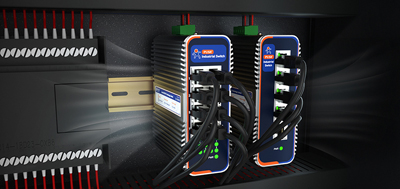
Industrial PoE switches are designed specifically for these conditions.
Key features:
These specifications are not a feature checklist. They address real construction site conditions. Cameras mounted on tower crane booms, at the bottom of foundation pits, or along perimeter walls need switches located in nearby distribution boxes. In harsh environments, stable operation matters more than raw performance.
Construction projects span long periods, and camera positions adjust as the site evolves. A surveillance system installed in the early phase needs to accommodate later additions and relocations, not a complete teardown and rebuild.
Industrial PoE switches offer two practical advantages here:
PoE port power management.Mainstream PoE switches support IEEE 802.3af/at standards, delivering up to 30W per port. The switch automatically detects and matches the power requirements of connected devices. New cameras plug in without additional configuration. Some managed switches also support remote port control — if a camera freezes, the port can be remotely powered off and back on, effectively rebooting the device without sending someone to the site.
24/7 continuous operation.Construction site monitoring does not pause. Switches need to run continuously for extended periods. The aluminum chassis cooling design maintains suitable operating temperatures even inside enclosed distribution boxes, with mean time between failures reaching tens of thousands of hours.
When selecting PoE switches for construction site camera networks, three points are sufficient:
First, PoE power capacity.Verify that per-port power meets camera requirements. Standard bullet cameras typically draw 8-12W, while PTZ cameras with pan/tilt or heating functions may require 20-30W. Switches supporting IEEE 802.3af/at standards cover most camera types.
Second, port count alignment.Select based on current camera count and near-term expansion plans. 5-port models suit small temporary sites. 8-port or higher models work for medium to large projects, leaving 2-3 spare ports for later additions.
Third, industrial-grade features are non-negotiable.Wide temperature range, surge protection, aluminum housing, and DIN-rail mounting are basic requirements at construction sites, not optional upgrades.
Cost control in construction site surveillance can start at the network switch level. PoE technology simplifies power delivery and cabling. Industrial-grade design ensures stable operation in harsh conditions. Port management reduces long-term maintenance costs.
Combined, these three factors improve system reliability and maintainability without requiring a complete system overhaul. The step is simple: select an Industrial PoE Switch during the equipment selection phase, and the overall system gains real, measurable improvements in reliability and serviceability.