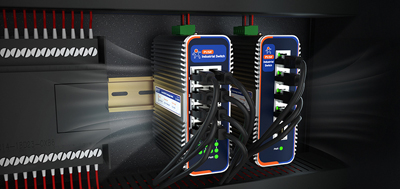
China Southern Power Grid demands "millisecond-level" fault detection: Ordinary routers simply can't do it, but cellular router can
Have you ever been through a scenario like this?
China Southern Power Grid's dispatch center pops up an alarm — a node's communication is down.
You call the site. The guy on the other end says: "The router seems to have frozen again."
You tell him to reboot.
After the reboot, data comes back.
But deep down, you know: this isn't the first time.
The problem is, you have no idea when it'll happen again.
Most engineers working on power, energy, and industrial automation projects have stepped into the same trap:
Blaming every communication failure on poor carrier signal or harsh site conditions.
But the truth is often more painful —
It's that router in your cabinet. It simply can't handle the "millisecond-level fault detection" requirement.
China Southern Power Grid's requirements for distribution automation, smart meter collection, and fault indicator reporting are no longer "just needs to connect." What they want is:
Now look at that ordinary router sitting in your cabinet —
What's its MTBF (Mean Time Between Failures)? Have you ever checked?
Does it support VRRP hot standby switchover? How many seconds does the switchover take?
Can it run stably in an outdoor cabinet at -20°C?
Can its CPU handle running OPC, Modbus, and IEC 61850 protocols simultaneously?
Chances are, you can't answer a single one of these.
And that, right there, is the root of the problem.
I've seen too many project sites where, to save a few hundred bucks, a commercial router was used.
And what happened?
These issues aren't on the procurement list. But every single one of them can make your project fail acceptance.
Let's look at a side-by-side comparison —
You see, the gap was never about "can it get online."
The gap is: when China Southern Power Grid's millisecond-level alarm pops up —can your device handle it?
If you're working on China Southern Power Grid distribution automation, smart grid edge collection, or any project with a hard requirement for "millisecond-level detection" — I'd like you to take a serious look at theUSR-G806w cellular router.
Not because it's the most expensive. Quite the opposite — it's the most cost-effective "won't fail you" option you can buy.
The G806w's processing power isn't "just enough" — it'sredundant.
Running multi-channel serial data collection, VPN encrypted transmission, and remote monitoring uploads simultaneously — CPU usage still has headroom.
What does that mean?
It means you don't have to worry about "it lags when the load picks up."
In China Southern Power Grid scenarios, a single node might be connected to fault indicators, smart meters, and ring main units simultaneously — the data throughput is no joke. Ordinary routers start dropping packets under load. The G806w won't.
Cabinet space at project sites is always tighter than you think.
The G806w comes in multiple form factors — small enough to fit in the gap next to a meter box, large enough to mount on a standard DIN rail.
Interface-wise: serial ports, Ethernet ports, DI/DO, Wi-Fi — it has everything you need.
No extra conversion modules needed. One device solves all your access problems.
For project integration, that means one less failure point, one less cable, one less debug session.
China Southern Power Grid projects aren't done by you alone.
Your device needs to talk to the dispatch master station, run IEC 61850, and be compatible with Modbus RTU-to-TCP conversion —
The G806w natively supports all these protocols. No need to add a separate protocol converter.
What you save isn't just money — it's debug time and acceptance risk.
This one I have to call out separately.
Because this is where ordinary routers fail the most.
The electromagnetic environment at power sites — you know the drill: VFDs, switchgear, transformers, all interference sources.
The G806w has dedicated EMC optimization. During testing, we actually measured it:touch the heatsink on the case with your bare hand — it's warm, not hot.
No fan. No noise.
You know what that means?
It means your O&M team won't be woken up at midnight by a fan alarm.
It means you don't have to worry about the device overheating and crashing when the fan fails.
It means your project acceptance report can state: "zero noise, low heat, maintenance-free" — and in China Southern Power Grid's scoring criteria,that's a bonus point.
Anyone who's done projects knows:
Installing the device is the easy part. Maintenance is the nightmare.
Especially with China Southern Power Grid projects — sites are scattered across mountains, fields, and substations. You can't be driving out every month to reboot a router.
The G806w supports remote management, remote upgrade, remote diagnostics.
Zero-touch deployment. No need to send anyone to site.
That's what "reducing O&M costs" actually looks like.
Let's talk price.
The G806w is priced lower than many so-called "cellular routers."
But what you get, it doesn't skimp on a single thing:
You're paying commercial router prices. You're getting industrial-grade reliability.
I've seen too many engineers agonize over selection, then pick the cheap one.
Then at project acceptance, fault detection latency exceeds China Southern Power Grid's requirements — get sent back for rework.
The cost of rework is ten times the price of that router.
Your data link shouldn't be destroyed by a device you thought was "good enough."
China Southern Power Grid's "millisecond-level fault detection" isn't a slogan.
It's a hard requirement.
Ordinary routers can't do it — not "a little short," theyfundamentally can't.
But cellular routers can.
The USR-G806w is the option that lets you make your selectionwithout gambling.
Not saying it's the only choice.
But it at least lets yougamble a little less.