Production lines in food processing, beverage filling, dairy, and meat processing industries share a special working condition: the equipment may be washed down on a daily basis.
After production ends, on-site personnel use water guns, foam cleaners, and even high-pressure water jets to clean the conveyor lines and external surfaces of the equipment. For equipment manufacturers, control devices such as PLCs and HMIs are usually already installed in protective electrical cabinets. However, after adding
4G remote operation and maintenance capabilities, a common question often arises:
Can an industrial
4G LTE router be directly deployed in such an environment?
The answer is that it can be used in washdown workshops, but "industrial-grade" should never be equated with "waterproof".
The USR-G806w features a metal casing, with an officially rated ingress protection level of IP30. IEC 60529 defines the ingress protection ratings of electrical enclosures against solid and liquid intrusion, and IP30 is not a rating designed for water washdown scenarios.
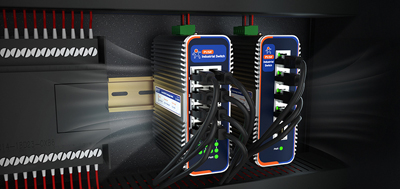
Therefore, the more reasonable installation position for the G806w is inside a protective electrical control cabinet, rather than being mounted exposed on the outer side of the production line.
Why Are Industrial
4G LTE Routers Still Needed in Washdown Environments?
An increasing number of such production equipment requires remote networking.
Filling machines, packaging machines, sterilization equipment, and conveyor lines are usually equipped with internal PLCs, HMIs, vision inspection systems, or industrial PCs. After the equipment is delivered to the customer's factory, if the manufacturer's engineers cannot remotely access the device once a program, parameter, or network fault occurs, they have no choice but to travel to the site for troubleshooting.
Thus, the G806w can be deployed inside the equipment control cabinet following this architecture:
PLC / HMI / Industrial PC
↓ Ethernet
G806
↓
4G / WiFi / Wired
Remote Operation & Maintenance Network
↓
Equipment Manufacturer's Engineer
When a plant network is available, the wired WAN can be used; when no existing network is present, 4G access is adopted. Link redundancy among wired, 4G, and WiFi can also be configured according to project requirements.
In this way, there is a protective cabinet physically separating the washdown area from the communication equipment.
The Real Challenge Lies in "Proper Cabinet Design"
If the equipment is already equipped with a waterproof control cabinet, the simplest solution is to install the router directly on the DIN rail inside the cabinet. The G806 series supports both DIN rail and wall-mounted installation, making it easy to integrate into equipment electrical cabinets.
If the router needs to be installed independently, an additional protective enclosure that matches the on-site washdown rating should be configured.
Moreover, you should never only focus on the enclosure itself.
After the power cable, Ethernet cable, and antenna pass through the enclosure, the cable entry points, cable glands, and connectors will also become potential water ingress points. Many on-site equipment failures are not caused by leaking cabinet doors, but by cleaning water seeping into the electrical cabinet along the Ethernet cable or antenna feeder.
For equipment manufacturers, the overall ingress protection of the complete machine should be inspected based on the "weakest link", rather than only checking either the router or the electrical cabinet alone.
How to Properly Handle the Antenna Installation
This is a common pitfall in washdown equipment deployment.
After the G806w is fully enclosed in a stainless steel metal cabinet, 4G and WiFi signals may be significantly attenuated. If the on-site signal is already weak, the device may go offline once the cabinet door is closed.
A common solution is to route the antenna to a position outside the cabinet with better signal coverage. At this point, the external antenna, feeder interface, and cabinet-penetrating connector must also meet the on-site waterproof and washdown requirements.
A more reliable approach is to treat the communication antenna position as an integral part of the equipment structure during the complete machine design phase, rather than drilling a temporary hole on the cabinet after the equipment is fully manufactured.
Cleaning Agents and Condensate Also Need to Be Considered
In washdown environments, water guns are not the only hazard.
When hot equipment is shut down and then rinsed with cold water, temperature differences inside the cabinet may cause condensation. Long-term exposure to acid and alkaline cleaning agents may also corrode ordinary connectors, seals, and antenna casings.
Therefore, the electrical cabinet should be installed in a position that avoids direct impact from cleaning water, with proper cabinet sealing, drainage, and internal temperature difference management implemented.
The G806w itself has an operating temperature range of -20℃ to 70℃, but the specified operating environment in the product documentation does not mean it can withstand direct liquid spray. Even if the ambient temperature meets the requirements, the waterproofing issue must be resolved through the overall structural design of the equipment.
Conduct a Dedicated "Washdown Condition Test" Before Putting the Network Into Operation
Stable network performance during normal production does not guarantee stability after cleaning.
Before delivery, equipment manufacturers should conduct a test following the actual on-site workflow: close the electrical cabinet, perform normal washdown on the equipment, check for moisture or water seepage inside the cabinet after cleaning, then verify that the 4G/WiFi signal, router online status, and PLC remote communication are all normal.
You can also actively disconnect the wired network to confirm that the 4G backup link recovers as configured. After the complete machine is powered off and restarted, check that the router, VPN, and remote device connections can be automatically re-established. The G806w supports link failover between WAN and 4G, and is equipped with a hardware watchdog and automatic recovery mechanism.
For washdown environments such as food processing, the question of whether an industrial 4G LTE router can be used does not actually depend on "whether the industrial 4G LTE router itself is waterproof".
A more accurate design logic should be:
The router is responsible for stable network connectivity, the protective cabinet isolates the device from the washdown environment, sealed connectors resolve cable ingress points, and external antennas eliminate signal shielding caused by metal cabinets.
IP30 industrial 4G LTE routers like the G806w are designed for installation inside control cabinets, not for direct exposure to water guns. Considering waterproofing, antenna layout, cabling, and network redundancy together during the equipment design phase is far more efficient than troubleshooting poor signals or water ingress into the cabinet after deployment.