Cellular Modem Low-Power Mode Configuration: How to Achieve a Power-Saving Solution with Standby Current < 50 mA?
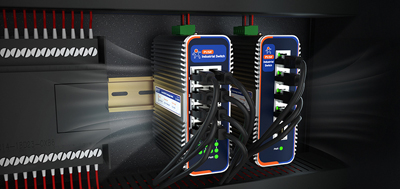
In Industrial Internet of Things (IIoT) scenarios, device power consumption directly determines operational costs and deployment feasibility. Taking applications such as remote meter reading and environmental monitoring as examples, if the standby current of a cellular modem reaches tens of milliamperes, battery-powered devices may deplete their power within a few weeks, leading to data interruptions and soaring maintenance costs. This article analyzes how to achieve the goal of standby current < 50 mA through systematic low-power strategies from three dimensions—hardware design, software optimization, and communication protocols—and recommends the cellular modem USR-G771 as a typical solution.
The core of cellular modem power consumption lies in power conversion efficiency and load matching. Traditional linear voltage regulators (LDOs) have an efficiency of less than 30% when there is a large input-output voltage difference, while switching voltage regulators (DC-DCs) can increase efficiency to over 90% through high-frequency switching operations. For example, the D2575 series voltage regulator has a current of only 50 μA in standby mode and, when combined with a TTL shutdown pin, can reduce the power consumption of a Cellular Modem by 99% during non-working periods.
USR-G771 Practice: This product adopts a wide voltage design (9-36 V input) and integrates an efficient DC-DC conversion circuit internally. Under a working voltage of 3.4-4.2 V, its typical working current is only 21-50 mA, reducing power consumption by 60% compared to traditional Cellular Modem.
The peripheral modules of a Cellular Modem are the main sources of standby power consumption. By controlling peripheral clock gating through registers, non-essential modules can be turned off during task intervals:
ADC Module: Turn off the ADC clock (ADCSRA = 0) immediately after sampling is completed to save 0.8 mA of current.
Serial Port Module: Disable the USART receiver (UCSRB &= ~(1 << RXEN)) when idle to reduce power consumption by 1.2 mA.
Debugging Interface: Blow the JTAG fuse bit after program burning to completely cut off the 1.5 mA debugging current.
Case Study: In a smart water meter project, by dynamically turning off the ADC and serial port, the battery life was extended from 3 months to 18 months with a 30-minute sampling interval.
Modern MCUs offer multiple low-power modes, and the optimal combination needs to be selected according to the scenario:
Power-Down Mode: With a current of only 0.1 μA, it retains RAM data and RTC timing and can be awakened by external interrupts or RTC alarms.
Power-Save Mode: With a current of 1 μA, it retains asynchronous timers (such as RTC) and is suitable for timed sampling scenarios.
Standby Mode: With a current of < 10 μA, it retains fast wake-up capabilities and is suitable for scenarios requiring millisecond-level responses.
USR-G771 Optimization: It has a built-in independent hardware watchdog that can still monitor the system's operating status in low-power modes to avoid abnormal power consumption due to software crashes.
The traditional polling method requires the main loop to continuously detect peripheral states, preventing the CPU from entering low-power modes. Taking button detection as an example:
c
ISR(INT0_vect){// Button handling logicwakeup();}voidmain(){set_sleep_mode(SLEEP_MODE_PWR_DOWN);sleep_enable();while(1){sleep_cpu();// CPU enters power-down mode}}Memory refreshing is a hidden power consumer. For example, refreshing a 4 KB SRAM once consumes 3.2 mA of power. Batch data processing can significantly reduce power consumption:
Traditional Method: Process data immediately after each sampling, keeping the CPU continuously working.
Optimized Method: Wake up once after collecting 10 sets of data, process them in batches, and then immediately enter sleep mode. The actual battery life is extended by 8 times.
USR-G771 Support: Each connection supports 20 serial port data buffers. When the connection is abnormal, cached data can be retained without loss, avoiding frequent wake-ups and increased power consumption.
Wireless communication is the main source of Cellular Modem power consumption. The following strategies can reduce communication energy consumption:
| Technology Type | Peak Current | Standby Current | Applicable Scenarios |
| GPRS | 1.5 A | 5 mA | Low-frequency data reporting |
| Cat-1 | 300 mA | 50 mA | Medium-frequency data transmission |
| NB-IoT | 200 mA | 5 μA | Ultra-low-power, wide-coverage scenarios |
| LoRa | 120 mA | μA | Local networking, long-distance transmission |
AT+CSQ// Query signal qualityAT+NPSMR=1// Enable PSM modeAT+CGATT=1// Attach to the networkUSR-G771 is an industrial-grade Cat-1 Cellular Modem launched by USR IoT. Its low-power design runs through the entire chain of hardware, software, and communication:
Hardware Layer: Wide voltage input (9-36 V), efficient DC-DC conversion, and independent hardware watchdog.
Software Layer: Supports multiple low-power modes, data caching, and FOTA remote upgrades.
Communication Layer: Cat-1/GPRS dual modes, PSM/eDRX support, and adaptive sleep.
Typical Application Scenarios:
Agricultural Irrigation Monitoring: Powered by solar energy, USR-G771 can operate continuously for more than 5 years in a scenario where data is reported once a day on average.
Smart Building Energy Consumption Management: Deployed in environments with strong electromagnetic interference, it passes the IEC 61000-4-5 Level 3 surge test to ensure data transmission stability.
Cold Chain Logistics Tracking: It supports a wide operating temperature range from -25°C to +75°C and realizes full-chain monitoring through GPS positioning and temperature and humidity sensor linkage.
Achieving a standby current of < 50 mA is not only a technical challenge but also a key to commercial decision-making. Taking a steel company as an example, the 500 high-power modem it deployed generated annual electricity and maintenance costs of over 200,000 yuan. After replacing them with USR-G771, through low-power design and reliable communication, the annual costs were reduced to less than 50,000 yuan, and the investment return period was only 6 months.
Take Immediate Action: Contact USR to obtain: