In projects such as commercial parks, residential communities, and street-side shops, remote meter reading does not seem complicated at first glance — it simply involves collecting electricity meter data and transmitting it to the management platform. However, anyone with on-site delivery experience will find that the problems rarely lie in "whether electricity meters are available". Instead, they stem from the wide variety of meter types, scattered wiring, unstable networks, and the difficulty of unifying new and old devices in one go.
For electricity meter manufacturers, distribution cabinet vendors, and energy management system integrators, if protocol adaptation, rewiring, and platform interface development are redone for every single project, remote meter reading can easily turn from a standard feature into a "construction schedule black hole".
Newly built projects usually adopt unified RS485 smart meters. But during the renovation of old residential communities and commercial parks, there may be RS485 meters, DL/T645 meters, meters with infrared interfaces, and metering equipment from different manufacturers and different eras coexisting on site. If these devices are directly connected to the platform, every additional meter type may bring a new set of adaptation work on the platform side.
The network conditions in underground power distribution rooms, weak current shafts, and remote shops are not always stable. The traditional "upload one data point as soon as it is collected" method tends to create data gaps once communication is interrupted. For ordinary equipment monitoring, missing a few instantaneous data points may have little impact. But meter reading involves billing and settlement. A data outage of several hours or even longer at the end of the month will require manual re-verification.
In many existing projects, electricity meters are scattered in the distribution boxes of different floors, units, and shops. If a large number of new network cables are laid for networking, the construction workload will be huge, and coordination with property management, shop owners, and residents will also be required. Many projects get stuck precisely at the site access and wiring stages.
Finally, there is the low efficiency of manual operation and maintenance. Checking hundreds or even thousands of meters one by one by personnel not only slows down the meter reading process, but also makes it difficult to immediately detect issues such as offline meters, communication abnormalities, or obvious anomalies in electricity consumption data.
Such projects can adopt the architecture of "zonal collection, edge processing, and unified upload".
In the early stage, conduct a full inventory of on-site current transformers, RS485 meters, infrared meters, and infrared meter readers, and group them by building, floor, power distribution room, or shop area. Special attention should be paid: current transformers are generally not directly connected to the
Edge IoT Gateway USR-N720. Instead, they are first connected to electricity meters or metering devices, which complete the metering work and then transmit the data to the gateway via RS485.
A typical link can be designed as:
Current Transformer → Electricity Meter → RS485 → USR-N720 → Meter Reading Platform
For existing electricity meters with infrared communication interfaces, conversion can be done via an infrared meter reader:
Infrared Meter → Infrared Meter Reader → RS485 → USR-N720 → Meter Reading Platform
TheEdge IoT Gateway USR-N720 provides 2 RS485 ports and 1 Ethernet port. It supports data collection in Modbus RTU, DL/T645-2007 and other protocols, and enables Modbus-to-MQTT/JSON and DL645-to-MQTT/JSON conversion. It can communicate with upper-level servers via TCP and MQTT, and supports a maximum of 1000 data points. In this way, the platform only needs to process relatively unified data, instead of directly handling dozens of different on-site devices.
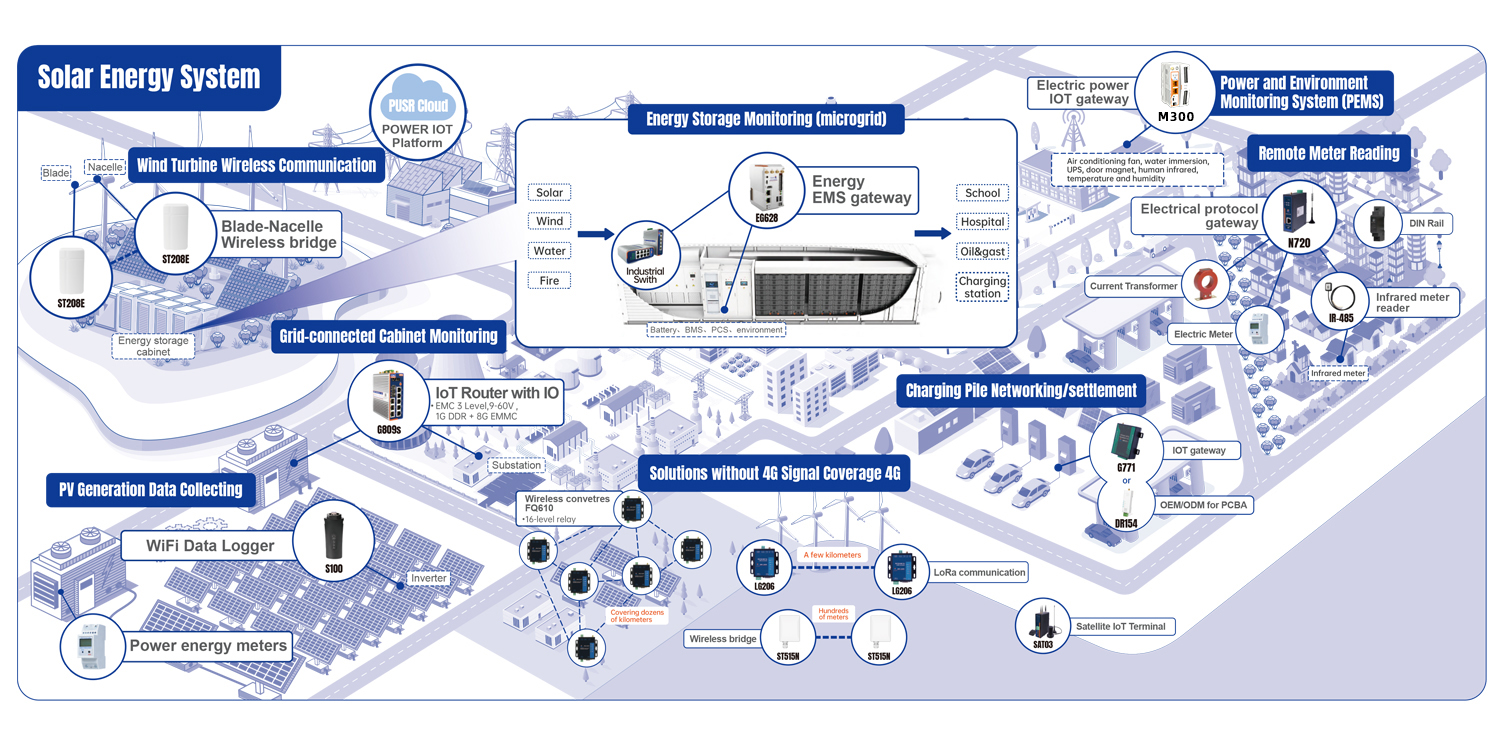
In actual projects, it is not recommended to connect all electricity meters to a single gateway.
A more reliable approach is to divide collection units by power distribution zones. For example, deploy one collection node for each building, each power distribution room, or several floors. The
Edge IoT Gateway USR-N720 is installed nearby in the weak current shaft or distribution box, with its two RS485 ports connected to electricity meters in the corresponding zones respectively.
For devices on the same RS485 bus, unify the communication parameters in advance and distinguish different devices via unique meter addresses. The gateway polls and reads required data such as total electricity, voltage, current, and power at the set cycle, and then uniformly uploads the data to the property management meter reading system or energy management platform.
If the project already has a stable local area network, data can be uploaded directly via Ethernet. For areas where new network cables are inconvenient to lay, the cellular communication version can be adopted according to on-site conditions.
TheEdge IoT Gateway USR-N720 currently provides both Ethernet and cellular communication versions.
A very practical feature is local caching. The USR-N720 supports external SD cards to cache collected data during network outages, and resumes data transmission to the server after the network is restored. For meter reading projects that require continuous metering, this is far more important than simply pursuing "real-time upload".
Before the project starts, take one meter of each brand and each batch for joint debugging, and confirm the meter address, baud rate, parity bit, register, and DL/T645 data items. If private protocols from certain manufacturers are encountered, confirm in advance whether they can be accessed via standard protocols or other methods. Do not assume that the gateway can directly parse all private protocols.
The top priority of old community renovation is to minimize modifications to the original system. If the existing RS485 bus can work normally, prioritize reusing it to avoid large-scale rewiring for remote meter reading.
On site, comprehensively consider factors such as transmission distance, number of nodes, baud rate, cable quality, and electromagnetic interference. For large buildings, it is better to deploy gateways in separate zones, rather than cramming dozens or even hundreds of widely scattered meters into one long bus just to save the cost of one gateway.
For residential billing, second-level collection is usually unnecessary. For commercial energy consumption analysis, the collection frequency can be appropriately increased according to actual demands. The shorter the collection cycle, the greater the pressure on bus polling and platform data processing. The cycle should be determined based on the requirements of billing, statistics, and anomaly monitoring.
The USR-Edge IoT Gateway N720 supports encrypted transmission via TCP+SSL and MQTT+SSL. During project docking, enable corresponding encryption and identity authentication mechanisms according to the platform architecture, to prevent meter reading and billing data from being transmitted in plaintext for a long time.
In addition, the environment in weak current shafts and distribution cabinets is not ideal, so long-term operation conditions should be considered during model selection. The Edge IoT Gateway USR-N720 adopts DC 9~36V power supply, with a nominal operating temperature range of -40℃~85℃, and supports DIN rail or wall-mounted installation. Its official documents also list certification information including 3C, CE, RoHS, and WEEE.
For commercial and residential remote meter reading, the core of renovation is not to build another complex system. Instead, it is to sort out the original scattered meter access methods: reuse usable existing lines, process protocols that can be handled on site at the edge side, cache data during network outages locally, and let the upper-level platform only process unified data.
In this way, no matter whether new buildings, new shops are added, or the meter reading platform is replaced later, there is no need to re-modify everything starting from the on-site devices. For equipment manufacturers and system integrators working on large-scale projects, this is often more practical than simply pursuing a certain functional parameter.