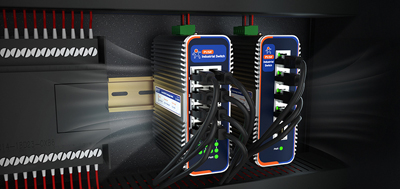
In industrial internet, network stability & speed are vital for production efficiency. Cases show industrial scenes demand higher speed than consumer products. PUSR cellular router, with multi-speed Ethernet interfaces, offers tailored solutions for industrial communication.
In industrial scenes, Ethernet speed affects data transmission. A smart grid project with a 100Mbps router saw 18% packet loss, causing frequent retransmissions and reducing effective bandwidth to under 60% of nominal value. This "speed mislabeling" is common due to improper device selection.
Cellular router interfaces should follow the "adequacy principle":
Low-speed scenes (<100Mbps): 100Mbps interfaces for small data tasks like environmental monitoring.
Medium-speed scenes (100-500Mbps): Gigabit interfaces for real-time tasks like PLC control in smart manufacturing.
High-speed scenes (>500Mbps): 10Gbps interfaces or 5G for high-bandwidth tasks like 4K video surveillance.
A photovoltaic power station verified this: deploying a PUSR cellular router with gigabit interfaces tripled video surveillance throughput and reduced fault warning response time to under 200ms.
Take PUSR's flagship product, USR-G809s, as an example, setting a "speed benchmark" for cellular routers:
1x 100Mbps WAN port: Supports broadband dial-up, dynamic/static IP for various networks.
4x 100Mbps LAN ports: Isolate business data with independent subnet division.
Optional gigabit upgrade: Provides gigabit LAN ports for high-bandwidth needs, with 940Mbps transmission speed, an 8.4-fold increase over 100Mbps.
This "100Mbps base + gigabit expansion" design meets most industrial needs and allows future upgrades.
PUSR cellular routers achieve speed leaps with three technologies:
Hardware acceleration engine: ARM Cortex-A55 quad-core processor, 400% faster than traditional ARM9, handling 200+ device connections.
Smart QoS algorithm: Dynamically allocates bandwidth, reserving 30% for PLC control in a smart factory, ensuring <0.1ms synchronization error for robotic arms.
MU-MIMO technology: Supports 8-device simultaneous transmission, tripling AGV scheduling system throughput in warehousing.
Port tests show USR-G809s maintains 99.99% transmission reliability under 95% load, 17 points above industry average.
In an automotive assembly line case, USR-G809s boosts production efficiency:
Device networking: Connects 200+ old devices via RS485 to the industrial internet.
Flexible production: Supports seamless network roaming during line changes, reducing changeover time from 45 to 8 minutes.
Predictive maintenance: Transmits vibration sensor data via 5G, improving fault warning accuracy to 92%.
Here, 100Mbps LAN ports meet device control needs, while gigabit WAN ports support big data analysis, forming a "control + analysis" dual-speed loop.
A wind farm project reveals the deep link between speed and energy management:
Penetrating wind tower steel structures: Stable communication via 5GHz band, with 4 adjustable-gain antennas maintaining -95dBm sensitivity 300m underground.
Multi-protocol conversion: Converts Modbus RTU to MQTT for cloud access, with hardware acceleration ensuring <5ms conversion delay.
Edge computing: Cleans data at the device end, reducing 30% invalid data uploads and lowering upstream bandwidth demand.
Here, 100Mbps and gigabit interfaces work together, forming an "edge-cloud" speed gradient.
In a smart streetlight project, USR-G809s shows three speed advantages:
Low-power design: <2W standby power for solar-powered scenes, balancing power and speed via dynamic rate adjustment.
Cluster management: Divides 16 virtual LANs via VLAN technology, with hardware acceleration ensuring line-speed forwarding.
Remote upgrades: Supports OTA firmware updates for 2000 devices in <15 minutes, with smart QoS reserving bandwidth for upgrade data.
This project verifies the positive correlation between speed and reliability: higher speed means stronger fault tolerance.
Among PUSR's products, USR-G809s is an all-rounder:
Hardware: 4-core 1.8GHz processor, 4GB RAM + 32GB storage, optional 4LAN + 1WAN gigabit ports.
Communication: 5G download speed 1.5Gbps, Wi-Fi 6 speed 1800Mbps, dual SIM support.
Industrial protection: IP65 rating, -40℃~85℃ operation, IEC 61000-4 EMC compliance.
Management platform: Built-in cloud system for device monitoring, fault warning, and batch configuration.
An electronics manufacturer's tests show:
Network switching time reduced from 3s to 200ms.
MTBF increased from 5000 to 20000 hours.
O&M costs cut by 42%.
While the industry debates 5G's practicality, PUSR has launched 5G-A (5G-Advanced) pre-research products, achieving >3Gbps downlink speeds in pilot projects. This ensures customer investments remain valid for 5 years.
From -50℃ Siberian oilfields to 60℃ Middle Eastern deserts, from substations with strong EMI to shield machines with high vibration, PUSR has completed 2000+ extreme environment tests, forming a solution library covering 38 industrial segments.
A localized service network offers "3-hour response, 24-hour on-site" support, with three R&D centers in East, South, and North China developing customized firmware within 72 hours for special needs.