In a factory workshop, the typical scenario is straightforward: a single production line runs PLCs from multiple vendors, temperature sensors communicate via RS485, smart meters use Modbus RTU, and some legacy equipment only supports serial communication. Different interfaces, different protocols, different manufacturers—centralized data collection means wiring and programming work multiply.
The solution is not complicated: add a "translator" between the device layer and the cloud. This is the Industrial IoT Gateway. It aggregates data from different interfaces and protocols, then uploads it to the cloud in the format the platform requires.
The following breaks down how an Industrial IoT Gateway connects these scattered devices, from wiring to configuration.
An Industrial IoT Gateway typically provides multiple physical interfaces. Each interface type corresponds to specific device categories.
RS485 port—the primary channel for Modbus devices.Temperature sensors, smart meters, and serial communication from some PLCs all use RS485. RS485 supports bus topology, where multiple slave devices daisy-chain along a single pair of wires. Each slave receives a unique Modbus address. When wiring, ensure polarity is correct, and add termination resistors at both ends of the bus to reduce signal reflection.
RS232 port—point-to-point communication.Some legacy equipment or specialized sensors use RS232. RS232 has a shorter transmission range and is suitable for one-to-one connections.
Ethernet port—for Modbus TCP devices.Newer PLCs and smart instruments typically come with an Ethernet port and use Modbus TCP. The gateway's LAN port connects directly to these devices, which coexist alongside serial devices under the same gateway.
DI/AI interfaces—for digital and analog signals.Digital Input (DI) connects to limit switches, buttons, and other on/off signals. Analog Input (AI) connects to 4-20mA or voltage-output temperature and pressure sensors. Some gateways also provide Digital Output (DO) for local control logic.
The USR-M300 Industrial IoT Gateway, for example, provides 1×RS232/485, 1×RS485, 2×LAN ports, 2×DI, 2×DO, and 2×AI interfaces. During physical connection, assign each device to the appropriate interface, power the gateway (supports DC 9~36V wide-input range), and the hardware connection is complete.
After physical wiring comes software configuration. The gateway's core task is protocol conversion—this determines whether data can be successfully uploaded.
Modbus RTU to Modbus TCP conversion.This is the most common requirement in industrial scenarios. Configuration begins by scanning the number and addresses of slave devices on the bus, recording each slave's register addresses and data types. Once configured, the gateway polls each slave periodically, converting Modbus RTU data into Modbus TCP or JSON format for upload.
Concurrent multi-protocol acquisition.In practice, a production line may have both RS485 buses and Ethernet-connected devices simultaneously. The edge computing capability of an Industrial IoT Gateway supports parallel acquisition—the serial and Ethernet ports work independently without interference. The USR-M300 features a dual-core processor running at 1.2GHz, capable of collecting up to 2,000 data points simultaneously.
Custom JSON message formatting.Different IoT platforms require different data formats. The gateway supports custom JSON message templates, so collected data can be packaged according to the target platform's requirements without modifying server-side code.
After data is collected, it must be uploaded to the cloud or a local server. The choice depends on the site environment.
Ethernet connection.If the workshop has a stable wired network, Ethernet is the preferred option. It provides high reliability and low latency, suitable for scenarios requiring real-time data transfer. The USR-M300 provides 1×WAN/LAN and 1×LAN ports—the WAN port connects to the upstream network, while the LAN port connects to local devices.
4G wireless connection.In workshops without wired network coverage, for mobile equipment (such as AGVs), or outdoor installations, 4G offers greater flexibility. The USR-M300 supports global LTE 4G bands with a built-in antenna—simply attach the antenna and connect.
Both connection methods support routing, VPN, and firewall functions, enabling network isolation and security at the gateway level.
Once data reaches the cloud, it typically passes through an IoT platform for ingestion, parsing, storage, and visualization. The gateway's cloud configuration determines the complexity of the downstream system architecture.
Standard MQTT protocol.Mainstream IoT platforms (Alibaba Cloud, AWS, ThingsBoard, Azure) all support MQTT. After configuring the gateway's MQTT parameters (Broker address, port, username, and password), data is automatically published.
PUSR Cloud for rapid deployment.Choosing PUSR Cloud eliminates the need to build a private server—the cloud platform handles device management, data monitoring, and remote configuration out of the box.
On-premise deployment.For scenarios with strict data security requirements, an MQTT server or custom IoT platform can be deployed locally. The gateway also supports standard TCP protocol for direct data upload.
In industrial settings, some data processing does not need to reach the cloud. Performing it at the gateway edge is more efficient.
Local protocol conversion and computation.The gateway converts Modbus RTU data directly into JSON format at the edge, performing decoding and calculations locally. This reduces the data volume sent to the cloud and lowers server load. The USR-M300 supports collection and analysis of up to 2,000 data points.
Node-RED visual programming.Some scenarios require complex edge logic, such as threshold checks, interlock control, or data filtering. The USR-M300 supports Node-RED visual programming—no coding required. Logic is configured by dragging and dropping nodes.
Offline data caching.When the network connection drops, the USR-M300 caches collected data on an SD card. Once the network reconnects, cached data is automatically forwarded, ensuring zero data loss.
Equipment stability directly impacts production. The gateway's alarm functions notify operators of issues in real time.
Alarms are delivered via MQTT push, cloud platform notifications, or SMS, enabling rapid problem localization.
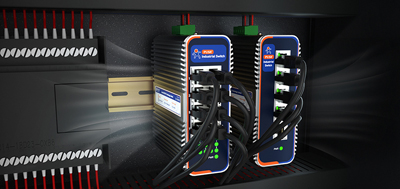
For hardware installation, the USR-M300 supports both DIN-rail mounting (inside electrical cabinets) and wall mounting. The operating temperature range of -25~75℃ covers most industrial environments.
For maintenance, PUSR Cloud allows remote monitoring of gateway status, firmware updates, and parameter configuration changes—no on-site visit required, saving time and labor costs.
The core path to connecting PLCs, Modbus devices, and sensors with one Industrial IoT Gateway:
When equipment on a production line comes from different vendors with different interfaces and protocols, the Industrial IoT Gateway is the hub that unifies everything.