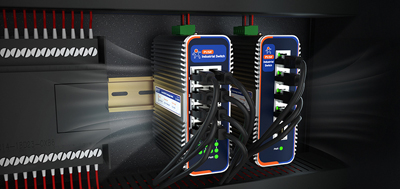
The biggest mistake when deploying edge computing at remote industrial sites is choosing equipment based on a data center mindset. Wind farms are on mountains, mines are in deserts, and solar plants may not even have stable grid power. What you need isn't a scaled-down version of a large DC—you need an industrial IoT gateway that can survive out there and still get the job done.
Here's the bottom line: for most remote industrial sites, an M300-class device is enough for the edge node. Dual-core 1.2GHz, Linux system, supports up to 2,000 data points, with both 4G and Ethernet dual links. Let's break down how to choose and how to use it.
The first barrier at a remote site isn't compute power—it's survivability.
Discussions around industrial-grade micro-modular data centers highlight a key difference: remote energy sites are often in areas without grid power or with voltage fluctuations, requiring equipment that supports wide voltage input and wide temperature operation. A solar plant cabinet can exceed 60°C in summer, and a northern wind farm can drop to -20 or -30°C in winter. Commercial-grade equipment rated for 0–50°C is just waiting for an RMA ticket.
The M300's operating temperature is -25 to 75°C, with a power input of DC 9–36V. That wide voltage range means even if the site's power supply is unstable, or the solar battery voltage swings significantly during charge/discharge cycles, the device won't go down. EMC protection meets IEC61000-4 Level 3: 6KV contact discharge, 8KV air discharge. In a cabinet next to large motors, VFDs, and frequently switching relays, this spec isn't a nice-to-have.
Another easily overlooked factor is the cooling method. In factory-floor edge computing hardware, fan failure is the number one cause of breakdowns. In dusty, oily environments, fans are consumables. The M300 is fanless, relying on natural convection cooling. At 79.6×58×110mm, it supports both DIN-rail and wall mounting.
The most common situation at remote sites: the equipment is already running, the PLC was installed ten years ago, and the data can't get out.
A wind farm might have converters and box-type transformer monitoring devices from different vendors, with a mix of protocols. A solar plant polls inverters via Modbus RTU, while the meters might use DL/T645. If this data isn't aggregated, the site is just an information island.
The M300's core strength is at the collection layer. It supports Modbus RTU/TCP conversion, with one RS232/RS485 and one RS485 serial port, and the Ethernet port can run Modbus TCP directly. Up to 2,000 data points processed in parallel means you don't need to add another device just to "connect a few more sensors."
There's an easily overlooked detail here: serial device data and Ethernet device data need to be collected simultaneously. Many low-end gateways can only poll in time slices, stretching the collection cycle. The M300's dual-core architecture and Linux system support parallel collection—serial, Ethernet, and IO data can be read at the same time.
A production line vibration sensor sampling at 1kHz, sending all raw data to the cloud, generates 86GB per day. Remote sites pay for 4G data by usage—no one can absorb that cost.
This is where edge computing delivers real value: complete data cleaning, filtering, and feature extraction locally, and upload only what matters. The M300 supports Node-RED graphical programming—drag and drop nodes to build logic flows. For example, read a temperature value, check if it exceeds a threshold, only report via MQTT if it does, discard if it doesn't. A few lines of logic, and data volume drops by over 90%.
Another benefit of Node-RED is lower customization cost. Your remote site may have special logic—like "trigger an alarm only when vibration exceeds the threshold AND temperature rises simultaneously." This kind of compound condition takes a few lines of JavaScript in a Function node, no need to ask the manufacturer for custom firmware.
The one thing you should never assume at a remote site is "the network is always up."
Oil fields, mines, offshore platforms—network outages are routine, not exceptional. If edge logic depends on cloud commands, a disconnection means production stops.
The M300's offline protection logic: preset rules continue to execute locally, data is cached to local storage, and automatically backfilled when the network recovers. This means even if the 4G signal disappears for three days, the site's local control logic keeps running, and no data is lost after recovery.
The dual-link design also solves another practical problem: wired network takes priority, automatically switches to 4G on disconnection. Link detection allows custom probe addresses and intervals, and the switching logic runs locally on the device, not dependent on cloud-issued commands. For sites that "occasionally have someone run an Ethernet cable, but normally rely on 4G," this feature eliminates the hassle of manual switching.
If you're in the selection process, check against this list:
Sufficient (most remote sites): M300 main unit, built-in 2DI/2DO/2AI, with serial + Ethernet + 4G. Connect to PLC for data, run Node-RED for local logic, MQTT to cloud. No additional expansion needed.
Extended (more IO points or future growth): M300 main unit + IO expansion modules. Modular design—add as many DI/DO/AI modules as you need, up to 6 modules. No need to replace the main unit when the site scales up.
For edge computing infrastructure at remote industrial sites, there's only one core criterion:can it survive on its own and do its job without anyone watching?Enough compute is enough, 4G failover works, Node-RED handles the logic. Spend the rest of the budget on wide temperature range, wide voltage input, fanless design, and EMC—the specs that actually determine whether it lasts three years.