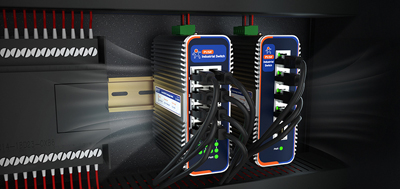
A small edge site or telecom site typically has a rack full of boxes: a gateway, a router, a switch, an OLT, with a server standing beside them. The equipment comes from different vendors and handles different jobs, and wiring and maintenance are anything but light work. It is hardly surprising that someone in the technical community once asked: if there are this many boxes, why not put everything into one modular edge unit? People working in data centers discussed the idea, and the conclusion was not encouraging — a modular unit cannot replace that row of dedicated devices. Instead of debating the conclusion, it helps to lay the devices out along the path the data actually travels. That also shows where an iot gateway (industrial IoT gateway) belongs, because it handles the segment that is most often underestimated.
OLT — the aggregation point of the optical access segment.When a site carries fiber access services, the OLT (optical line terminal) aggregates the ONU/ONT units hanging off it — the optical modems on the subscriber side — completing the optical link and uplinking toward the central office. This is one of the most clearly bounded layers in a carrier network: port density, uplink method and access authentication are all planned around it, and it rarely shares duties with other devices.
Switch — in-site Ethernet distribution.The wired connections of the devices and service ports inside the site converge here; the switch solves the problem of running out of ports and extending the LAN. It forwards but does not make decisions — it is the physical foundation of the in-site segment.
Router — the site's exit.Which direction the site's traffic takes, and over which link, is decided at this layer: WAN routing, NAT, VPN and dial-up all live here. Put differently, the switch handles forwarding inside the site, while the router handles the path between the site and external networks. Each keeps its own segment.
Server — general-purpose compute kept on site.Strictly speaking, a server is not a network device, yet it is where software functions tend to be loaded: video processing, local applications, data buffering — heavier workloads usually land here. Anything that needs continuous computation or substantial storage is assumed to live on the server by default.
Industrial gateway — translating devices that do not speak IP.When a site also carries power-distribution, building or production equipment, things get complicated quickly: electricity meters, PLCs and thermostats often have only serial ports or speak Modbus-style industrial protocols. They cannot connect to a cloud platform directly, and running individual cables to the server is impractical. The industrial gateway closes this segment: it takes in devices over serial and I/O, converts protocols and uplinks everything as unified IP traffic, then performs threshold checks, alarms and reporting locally. It is the most protocol-heavy segment on the whole path.
With the division of labor laid out, the question of whether a modular edge unit can take over everything has a workable answer. What can be merged is the access segment plus light computing: serial ports, I/O, protocol conversion and edge logic can all fit inside one industrial gateway — this class of device exists precisely for consolidation. What cannot be replaced are the dedicated roles of the carrier network layer, such as the OLT and the router, and the reason is not raw computing power. Three points matter.
First, port density and protocol stack differ. An OLT is designed around dozens or hundreds of optical ports, and a router has to run full routing and security policies; neither matches the structure of a general-purpose edge device. Second, fault domains should not be merged. When one box does everything, access, forwarding, egress and compute share a single point of failure. Segmented deployment exists to isolate faults — when one segment fails, only that segment is affected. Third, compliance and ownership differ. Carrier-network equipment carries its own certification and regulatory requirements, and folding it into a general-purpose device fails review in many markets. In short, segmentation is not outdated equipment; it is necessary isolation in site engineering.
The conclusion follows: what these sites really need to unify is not the carrier network layer but the device-access segment — and that is exactly the industrial gateway's territory. Take the USR-M300 modular edge gateway from PUSR as an example of how that segment gets closed. Two serial ports (RS232/485 and RS485) connect to meters and PLCs; dual Ethernet ports handle the in-site uplink; 2 DI, 2 DO and 2 AI channels carry status points and control outputs; and as the point count grows, expansion I/O modules slide in without replacing the whole unit. The dual-core Linux system runs Node-RED graphical programming, so threshold checks, alarms and reporting rules are adjusted locally without touching the upper-layer network. Wide operating temperature, wide-input DC power, and DIN-rail or wall mounting match the realities of cabinet and outdoor-enclosure deployment. Modbus RTU/TCP conversion and parsing for common PLC protocols cover the dialects most often seen at the access segment.
Back to the opening idea: when a rack holds many devices, that is usually not redundancy — each device is holding down its own segment. The planning method for such a site is straightforward. First, draw the data path from field devices to the outside network and mark who owns each segment. Then hand the messiest, most protocol-heavy access segment to one iot gateway, and keep the remaining segments independent. This delivers the convenience of unified connectivity and management without betting the whole site on a single box. For an edge site with mixed device types, that is far more dependable than trying to fit everything into one enclosure.