 Several times a day, someone asks where a truck is. Dispatch waits for the driver to call back, the customer presses on the phone, and the position always arrives half a beat late; once the truck is back at the yard, mileage and fuel still get filled in by hand. What is missing in the cab is an embedded industrial pc that pulls position, vehicle condition and cargo-box status together and sends all of it upstream as one stream.
Turnover gets stuck on three delays: how long data takes to reach the dispatch desk, how long the desk takes to assign a truck, and how long handover takes once the truck is in the yard. None of the three is solved by one box alone. Interfaces, reporting rules and yard equipment have to line up.
Start with the version. The -GL variant of the USR-EG628 carries a built-in GPS/BeiDou module: sensitivity -162 dBm, 20 channels, positioning accuracy better than 10 meters. Cross-province and cross-border routes also come down to bands — the G4 and GL variants use different LTE bands, and the wrong variant will not register at the destination.
Take speed from CAN first. Satellite positioning loses lock in tunnels, urban canyons and underground garages, while vehicle speed on the CAN bus is continuous; the two cross-check each other, and the result is steadier.
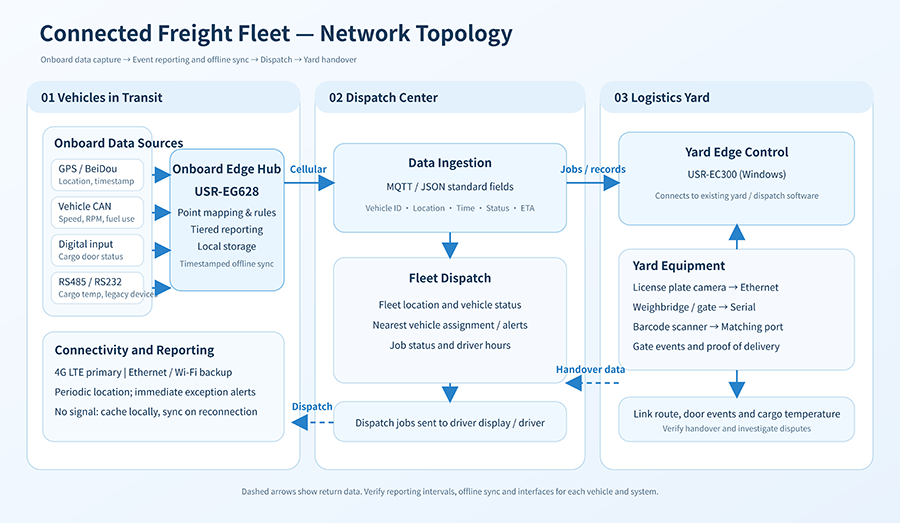
Tier the reporting frequency. Position once every 10 to 30 seconds is enough for dispatch; engine speed and cumulative fuel go out on change or on a fixed cycle; overspeed, route deviation, long idling and cargo-door opening report immediately. Sending everything at a high rate only drives up the data bill, and the desk cannot read it all anyway.
Keep a backup uplink. 4G (LTE Cat4) is the primary link, with Ethernet and Wi-Fi as backup; dual SIM single standby — two external cards on GL, one external plus one internal on G4 — so swapping in another carrier's card avoids regional dead spots. When the network drops in a tunnel or a mountain stretch, data lands on the local SD card (up to 128 GB) and is back-filled by timestamp after recovery, so the track has no gaps. Whether back-fill runs on the device or on the platform is worth confirming during selection.
Nearest-truck assignment only works if the fields are complete: truck ID, latitude and longitude, timestamp, load status, current job status, ETA, driver hours. Miss one and the ranking falls back to a phone call.
Those fields arrive on different ports: position from the positioning module, speed and cumulative fuel from CAN, door open and closed from DI, cargo temperature over RS485, and legacy equipment sometimes only offers RS232. They have to be merged into one tag table on the vehicle, then sent out in the format the dispatch system accepts.
No code is needed. Local configuration in WukongEdge plus the pre-installed Node-RED: fill in the station number and the register address to build the tag table, then wire acquisition, logic and reporting by drag and drop. The device handles 2000+ tags and covers Modbus, OPC UA and other protocols. Keeping the logic on the vehicle brings one more benefit: with no network in a tunnel, it records and judges first, then sends once out.
Output goes to the dispatch system over standard MQTT or JSON — the full set on a cycle, exceptions as a separate message.
Yard equipment is more mixed: license-plate cameras on Ethernet, weighbridges and barrier gates on serial, barcode scanners each with their own way in. Older dispatch software usually runs only on Windows, so that box has to be x86. The USR-EC300 is an i5-7200U with 8 GB expandable to 32 GB, a 128 GB wide-temperature SSD, six serial ports (two switchable between RS232, RS485 and RS422, the other four fixed RS232), two Intel Gigabit ports, 14 GPIO lines, DC 12-36 V, -20 to 60 °C, all-aluminum and fanless, Windows as standard.
Evidence collected at handover beats arguing afterwards. The in-cab unit has HDMI for a driver screen showing jobs and sign-off; track, door timestamps and cargo temperature curves are stored by truck ID, so a damage or delay dispute can be pulled up on the spot.
ARBOR's AGV and AMR pages revolve around Jetson AGX Orin, GMSL cameras and Hailo or MemryX accelerators; Sintrones leads with 14th-generation Core plus a discrete GPU and up to eight Gigabit ports with PoE; TSL's nine-point list lands on 9-36 V wide input, -20 to 60 °C, IEC 60068-2-6 and -2-27 vibration and shock, CAN with RS-485 and isolated GPIO, onboard compute, and a five-to-seven-year supply window.
The point of that list is to let a robot find its own way. A freight fleet does not find its own way — the driver does. What the box in the cab has to answer is different: can position get back, can vehicle data be read, is anything lost when the network drops, and can the data get into the dispatch system already in use.
So the difference sits in four places: positioning and cellular on the same device, with no separate tracker and router; CAN, RS485 and RS232 connected at once — CAN for the vehicle, RS485 for cargo-box sensors, RS232 for legacy equipment; tag tables configured without writing code; routing, VPN and firewall built in. Cross-region routes also come down to certifications — the EG628 covers RCM, 3C, ANATEL, CE, FCC, MTC, NBTC and others.
Four steps: list what has to be collected on the vehicle and which port each item uses; fix the reporting rules, with the tiers and exception conditions written down; align the MQTT field names with the dispatch system; run a disconnect drill — pull the antenna or drive into an underground garage — and check whether the data back-fills.
The USR-EG628 itself is an RK3562J quad-core A53 at 2.0 GHz with a built-in 1.0 TOPS NPU, 4 GB DDR4 plus 32 GB eMMC and an SD card of up to 128 GB, 1×RS232 + 2×RS485 + 1×CAN, two Ethernet ports (one Gigabit, one 100 M), dual-band Wi-Fi, wide-voltage input, -20 to 70 °C, Ubuntu with WukongEdge, Node-RED and Docker, plus OpenPLC compliant with IEC 61131-3.
Higher compute only comes in when video is involved: the USR-EG928A is an RK3588J octa-core with a 6 TOPS NPU, up to 32 network cameras, Gigabit Ethernet with Wi-Fi 6 and 5G/4G expansion slots, -25 to 75 °C — the class for driver monitoring and blind-spot views. Position and vehicle data alone do not need it.
Position reporting, nearest-truck assignment and yard handover: shave a little off each of the three delays and turnover starts to move. Working backwards from those three, the embedded industrial pc in the cab is judged first on interfaces and positioning variant, then on reporting rules and uplink backup, and only last on compute.
1. Does fleet networking really need an in-vehicle industrial PC?
Will a simple tracker do?A tracker is enough when only position goes back. Getting speed, cumulative fuel, door status and cargo temperature back as well means doing the aggregation on the vehicle: positioning, CAN and serial sensors each have their own port, and a tracker cannot take them all. The test is whether dispatch needs anything beyond position.
2. How often should position be reported?
Tier it by use: every 10 to 30 seconds is enough for dispatch to follow a truck, while overspeed, route deviation and long idling report immediately. Sending everything at a high rate raises the data bill, and the desk cannot read it all anyway. Keep the interval as a parameter that can be changed remotely, then tune it after a few weeks of real running.
3. What can be read off the CAN bus?
Engine, transmission and instrument cluster on commercial vehicles generally talk over CAN, and vehicle speed, engine speed, cumulative fuel and fault codes are all in the messages. The message definition or protocol version for that specific model has to be obtained first — the same bus does not carry identical data across models.
4. Is data lost in tunnels or mountain stretches with no signal?
It depends on local buffering and back-fill during the outage: data is written to local storage and filled in by timestamp once the link returns, so the track keeps no gaps. Whether that happens on the device or on the platform is worth asking during selection, and worth verifying with an antenna-pull drill.
5. How does vehicle data get into a dispatch system already in use?
The sources are merged into one tag table on the vehicle and pushed out over standard MQTT or JSON using the fields the dispatch system already knows. Field names, timestamp format and vehicle identity — truck ID or plate — have to be aligned first; if those three do not match, every report downstream has to be rebuilt.
6. Does voltage fluctuation on a vehicle affect the device?
Voltage jumps when starting, shutting down or switching loads, so the input range has to cover what is actually measured, with reverse-polarity protection. Where it is mounted — cab or cargo box — also changes heat and temperature; measuring real voltage and the temperature at the mounting spot before installation avoids surprises.
7. What matters when choosing a model for cross-province or cross-border routes?
Whether the cellular bands and positioning systems cover the operating region, since variants of the same model can carry different bands. Then the certifications the device needs in that market. Dual SIM models take cards from two carriers, which cuts the dropouts caused by one carrier's coverage gaps.
8. If only position tracking is needed, is the higher configuration still required?
No. For position alone, the variant with positioning and cellular is the right pick, and CAN plus multiple serial ports stay unused. Move to a model with a full