In the daily operation of hemodialysis centers, the flow data of dialysis machines are core indicators directly related to patient treatment safety. The real-time changes in the dialysate inflow and outflow flow and ultrafiltration rate of each device — even a few seconds of data collection delay may cause medical staff to miss the early warning window for abnormal flow.
In mild cases, it affects the accuracy of dialysis treatment; in severe cases, it can lead to life-threatening consequences such as excessive ultrafiltration and fluid imbalance. However, for a long time, many hospital dialysis centers have been troubled by the pain point of flow data collection delay. In the traditional "terminal collection-cloud processing" mode, a large amount of real-time data from dialysis machines needs to be transmitted across floors and hospital areas to remote servers. When network jitter or bandwidth congestion occurs, data delay can even reach several seconds, completely failing to meet the strict real-time requirements of dialysis treatment.
Traditional dialysis machine data collection solutions mostly rely on ordinary commercial switches for data transmission, with all flow calculation and anomaly judgment logic placed on the backend server. In this mode, the high-frequency flow data of dozens of dialysis machines continuously transmit to the cloud, not only occupying a large amount of network bandwidth, but also causing data packet loss and delay accumulation once the hospital area network experiences brief fluctuations. More critically, during the dialysis treatment process, the golden intervention window for abnormal flow is often only a few seconds. After data is transmitted to the cloud, analyzed and alarms are issued, the delay of the entire process has far exceeded the safety threshold. In many cases, by the time the system issues an alarm, the patient has already been exposed to risk. Many dialysis centers have tried upgrading bandwidth and increasing server computing power, but they have never been able to fundamentally solve the delay problem caused by long-distance data transmission, nor achieve truly real-time response.
To completely break this deadlock, the core idea is to move data processing capability from the cloud down to the network edge where dialysis machines are located. The Ethernet switch USR-ISG equipped with edge computing functionality is precisely the targeted solution built for such high-real-time medical scenarios.
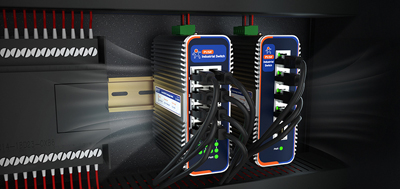
As an Ethernet switch designed for high-reliability industrial scenarios, USR-ISG breaks the traditional positioning of switches as only data forwarders. It integrates a lightweight edge computing module at the hardware level, eliminating the need to upload all dialysis machine flow data to the cloud, and enabling real-time data processing directly locally on the switch. It can perform line-speed parsing of the flow data from each connected dialysis machine, completing cleaning, calibration and real-time calculation of flow values at the port side without long-distance network transmission. The end-to-end delay from when data is sent from the dialysis machine to when anomaly judgment is completed is compressed to within 10 milliseconds, completely eliminating the transmission delay problem in the traditional mode. For the private communication protocols of different brands and models of dialysis machines, the edge computing module of USR-ISG supports local protocol parsing. Without additional collection gateways, it can directly read the original flow data from the device's underlying layer, avoiding secondary delay caused by multi-device relaying, and ensuring that every second of flow change can be accurately captured.
In addition to the core capability of localized real-time data processing, the industrial-grade characteristics of USR-ISG are fully adapted to the special operating environment of dialysis centers. It adopts a fanless all-metal shell design with IP40 protection rating, and its anti-EMC electromagnetic interference capability reaches industrial Level 3 standard. It will not cause mutual signal interference with the precision circuits of dialysis machines, fully complying with the equipment usage specifications of medical places. The whole machine supports wide-temperature operation from -40℃ to 85℃, with redundant wide-voltage power input, and MTBF exceeding 300,000 hours. It can operate uninterrupted 24/7 without crashes or disconnection issues, fully matching the continuous operation needs of dialysis centers. Meanwhile, it supports IEEE 1588 PTP sub-microsecond time synchronization. All collected flow data will be marked with precise timestamps locally, avoiding the problem of disordered data sequence from multiple dialysis machines, and subsequent treatment data traceability and medical compliance audits can be accurately checked.
In actual deployment scenarios, the edge computing capability of USR-ISG can further release the operation and maintenance efficiency of dialysis centers. It can preset flow anomaly judgment rules locally. Once the flow of a dialysis machine deviates from the safety threshold, the switch can directly trigger audible and visual alarms locally without waiting for cloud instructions, while pushing warning information to the medical staff terminal beside the bed. The response speed is dozens of times faster than the traditional cloud processing mode. Local edge computing can also greatly reduce the amount of data transmitted to the cloud, only uploading processed summary data and abnormal events to the hospital management system, which not only saves bandwidth resources but also avoids information security risks caused by large amounts of sensitive medical data transmitting across networks. Currently, USR-ISG has passed a number of authoritative certifications including 3C, CE, FCC and ROHS, and has completed deployment verification in the hemodialysis centers of several tertiary hospitals. After deployment, the real-time rate of dialysis machine flow data collection reaches 100%, and the abnormal alarm response delay is controlled at the millisecond level, completely solving the long-standing data delay pain point and building a solid underlying network defense line for the whole-process safety of dialysis treatment.
From the high-delay deadlock relying on cloud processing in the past to the safety guarantee of localized real-time response today, USR-ISG redefines the value of Ethernet switches in medical scenarios with integrated edge computing capability. It enables real-time sensing and immediate processing of the flow data of every dialysis machine, building a high-reliability real-time safety barrier for patients' hemodialysis treatment.