Ethernet Switches with Integrated Intelligent Backup Power: Solving Network Endurance Pain Points in Distributed Access Scenarios
In a large number of scenarios where access switches are deployed in a distributed manner, such as campus networks, outdoor security systems, and industrial edge environments, traditional networking solutions have long faced a persistent industry-wide pain point that is hard to completely resolve: It is difficult for access-layer switch devices to directly reuse the centralized UPS backup power system in the core equipment room. Equipping each individual access switch with an external UPS, lead-acid battery or independent power backup module not only leads to cumbersome and complicated wiring construction, but also results in extremely high subsequent operation and maintenance troubleshooting costs. Once the mains power supply is suddenly interrupted, it will directly cause widespread network disconnection of access-side terminals, and the business continuity of the entire network cannot be guaranteed at all.
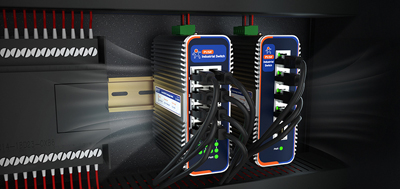
To address this long-standing problem that plagues networking users, Ethernet switches with a built-in intelligent battery management system are becoming an efficient alternative to traditional external backup power solutions. The series of battery-powered Ethernet switches launched by PUSR are typical representatives of such products. They deeply integrate high-performance switching hardware with safe and reliable lithium battery modules, fundamentally solving the backup power deployment pain points of access-layer networks.
The backup power methods for access-layer networking in the past generally have many drawbacks: Centralized UPS can only cover core equipment in the equipment room, and cannot extend to access switches deployed in building corridors, outdoor pole lines, weak current wells and other locations. External independent backup power equipment requires additional separate power supply lines, which not only increases material costs, but also greatly prolongs the construction period. Meanwhile, the distributed external batteries lack unified intelligent monitoring capabilities. Operation and maintenance personnel can hardly detect hidden problems such as battery power loss, aging and damage in the first place. Faults are often not discovered until the mains power is interrupted and the network is disconnected, which completely fails to meet the operation and maintenance requirements of highly reliable networks.
Such integrated battery-powered switches are designed at the underlying level to solve the above pain points in a targeted manner, with core functional advantages covering the entire process of deployment, operation and maintenance:
The device has a built-in high-performance lithium battery module. When the mains power is normal, it automatically and intelligently replenishes power for the battery pack while supplying power to itself. Once the mains power is interrupted, the system will complete the power supply link switching within milliseconds. There will be no network disconnection or jitter throughout the process, and the services of all access terminals remain online. The access-layer network can be guaranteed not to be interrupted without manual intervention.
The whole machine adopts an integrated design. Users do not need to purchase additional external UPS, independent backup power supply and corresponding auxiliary power supply lines. The device deployment can be completed only after finishing basic network wiring, which greatly reduces the construction and transformation cost of access-layer networking. It is especially suitable for scenarios where new wiring is inconvenient, such as old campus renovation and outdoor point expansion.
The device is equipped with a real-time battery monitoring system. Operation and maintenance personnel can directly check the real-time operating data of the battery, such as real-time voltage, charging and discharging current, working temperature, remaining endurance time, etc., at any time through the Web network management, without the need to regularly go to the site to disassemble each unit to detect the battery status. At the same time, the built-in intelligent charging and discharging algorithm automatically maintains the battery status in the optimal working range, greatly extending the overall service life of the battery.
When the device switches to the built-in battery power supply mode, it will automatically enable the intelligent energy-saving strategy, and automatically put idle ports that have no traffic transmission for a long time into the sleep state to reduce the operating power consumption of the whole machine. Under the limited battery capacity, it maximizes the backup power endurance time, meeting the power-off continuous transmission requirements for several hours in most small and medium-sized access scenarios.
It has built-in multiple hardware-level protection logic, realizing full-scenario abnormal fallback such as over-temperature protection, over-voltage protection, over-current protection, under-voltage protection, short-circuit protection, etc., completely avoiding safety hazards such as overheating, bulging, overload and fire that are prone to occur in traditional external independent battery solutions. At the same time, abnormal events will automatically generate alarms and actively report to the operation and maintenance platform, so that potential faults can be detected and handled early.
At present, such battery-powered Ethernet switches have formed a complete product line, which can fully meet the differentiated needs of different scenarios: From the entry-level 100Mbps 8-port access switch, to the Gigabit full-port POE power supply model, and then to the 10G uplink model for large-bandwidth scenarios. It also provides configuration options supporting different network protocol functions of Layer 2 and Layer 3. Professional manufacturers like PUSR also support customized battery capacity selection for special scenarios. Users can fully select the adapted product model according to their own number of access points, endurance time requirements and network bandwidth demands.
For scenarios with high-reliability access network requirements, Ethernet switches with built-in intelligent batteries break away from the traditional separated networking idea of "switch + external backup power". With an integrated solution, it solves the three core problems of difficult deployment, complicated operation and maintenance, and insufficient reliability at the same time. It has now become the mainstream preferred solution for high-reliability networking at the access layer.