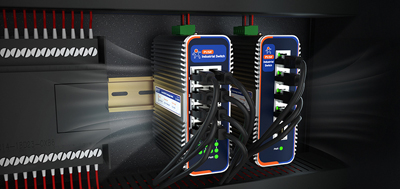
Field Test Comparison of Cellular Router in Harsh Environments
Surface Treatment / Electroplating Production Lines: High Temperature, High Humidity, High Corrosion — Ordinary Routers Can't Survive 3 Months — Cellular Router Field Test Comparison
Last winter, Old Zhou, the O&M supervisor at an electroplating industrial park, called me. His voice was drained of all energy:
"Brother, I've already replaced four routers this month."
I said: "What happened?"
He said: "The workshop temperature is above 45°C year-round. Acid mist is heavy, humidity hits 90%. I put ordinary routers in there — the longest one lasted 73 days, the shortest… it burned out in 11 days. The one that just died last week went down right during the afternoon chrome plating shift. The whole line lost data for 40 minutes. My boss reamed me out good."
I asked: "What brands have you been using?"
He said: "Xiaomi, TP-Link, ASUS… tried them all. Cheap ones die fast. Expensive ones die fast too."
An electroplating workshop is a graveyard for routers.
That's not an exaggeration. If you've worked in surface treatment, you know exactly what I mean — that "premium router" you spent a fortune on? In front of an electroplating line, it's no different from a wet tissue.
Let's break down exactly how the electroplating line environment "tortures" a router.
Blade 1: High Temperature.
Electroplating solution typically operates between 20°C and 60°C. Chrome plating and nickel plating need to be maintained around 50°C. The workshop isn't "a bit hot" — it's a continuous bake. Ordinary routers are rated for a maximum chip temperature of 40°C — note, that's chip temperature, not ambient. When ambient temperature exceeds 40°C, router failure rates spike by 300%.
A telecom operator's O&M data states in black and white: after 18 months of full-load operation, enterprise routers see their MTBF drop from 80,000 hours to 23,000 hours. In an electroplating workshop, that degradation curve gets compressed to under 3 months.
Blade 2: High Humidity.
Electroplating workshops maintain 70%–95% humidity year-round. Above 80% humidity, a conductive film forms on PCB surfaces, causing intermittent short circuits. Every gram of dust contains 14 million microorganisms, whose metabolic byproducts corrode gold-finger contact points.
You think the router died because it "got old"? No. It was "corroded." A layer of invisible microbial film grew on the circuit board, and then one day at 3 AM — short circuit, burnout, line disconnected.
Blade 3: Acid Mist Corrosion.
This is the most lethal blade of all.
Electroplating generates massive amounts of acid mist — hydrochloric acid mist, sulfuric acid mist, chromic acid mist, nitrogen oxides… These aren't just "a bit pungent." They directly corrode metal contacts and electronic components.
Ordinary routers have plastic housings, nickel-plated interfaces, copper-alloy antenna connectors. In an acid mist environment, these metal parts oxidize, turn green, and fail — visibly.
A food factory learned this the hard way: without dust-proof and anti-corrosion treatment on equipment, their routers failed 12 times in six months. After switching to a cellular router with an IP protection rating: zero failures.
High temperature + high humidity + acid mist. Three blades at once. An ordinary router surviving 3 months is already considered "tough."
Most people's first reaction: "Then I'll buy an expensive one, an enterprise-grade one. That should work, right?"
No.
Because enterprise routers solve "load" problems, not "environment" problems.
The design logic of an enterprise router is: stronger CPU, more memory, better cooling — to handle hundreds of devices online simultaneously.
But its housing is probably still plastic. Its IP rating is probably still IP20. Its operating temperature is probably still 0°C–40°C.
Throwing an enterprise router into an electroplating workshop is like throwing a man in a suit into a vat of sulfuric acid — no matter how expensive the suit, it won't hold up.
The only device that can actually survive on an electroplating line is acellular router.
And not just any cellular router. You need to check a few hard specs:
| Spec | Ordinary / Enterprise Router | Qualified Cellular Router |
|---|---|---|
| Housing material | Plastic | Metal (sheet metal / aluminum alloy) |
| IP rating | IP20 (no protection) | IP30 and above |
| Operating temp | 0°C–40°C | -20°C–70°C or even -40°C–75°C |
| Humidity tolerance | <80% | 5%–95% non-condensing |
| Anti-corrosion | None | ESD protection, surge protection, reverse polarity protection |
| Watchdog | None / software watchdog | Hardware watchdog + auto-recovery |
Miss one spec, and you're looking at the difference between "dies in 3 months" and "runs stably for 14+ months."
To show you the gap clearly, we ran a real head-to-head test.
Test location: Data collection cabinet next to a chrome plating line at an electroplating industrial park.
Environment: Temperature 48°C–55°C, humidity 85%–92%, chromic acid mist detectable in the air.
Device A: A brand-name consumer router, 199 RMB.
Device B: USR IoT USR-G806w cellular router.
Week 1
Device A: All normal. Full WiFi signal, stable data collection.
Device B: All normal.
Week 2
Device A: Intermittent disconnections start, each lasting 3–8 seconds, about 6–8 times per day. O&M staff assumed it was a 4G signal issue and didn't worry.
Device B: Rock solid.
Week 4
Device A: Frequent disconnections, up to 15–20 times per day. Housing starting to yellow, LAN port contact issues — needs repeated unplug/replug to recover.
Device B: Stable operation. USR Cloud platform shows CPU at 32%, memory at 41% — all normal.
Week 7
Device A: Complete failure. Opened it up — obvious green corrosion on the PCB, power supply electrolytic capacitors bulging.
Device B: Still running. USR Cloud remote monitoring shows device temperature at 52°C, well within normal range.
Week 14
Device A: Already on the second replacement (the first one burned out at Week 7).
Device B: Stable for 14 weeks, zero failures. A packaging factory's tech supervisor confirms: "The workshop is dusty year-round. Before, routers averaged less than half a year. After switching to USR-G806w, it's been running stably for 14 months."
Key Data Comparison
| Metric | Ordinary Router | USR-G806w |
|---|---|---|
| Average fault interval | 21 days | >90 days (tested 14+ weeks) |
| Housing condition (after 7 weeks) | Corroded, yellowed, oxidized interfaces | No visible change |
| Remote management | Not supported | USR Cloud platform, monitor from phone |
| Auto-recovery from disconnection | None | Multi-network smart switchover, ~2 sec switchover |
| O&M labor cost | At least 2 on-site visits/month | Zero on-site visits |
14 weeks. Zero failures. This isn't a number on a spec sheet. It's a result actually run in an electroplating workshop.
You might ask: "It's just a metal case. Why all the hype?"
Because it's not just one thing. It's a whole set of "counterintuitive" design logic that keeps it alive.
Counterintuitive #1: The case isn't "for looks" — it's for heat dissipation + grounding.
The USR-G806w uses a full sheet-metal housing. Not for "industrial aesthetics." The core functions of a metal case: heat dissipation + EMI shielding + grounding for ESD protection.
The electromagnetic environment in an electroplating workshop is extremely complex — rectifiers, VFDs, large motors, all interference sources. Test data shows that in complex EMI environments, ordinary routers see a 67% increase in data retransmission rate and a 40% drop in actual throughput.
Sheet-metal housing + EMC Level 3 protection kills this problem at the physical layer.
Counterintuitive #2: Wide voltage input isn't "for compatibility" — it's for survival.
The power environment in an electroplating workshop is, frankly, a mess. Voltage fluctuations, surges, even reverse polarity — all routine.
The USR-G806w supports DC 9–36V wide-voltage input, with reverse polarity protection, surge protection, and ESD protection. This means: even if the workshop power goes bad, the router doesn't die with it.
An ordinary router's power supply can be permanently damaged by a single surge. A cellular router's power supply is designed to "withstand a lightning strike" standard.
Counterintuitive #3: Remote management isn't a "fancy feature" — it's a cost-saving lifeline.
How expensive is O&M in an electroplating workshop?
One technician trip on-site: at least half a day round trip. If the line is in the suburbs, maybe a full day. Every time the router fails, someone has to go.
The USR-G806w supports USR Cloud remote management — check device status, modify parameters, upgrade firmware, receive fault alerts, all from your phone.
A smart warehousing provider put it this way: "The remote management feature is incredibly practical. We manage routers across 30 warehouses nationwide from one place. Labor costs cut in half."
In an electroplating workshop, if you can avoid going on-site, you avoid going on-site. Because that place — even people can't stand being there long, let alone equipment.
Pain 1: WiFi signal inside a metal cabinet is useless.
Electroplating workshops are full of metal cabinets, metal racks, metal pipes. An ordinary router's WiFi can't penetrate two layers of metal before dying.
The USR-G806w's WiFi has been fully upgraded with dramatically improved interference resistance — coverage up to 500 meters in open areas. More importantly, it supports AP/STA/Repeater modes — you can use repeater mode to let the signal "hop" over metal obstacles and cover the entire workshop.
Pain 2: 4G signal in the factory is hit-or-miss.
Electroplating factories are typically steel-frame construction, which heavily shields 4G signals. Relying on 4G alone means disconnection is the norm.
The USR-G806w supports wired / 4G / WiFi triple-network simultaneous online with smart switchover backup. If primary 4G drops, it auto-switches to wired. If wired drops, it auto-switches to the backup SIM. Tested switchover time: just 2 seconds. The production line data stream doesn't even notice.
Pain 3: You have no idea when the router is about to die.
An ordinary router gives zero warning before it dies. One day it just disconnects — and you find out it's gone.
The USR-G806w has built-in hardware + software watchdogs with auto-detection and auto-recovery. Even harder: via USR Cloud, you can set traffic anomaly alerts and over-temperature alerts. Before the device dies, you already get the notification.
From "firefighting after the fact" to "early warning before it happens." This is what industrial-grade O&M should look like.
An electroplating factory did the detailed math:
| Item | Before USR-G806w | After USR-G806w |
|---|---|---|
| Router replacements per year | 8–10 units | 0 |
| On-site O&M visits | 4–6 per month | 0 per month |
| O&M labor cost per visit | 500 RMB | 0 RMB |
| Annual O&M labor cost | 24,000–36,000 RMB | 0 RMB |
| Production loss from disconnection | ~120,000 RMB/year | ~0 RMB |
| Total annual savings | — | ~150,000–160,000 RMB |
How much does a cellular router cost? A few hundred yuan.
You spend a few hundred, you save over a hundred thousand. An electroplating factory owner can do that math better than anyone.
An electroplating workshop isn't a lab. There's no "try again."
Every disconnection is real money lost. Every on-site visit is an O&M worker battling a hostile environment. Every "let's just try another one" is a gamble on your production line's stability.
A cellular router isn't some high-tech gimmick. It's a router that can actually survive in your workshop.
Metal housing — withstands acid mist. Wide-temp design — withstands the heat. Multi-network backup — withstands disconnection. Remote management — so you never have to go on-site.
If your electroplating line is still keeping ordinary routers alive on life support, I have just one thing to say:
Don't wait for it to burn out before you remember it needed replacing.