Large livestock farms often run into the same problem: across a thousand acres of pasture, hillside enclosures, or aquaculture ponds along a river valley, 4G cellular coverage works only near the management office. By the time the barns, feed silos, or the center of the plot are reached, the signal drops to one bar or disappears entirely. Sticking with a 4G cellular approach means either no signal at the site at all, or a SIM card and monthly fee for every single node — a cost that adds up quickly over time.
LoRa wireless networking is built for exactly this situation. Nodes talk to each other over LoRa (long-range, low-power) radio, the data is collected locally by a single outdoor lora gateway, and that gateway backhauls everything to the management platform. Areas beyond cellular base-station coverage are handled by LoRa; the backhaul link then uses whatever conventional network is available. This article walks through how the network is structured, which specifications matter, and what to confirm before deployment.
A typical livestock networking deployment consists of two types of hardware:
Together they form a three-layer "node – gateway – platform" architecture. Each gateway supports up to 2,000 end nodes, and the measured communication distance from a single gateway to a node reaches 5.5 km (open terrain, maximum power); point-to-point between nodes, the range extends further to 6 km. For farms from a few hundred to a thousand acres, one LG280 is usually enough coverage.
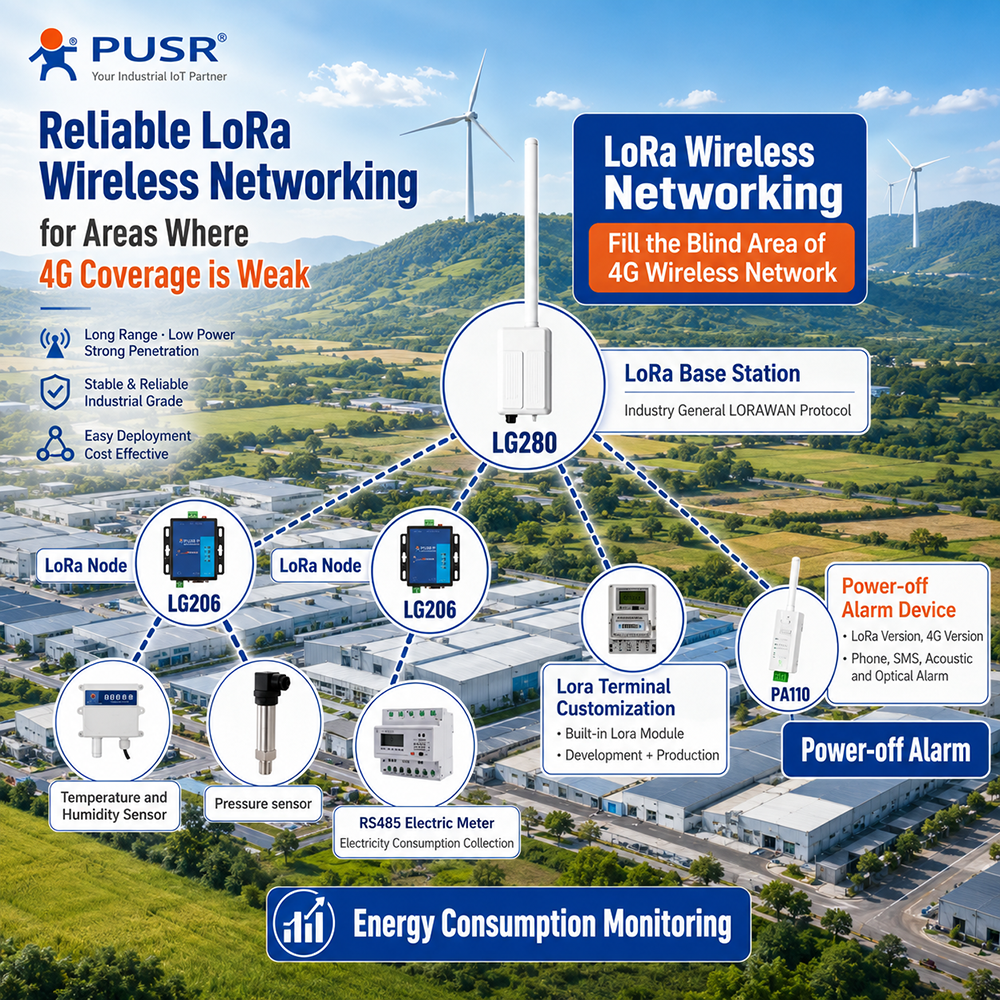
LoRa uses spread-spectrum communication in the Sub-GHz band, which gives it fundamentally better penetration and diffraction than high-frequency options like 2.4 GHz Wi-Fi. On top of that, the LG206 includes LBT (Listen Before Talk) channel arbitration, visual signal-strength diagnostics, FEC forward error correction, and data retransmission — so it holds up far better than a bare 4G module against the common obstacles on a farm: barn walls, metal feed silos, and hills.
For a pasture, this "self-built network" brings two immediate benefits:
Turning the plan into a working installation comes down to a short checklist:
This architecture suits outdoor scenarios with weak or absent 4G coverage, scattered node locations, and a need for long-term low-power operation: large-scale livestock farming, smart agriculture (aquaculture, orchards, protected cultivation), and energy monitoring in remote factory workshops can all follow the same layout. The root cause of weak signal is usually geographic remoteness — a low return on investment for carriers to build base stations — which is precisely the comfort zone for long-range, self-built LoRa networks.
For larger pastures that need multiple cooperating gateways, or deployments that involve more complex Modbus device protocols, the engineering team can help evaluate the overall topology and parameter configuration.